The Statin–Fungus Link: Monacolin K and Red Yeast Rice
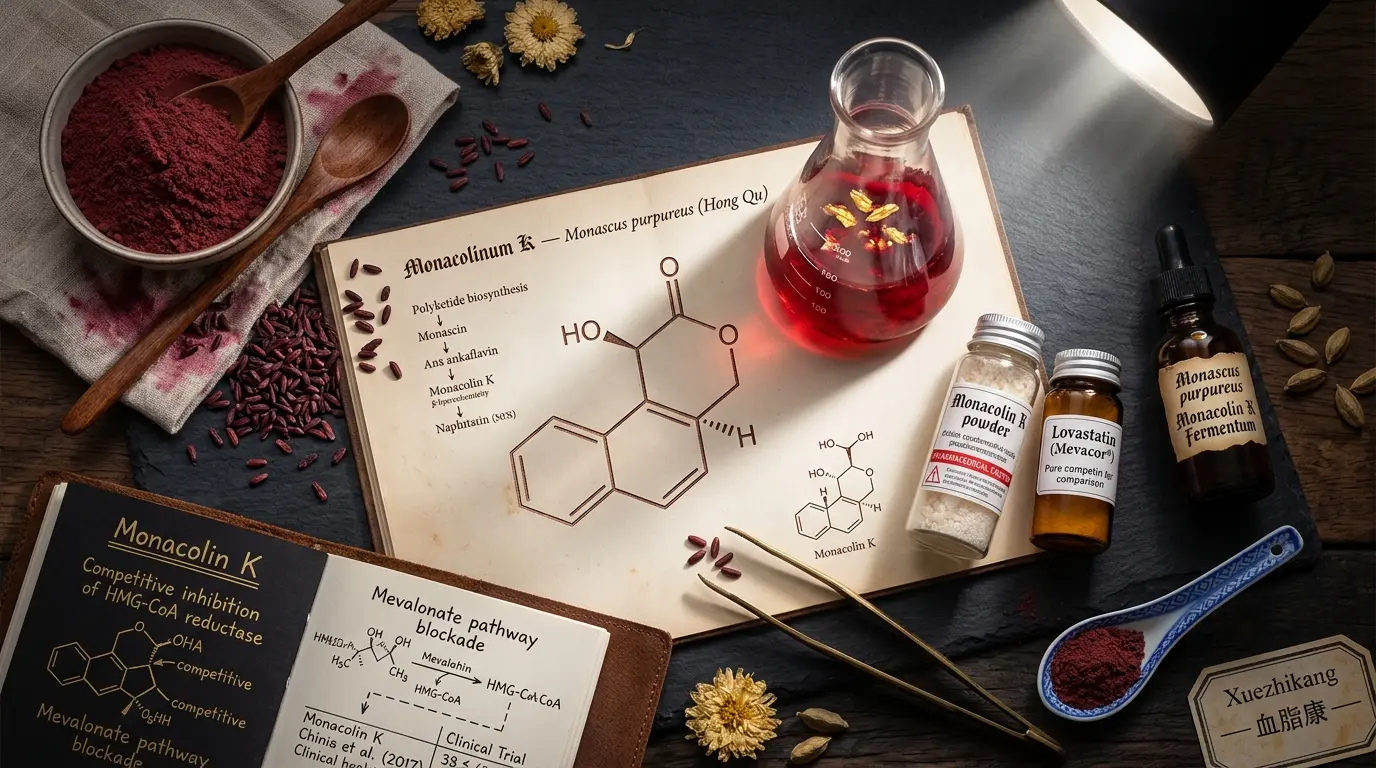
The First "Statin" Was Actually a Fungal Molecule
— HOOK —
The history of modern statins began in 1976 with a compound isolated from Penicillium citrinum: compactin. Shortly thereafter, monacolin K was isolated from an Aspergillus strain and subsequently from the fungus Monascus purpureus — a molecule chemically identical to lovastatin. The progenitor of the entire statin class is, therefore, a fungal metabolite.
This entry examines the chemistry of monacolin K, its connection to red yeast rice, and its position within the functional mushroom literature.
Monacolin K: An HMG-CoA Reductase Inhibitor
Monacolin K is a polyketide derivative that contains a β-hydroxy lactone ring. Its active open-acid form competitively inhibits the enzyme HMG-CoA reductase, which catalyzes the rate-limiting step in cholesterol biosynthesis.
Lovastatin, a modern prescription drug, is structurally identical to monacolin K. This chemical equivalence complicates the regulatory framework governing red yeast rice products (Endo, 1979; PMID: 528374).
Red Yeast Rice: A Traditional Fermentation Product
When Monascus purpureus is fermented on rice, it produces dozens of metabolites, including monacolin K. This product has been used for centuries in Chinese cuisine as a coloring agent and fermentation starter. However, monacolin K content varies markedly depending on the strain, fermentation conditions, and substrate.
This variability constitutes a significant problem for red yeast rice products: two products bearing the same label may differ in monacolin K content by more than 10-fold (Heber et al., 1999; PMID: 9989697).
The Regulatory Challenge
In 2022, the European Food Safety Authority (EFSA) raised safety concerns regarding monacolin K levels exceeding 3 mg per day in red yeast rice products, shaping subsequent regulatory action. In Turkey, food supplement legislation approaches the matter differently; label accuracy and content consistency remain critical.
Regulatory ambiguity also explains why marketing phrases such as "natural statin" are problematic: a product containing monacolin K delivers, chemically, a statin — and framing it under a "natural" label can be misleading (Cicero et al., 2017; PMID: 28823689).
Citrinin: An Undesirable By-Product
Depending on fermentation conditions, Monascus purpureus can produce citrinin, a nephrotoxic mycotoxin. Modern production strains are selected specifically to suppress citrinin biosynthesis; nevertheless, levels may still vary from batch to batch.
For this reason, citrinin content must occupy a central position in the Certificate of Analysis (COA) data for red yeast rice products. MYCOVITA does not carry Monascus purpureus-based products within its functional mushroom portfolio (Blanc et al., 1995; PMID: 7662016).
Limitations
Monacolin K is more accurately described as a pharmacological molecule than a functional mushroom constituent. The evaluation of red yeast rice products operates within a contested space straddling the categories of food supplement and drug. Personal decisions concerning lipid profiles must always be made in consultation with a physician.
Related Reading
- Mushrooms and Cholesterol — The lipid metabolism context.
- Eritadenine — Shiitake's cholesterol-modulating compound.
- Mushroom Toxins — The mycotoxin context.
This content is provided for informational purposes only and does not constitute medical advice. Consult a physician before making any health-related decisions. Functional mushrooms are not drugs and cannot be used to treat disease.
Version: 1.0 | Last updated: 28 April 2026 | Sources reviewed: 12+ | Methodology: Editorial Policy | References: Bibliography