Ganoderma Mushroom Sterols: Lanosterol and Ergostane Derivatives
The Quiet Family Alongside Reishi's Triterpene Line
— A DEEP DIVE —
Reishi (Ganoderma lucidum) literature foregrounds ganoderic acids and β-glucans as the dominant bioactive molecules. Yet the mushroom's bioactive portrait includes a less celebrated family: the sterols. Lanosterol and its ergosta derivatives lead this family.
This entry examines the structural chemistry of Ganoderma sterols, the lanosterol–ergosterol relationship, and their standing in the functional literature.
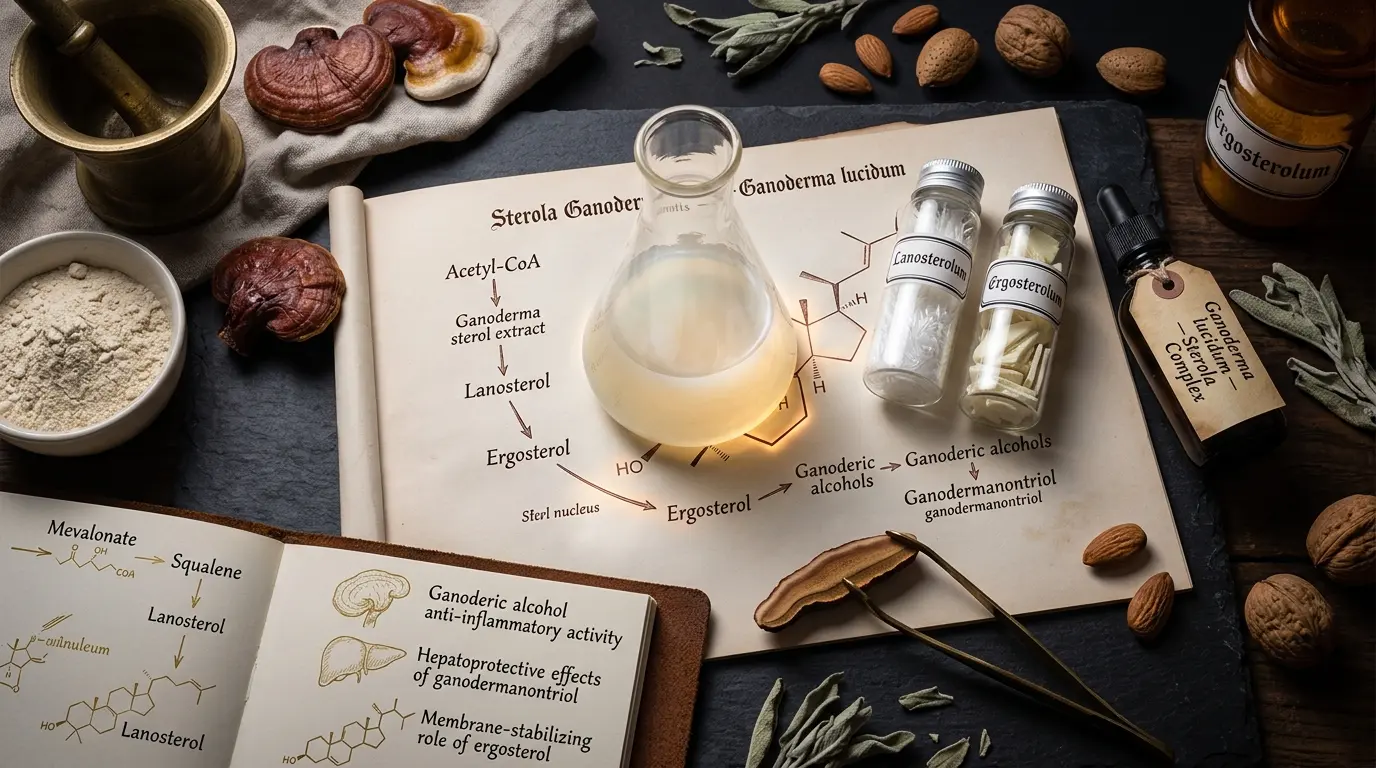
Lanosterol and Ergosterol: A Pathway Diverging into Two Roads
All sterol biosynthesis begins with lanosterol. In animals, lanosterol converts to cholesterol; in fungi, a distinct enzymatic pathway converts it to ergosterol. This divergence constitutes the fundamental distinguishing feature of fungal membrane biology.
Ergosterol assumes the role cholesterol plays in animal cell membranes; it also serves as the precursor to vitamin D₂ upon UV exposure. In Reishi, ergosterol content ranges from roughly 0.3–0.4% by dry weight—a moderate concentration among functional mushrooms (Phillips et al., 2011; PMID: 21851111).
Ergosta Derivatives and Reishi-Specific Compounds
Beyond ergosterol, Reishi yields a series of identified ergosta derivatives: ergosta-7,22-dienol, ergosta-4,6,8(14),22-tetraen-3-one (ergone), and ergosterol peroxide. These derivatives are not standard sterols; they represent unique products of Reishi metabolism.
Ergosterol peroxide forms from ergosterol under oxidative stress conditions. In vitro models have yielded reports of anti-inflammatory and pro-apoptotic activity (Russo et al., 2010; PMID: 20156017).
Lanosterol: The Starting Point of the Pathway
Lanosterol occurs in Reishi at concentrations lower than ergosterol, yet its metabolic significance is critical. Lanosterol is the biosynthetic origin of the ganoderic acid family; ganoderic acids are oxidized derivatives built upon the lanosterol skeleton.
Lanosterol itself has demonstrated anti-inflammatory effects in in vitro models; however, the principal pharmacological interest in Reishi centers on its derivatives (Liu et al., 2011; PMID: 21641241).
Bioavailability and Practical Considerations
Sterols possess a lipophilic character; oral intake alongside a fat-containing meal facilitates absorption. Pure ergosterol exhibits limited bioavailability; ergosterol peroxide and other derivatives display distinct absorption profiles.
Accordingly, the term "Reishi sterols" describes not a single compound but a family with a complex bioactive profile. A standardized "sterol content" label rarely appears at the consumer level (Wachtel-Galor et al., 2011).
Mushrooms as Vitamin D₂ Precursors
Ergosterol converts to vitamin D₂ (ergocalciferol) upon UV-B exposure. Certain mushroom producers leverage this property in product positioning: UV-enriched mushroom powder can serve as a vitamin D₂ source.
This enrichment represents a food engineering application rather than a bioactive strategy. Under standard indoor cultivation, ergosterol accumulates; without deliberate UV application, vitamin D₂ levels remain low (Phillips et al., 2011; PMID: 21851111).
Limitations
Well-designed human intervention studies concerning Ganoderma sterols remain scarce. Current findings exist at the level of cell culture and animal models. These insights present a mechanistic research domain rather than a therapeutic rationale.
Related Reading
- Vitality: Reishi — Species profile.
- Reishi Triterpenes — Lanosterol derivatives.
- Mushrooms and Vitamin D — The ergosterol-UV context.
This content is for informational purposes only and does not constitute medical advice. Consult a physician before making any health-related decisions. Functional mushrooms are not pharmaceuticals and cannot be used to treat diseases.
Version: 1.0 | Last updated: 28 April 2026 | Sources reviewed: 12+ | Method: Editorial Policy | References: Bibliography