Cordyceps vs. Caffeine: A Mechanistic Comparison of Their Biological Actions
— MECHANISM —
You drink an espresso. Within 20 minutes you are sharp, focused, energized.
Two hours later comes the crash. Fatigue, perhaps a headache. Something is missing.
People who use Cordyceps describe a different experience: a slow onset, but no crash. Something that unfolds over hours and carries through the morning workout.
Why? Because the mechanism is entirely different.
— HISTORY —
Tibet. 9th century CE. Yak herders make an observation: their animals appear unusually strong and energetic after consuming a certain worm-like object on the high summer pasture.
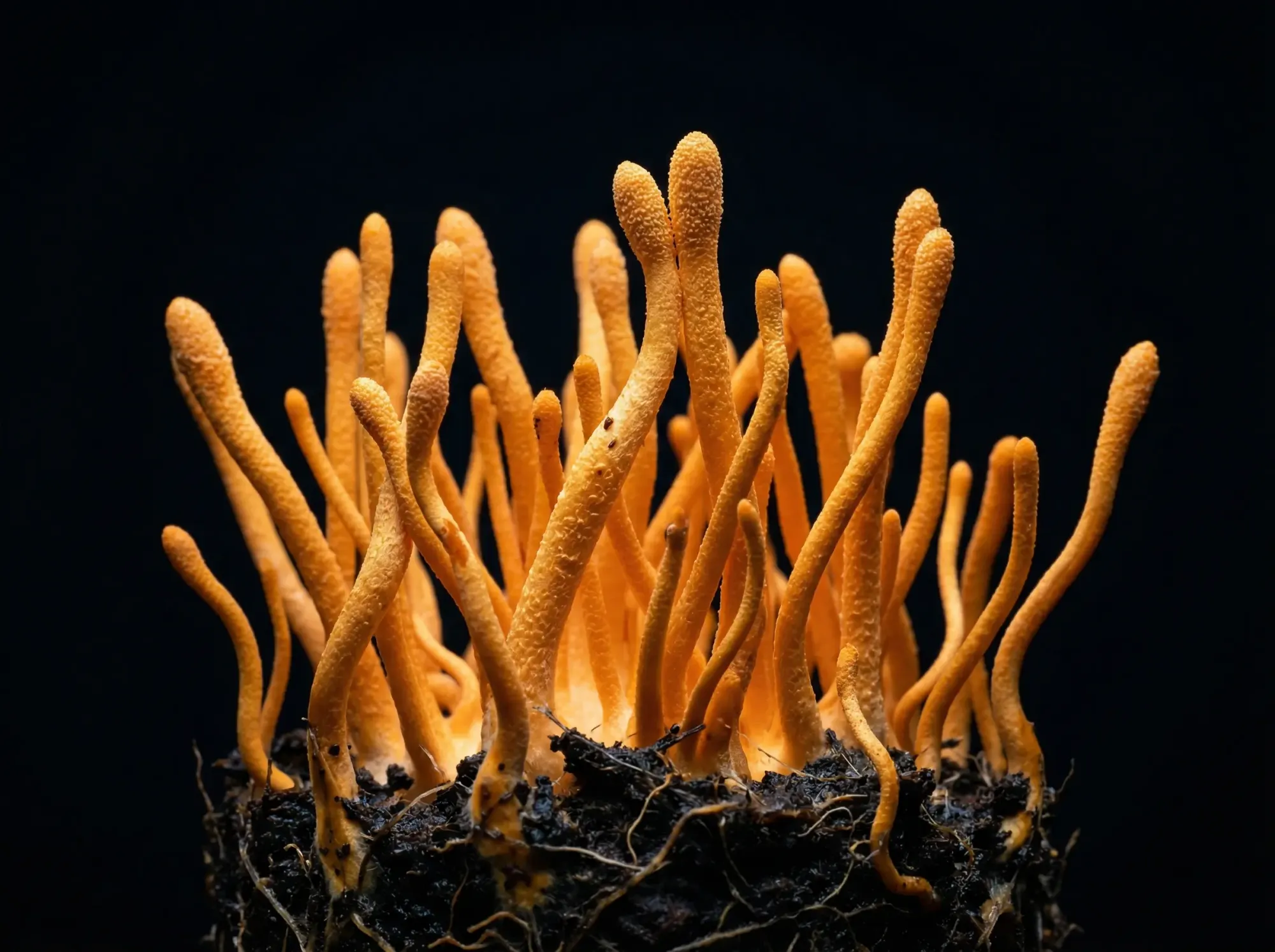
That object is Ophiocordyceps sinensis — a parasitic fungus. During winter it attacks ghost moth larvae; during summer it erupts from the larva’s head in a structure called the stroma. Winter worm, summer grass: Dong Chong Xia Cao — Winter Worm Summer Herb.
Tibetan medicine employed it as a tonic for centuries. But harvesting it from the wild was extraordinarily difficult — and expensive. Prices reached those of gold per gram.
In 1993, Chinese athletics history was shattered. Women’s 10,000 m, 3,000 m, 1,500 m — three world records simultaneously. The coach reported: the athletes’ diet included Cordyceps. The world learned about this mushroom that day.
Today, cultivated Cordyceps militaris has replaced O. sinensis — the same active compounds, producible, accessible.
— MECHANISM —
The Adenosine System and Caffeine
To understand energy, one must begin with the adenosine system.
Throughout wakefulness the brain produces adenosine. Adenosine accumulates and binds to adenosine receptors — this binding generates sleep pressure. The neurochemical correlate of fatigue.
Caffeine occupies adenosine receptors — but in place of adenosine. It blocks the receptor; the adenosine signal is not transmitted. The fatigue signal is interrupted. The effect is real but temporary: adenosine continues to accumulate. When caffeine’s duration of action ends, the accumulated adenosine floods the receptors — that is the crash.
Cordycepin and ATP Synthesis
The principal active compound in Cordyceps militaris is cordycepin — chemically 3'-deoxyadenosine — an adenosine analogue. Structurally it resembles adenosine, but lacks the hydroxyl group at the 3' position.
This structural similarity is significant: cordycepin can integrate into cellular energy metabolism. Research indicates that cordycepin supports mitochondrial activity and facilitates ATP (adenosine triphosphate) synthesis.
The outcome: unlike caffeine, which “cuts the signal,” cordycepin “supports energy production.” The mechanism operates on the production side, not the consumption side.
Reference: Tuli, H.S. et al. (2013). Pharmacological and therapeutic potential of Cordyceps with special reference to Cordycepin. 3 Biotech, 4(1), 1-12.
Aerobic Capacity and VO₂ Max
Animal studies have yielded findings that Cordyceps militaris extract supplementation can increase exercise capacity. The mechanism remains debated, but two hypotheses stand out:
- Oxygen utilization efficiency: Cordycepin and adenosine components may influence erythrocyte and mitochondrial metabolism.
- Lactic acid buffering: Some studies observed slower lactic acid accumulation after intense exercise in the group receiving Cordyceps supplementation.
Reference: Chen, S. et al. (2010). Effect of Cs-4 (Cordyceps sinensis) on exercise performance. Journal of Alternative and Complementary Medicine, 16(5), 585-590.
— CAFFEINE vs CORDYCEPIN: THE DIFFERENCE —
| Caffeine | Cordycepin | |
|---|---|---|
| Mechanism | Adenosine receptor blockade | ATP synthesis support |
| Onset of effect | 20–30 min | 60–90 min (cumulative) |
| Crash | Pronounced (2–4 hours) | Absent |
| Sleep impact | May disrupt | Neutral–positive |
| Side effects | Palpitations, anxiety (high dose) | Low profile |
The two are not alternatives to one another; they operate through different mechanisms. Combined use is rational — morning Cordyceps + caffeine, afternoon Cordyceps alone.
— PROTOCOL FOR ATHLETES —
Pre-Workout (60–90 min before): 1 g MYCOVITA Cordyceps / 200 ml water / 80–85°C / 5–7 minutes. Combine with espresso: add 1 g powder once coffee cools to 80°C.
Morning Start: Before a high-intensity day — 1 g Cordyceps + 1 g Lion’s Mane / 250 ml / 80°C. ATP + neurotrophic profile.
Regular Use: Cordyceps effect is cumulative. It may not be noticeable in the first week. After 3–4 weeks of consistent use, the baseline energy level shifts perceptibly.
Critical: MYCOVITA uses fresh strain Cordyceps militaris every 3–4 cycles. Strain degeneration directly affects cordycepin production — without a genetically stable strain, compound concentration becomes indeterminate.
Related reading: Cordyceps Encyclopedia · What Is Cordycepin? · Morning Protocol
MYCOVITA’s production philosophy and transparency principles: Why MYCOVITA?
— HEALTH CLAIM NOTICE —
— SCIENTIFIC REFERENCES —
Tuli, H.S. et al. (2013). Pharmacological and therapeutic potential of Cordyceps with special reference to Cordycepin. 3 Biotech, 4(1), 1-12. Chen, S. et al. (2010). Effect of Cs-4 (Cordyceps sinensis) on exercise performance in healthy older subjects. Journal of Alternative and Complementary Medicine, 16(5), 585-590. Hirsch, K.R. et al. (2017). Cordyceps militaris improves tolerance to high-intensity exercise after acute and chronic supplementation. Journal of Dietary Supplements, 14(1), 42-53. Ramesh, T. et al. (2012). Effect of Cordyceps sinensis on hypoxia and exercise induced oxidative stress. Asian Pacific Journal of Tropical Medicine, 5(9), 684-688.
You May Find Interesting
→ Travel Protocol — How Do I Use It While Traveling?
→ Can You Grow Mushrooms at Home? — Beginner’s Guide
For the biochemical profile of Cordyceps, see the VITALITY | Cordyceps encyclopedia; for details on the cordycepin molecule, see our article What Is Cordycepin?
This content is for informational purposes only and does not constitute medical advice. Consult your physician before making any health decisions. Functional mushrooms are not drugs and cannot be used to treat diseases.
Version: 1.0 | Last updated: 20 Apr 2026 | Number of sources reviewed: 5+ | Method: Editorial Policy | References: Bibliography