Manufacturing Process
🇹🇷 Bu sayfayı Türkçe oku Why We Wrote This Page
Most mushroom powder brands do not disclose their production process.
Either there is genuinely nothing to share — or they prefer not to.
We want to share. Because MYCOVITA’s value lies not in the packaging, but in the decisions behind it. Understanding why each step is taken is the only way to truly understand a product.
Starting Point — Genetic Selection
Everything begins with the right strain.
All MYCOVITA species are sourced from certified production facilities based in the Netherlands. Each strain is traceable, certified, and verified for genetic purity.
This selection is not left to chance. The bioactive compound profile can vary dramatically among different genetic lines of the same species. A seed of uncertain origin yields a product of uncertain quality. Clarity at the outset determines the quality at the finish.
From Laboratory to Production Room
Incoming seeds first enter our own laboratory. Here, in a controlled environment, they are cultivated, multiplied, and their health status is confirmed. Development is observed at every stage — any line that does not progress normally is discarded.
We do not share the details of this phase publicly. But we can say this: This preparatory stage, which most producers skip, is where MYCOVITA invests the most time and attention. Because a mistake here compromises everything that follows.
Substrate — The Mushroom’s Soil
What a mushroom grows on directly influences what it produces.
MYCOVITA uses a distinct formulation for each species. These formulations are developed based on the species’ natural habitat and biochemical requirements. The specific ratio of each component is the result of our own R&D process.
The core principle is this: A species-specific substrate yields a species-specific outcome. It is possible to grow all species on a single standard formula — but we choose not to.
Growth Rooms — The Silent Process
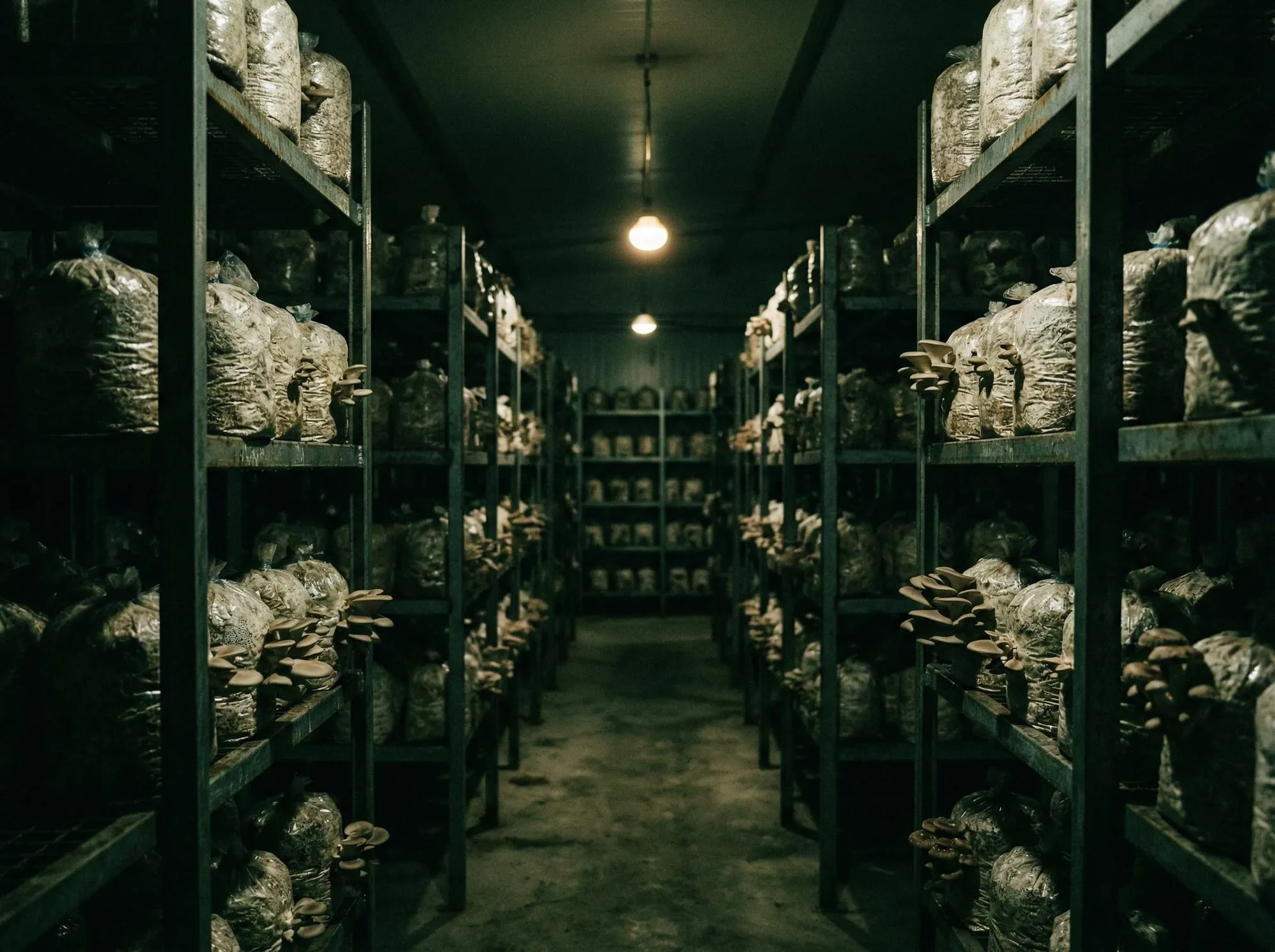
Once inoculation is complete, the blocks are moved into the growth rooms. Outwardly, it is a quiet process. But inside, millions of cells divide every minute.
Temperature, humidity, CO₂, and light cycles are managed with separate parameters for each species. A VRF (Variable Refrigerant Flow) climate system controls temperature with 0.5°C precision. An AI-powered sensor network monitors all parameters in real time — any temperature deviation, humidity drop, or CO₂ anomaly is detected instantly and corrected. An industrial generator system guarantees uninterrupted power — a few hours of electrical outage can reset weeks of colonization. During this stage, blocks are under daily observation. Any block showing development outside the norm is removed from the production line. No product comes out — only discarded expectations.
Harvest — The Moment When Timing Is Everything
Harvest is the most critical decision in the entire process.
Too early: The bioactive compounds have not yet reached their peak. Too late: Density has already begun to decline.
Each species has a distinct correct harvest window. Recognizing these windows demands a discipline of observation cultivated over years. Harvesting is done by hand. Every fruiting body is weighed, numbered, and proceeds to processing.
42-45°C — Why This Temperature?
Industrial drying typically occurs between 70-90°C. It is fast, efficient, and low-cost.
MYCOVITA chooses to dry at 42-45°C. This is slow, energy-intensive, and takes longer.
Above a certain temperature, enzymes begin to denature. Volatile aromatic compounds are lost. Color pigments degrade. Some polysaccharide structures break down. 42-45°C remains below these thresholds — the product preserves a biochemical profile closer to that of the fresh harvest.
The intensity of aroma and the color you perceive upon opening the jar are directly tied to this choice.
Two Formats, Two Philosophies
Once drying is complete, the products diverge along two separate paths. This division is not arbitrary — each format serves its own functional logic.
Apothecary Series — Medicinal Grind Size
The Apothecary Series, designed for functional use, is ground to a fineness approaching medicinal product standards. For reference: a particle size comparable to a quality coffee grind — homogeneous and fine.
This size is no accident. During infusion, the contact surface with water is maximized. The solubility and bioavailability of bioactive compounds are directly linked to grind fineness. A coarsely ground powder, steeped however long, will never deliver the same extraction.
INFUSION GRADE format. Each pack includes a brewing sachet.
Gastronomy Series — Dried Whole
The Gastronomy Series, designed for gourmet kitchens, is not ground. The harvested fruiting body is dried at 42-45°C and packaged whole.
There is a reason: King Oyster, Shiitake Donko, and Maitake’s culinary value begins with their texture. When rehydrated, the whole dried format reclaims its original fiber structure, and during cooking, the natural texture and umami profile fully emerge.
The difference between powdered Shiitake and whole dried Donko-grade Shiitake is felt immediately in the first kitchen use.
DRIED WHOLE format.
Analysis — Document, Not Words
Every harvest batch is sent to an independent analytical laboratory.
Beta-glucan concentration, moisture content, microbiological screening. Results are recorded under the batch number. Any product failing to meet the analytical threshold is not released for sale. Product that passes remains traceable by its batch number.
Transparency is proven with documentation, not with claims.
Packaging — The Visible Part of the Invisible
Opaque, moisture-barrier doypack.
Transparent packaging may be visually appealing. However, light transmission has a detrimental effect on bioactive compounds. The opaque doypack was chosen for this reason — a functional decision, not an aesthetic one.
Every package carries the batch number, production date, and expiration date.
How Long Does It Take?
Proper production demands time.
From the starting point to reaching the consumer, the fastest species require 3 months, while slower ones take 5-6 months. This timeframe cannot be compressed — mycelium colonizing the substrate, bioactive compounds accumulating, low-temperature drying completing — each step insists on its own clock.
Producers who prioritize speed can halve this period. But the result is a different product.
At MYCOVITA, the choice is clear: Let the process be right, let the product speak for itself.
MYCOVITA’s transparency manifesto: Why MYCOVITA?
MYCOVITA Biotechnology and Functional Food Ordu, Türkiye — mycovita.bio