About
🇹🇷 Bu sayfayı Türkçe oku It Started With a Question
In 2021, we ordered a mushroom powder. The label said "premium." We wanted to know what was actually inside — so we commissioned an independent analysis. Beta-Glucan content: 3.2%. The label claimed: 40%+.
That day we understood two things. First: this market has a serious trust problem. Second: someone who cares needs to step in and fix it.
That someone turned out to be us.
Who We Are
Husband and wife. Kemal and Katya. We come from different professional backgrounds but share one trait: when something piques our curiosity, we dive to the bottom. The surface does not satisfy us.
Kemal's background is in business development and operations. Katya's eye is on the details — quality control and process management. This combination proved invaluable in mushroom cultivation, a discipline that leaves zero room for chance.
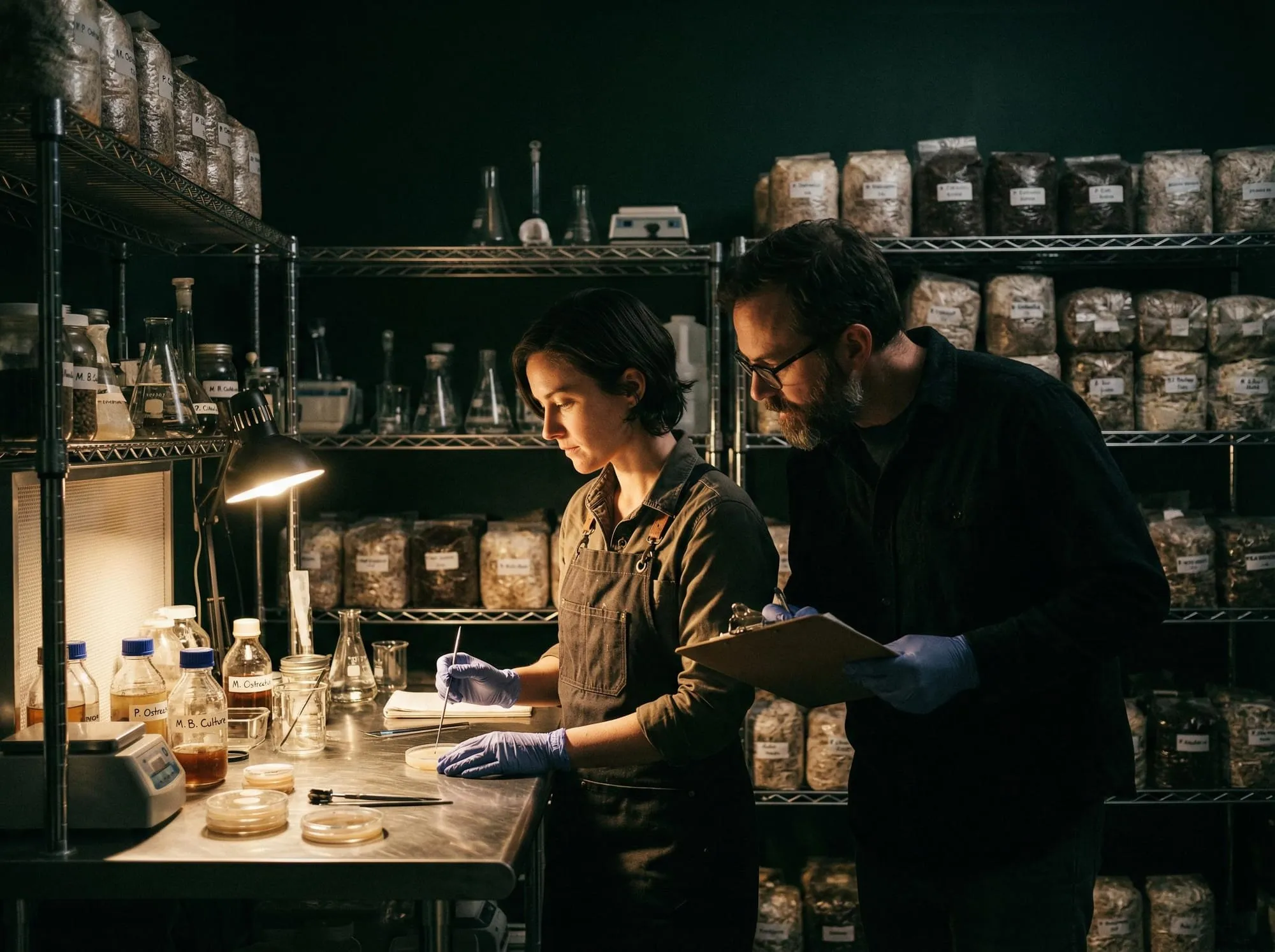
But let us be honest: we were not mushroom experts when we started. We read mycology textbooks. We spent countless hours on PubMed. We reached for sources from the Netherlands, Japan, China — some in English, some in Japanese. We had them translated. We read. We struggled to understand. We ran experiments. We failed. We tried again.
Our first cycle had a contamination rate of 34%. We published that number on our website. Because transparency is not only about sharing the good results — it is about sharing the hard ones too.
Why We Go to Such Lengths
Do we care about making sales? Of course — we are a company, we have bills to pay. But we did not build this company to sell. Sales should be the natural consequence of doing things right.
What truly drove us was curiosity. We wanted to understand how Lion's Mane stimulates NGF synthesis. We wanted to learn why Reishi triterpenes are bitter. We wanted to unravel the biochemistry behind the Furin pattern on Shiitake Donko. And as we learned, we noticed something: this knowledge does not exist in Turkish.
It exists in English-language sources. In Japanese. In Chinese. But in Turkish — a reliable, scientifically referenced, encyclopedia-format resource, free of commercial agendas — there is none.
That is why we built this site.
How This Site Was Built
Every article took hours. Some took days.
The "What Is Beta-Glucan?" article required combing through 14 different academic sources. "Mycelium vs. Fruiting Body" involved comparing analysis reports from over 20 products on the market. Each species encyclopedia entry — Lion's Mane, Reishi, Cordyceps, Turkey Tail, Sparassis, King Oyster, Shiitake Donko, Maitake — was treated as its own research project.
Our glossary contains over 130 terms. Every term was written individually, every cross-reference checked individually. The Reading Map — 8 distinct reading pathways — maps out how the content interconnects.
In total: 75+ published posts, 10+ pages, hundreds of internal links, each one backed by PubMed references.
And not a single one tells you "buy this, drink that." Not a single one uses the word "miracle." Not a single one tries to sell you anything.
Because this site is not a sales channel — it is a knowledge library.
Hoarding Knowledge Serves No One
Once, knowledge was power — because access was restricted. A company would say "our proprietary formula," and the consumer would say "fine." No one asked for an analysis report. No one asked about Beta-Glucan content. If it said "premium," it was premium.
That world is gone.
In the age of artificial intelligence, of open-access academic databases, in a world where anyone can go on PubMed and search — hiding knowledge is not possible. Companies that try only lose trust.
Who are we to hoard knowledge? Kawagishi discovered Hericenone in 1991 — that knowledge belongs to humanity. Brown and Gordon identified the Dectin-1 receptor in 2001 — that knowledge belongs to humanity. Chihara isolated Lentinan in 1969 — that knowledge belongs to humanity.
We translate this knowledge into Turkish. We make it understandable. We establish the context. That is all.
And while doing so, we never once thought, "But what about our competitive advantage?" If we had, we could not have built this site. A 130-term glossary, an 8-pathway reading map, 75+ in-depth articles — these are not things you create with a competitive advantage calculation.
You create them because you love the work.
We do.
Where We Struggled
Everywhere.
We struggled with access to information. The vast majority of functional mushroom literature is in English and Chinese. Turkish academic sources are virtually nonexistent. Some critical papers sit behind paywalls — one article costs 40 dollars. Ten articles, 400 dollars. A hundred articles…
We struggled with production. The first year was a battle against contamination. Optimizing substrate formulations for each species took months. Building a system that controls temperature and humidity with 0.5°C precision — VRF climate control — required serious investment.
We struggled to build trust. Saying "we are different" is easy. Proving it is hard. Commissioning an independent COA analysis for every batch, publishing the results on our website, saying "look, this batch was analyzed on this date, the results are here" — that is the construction process of trust.
And that process will never end.
We Listen to Science, Not to Everyone
Most of what is said about mushrooms on the internet is either exaggerated or wrong. "Reishi cures cancer." It does not — it is a food product. "Drink Lion's Mane and you will focus instantly." No — it is a group of compounds with a cumulative effect profile; it is not coffee.
You will not find such statements on this site. Here, the difference between "under investigation" and "proven" is made unmistakably clear. Every article ends with scientific references. Every page carries a health claims disclaimer.
Not what is popular — what is accurate. Not what sells — what informs. Not what the influencer says — what the researcher says.
That is our compass.
What This Site Strives to Be
Turkey's functional mushroom knowledge library. Encyclopedia format. Continuously updated. Scientifically referenced. Accessible to everyone.
Curious about a mushroom species? Its encyclopedia entry is here. Asking about a compound? Its explanation is here. Not sure which mushroom to use, when, or how? The guide is here. Did not understand a term? The glossary is here.
This resource is unique in Turkey. Stating that is not hubris — it is fact. And to keep that fact true, we will continue adding content, updating, and correcting every week.
Because a knowledge library is a living organism. The day it stops is the day it dies.
We will not stop.
Our Production Philosophy — In Brief
100% fruiting body — we do not produce mycelium-on-substrate powder. Independent COA analysis for every batch — Beta-Glucan, heavy metals, microbiology. Low-temperature drying at 42–45°C — preserving enzymatic structure. Netherlands-certified spawn — genetic stability. Species-specific substrate — no single formula. VRF climate control — 0.5°C precision.
Details: Why MYCOVITA? · Production Process · Analysis Reports
Contact
Do not hesitate to ask questions. Do not hesitate to criticize. If you spot an error in an article, tell us — we will correct it. If you notice a topic we have not covered, tell us — we will write it.
This site is yours too.
Our contact page · [email protected]
Kemal & Katya — Ordu, Türkiye
Transparency and Methodology
How this site is written, which sources it draws upon, and the legal framework within which it operates are open to scrutiny. Three pages serve as the documentation of our accountability:
- Editorial Policy — Source hierarchy, science-level labeling, health claims stance, error correction process.
- Bibliography — Cumulative list of primary scientific sources cited across all site articles (Kawagishi, Chihara, Brown & Gordon, and others).
- Legal Framework — Turkish Food Codex, health claims prohibitions, EU Novel Food regulation, FDA, FSA, and Japan-approved indications.