Low-Temperature Drying: The Scientific Rationale Behind the 42–45°C Cutoff
Harvest does not mark the end of the process.
A mushroom collected at the precise moment of full maturity remains a living organism. Its enzymes are active, its water content is high, and its bioactive constituents sit at their peak concentration. From this point, the clock begins to tick — and every misstep irreversibly destroys a portion of that accumulated biochemical wealth.
Drying constitutes the most critical segment of that clock.
Done correctly: moisture departs, character stays. Done incorrectly: moisture departs, and everything else departs with it.
How Heat Acts Upon a Mushroom
What resides inside a mushroom?
Water — 85–90% of its fresh weight. Enzymes — protein structures that orchestrate biochemical reactions. Volatile aromatic compounds — the olfactory and gustatory identity of the species. Bioactive molecules — Beta-Glucan, Triterpenes, Hericenones, Cordycepin. Color pigments — the visual signature of the species.
Each of these constituents responds to heat differently. And that differential response constitutes the foundational reality governing drying technology.
Above 50°C: Beta-Glucan chains begin to shorten — the molecular architecture shifts. Above 60°C: Enzymes denature — protein structures collapse irreversibly. Above 70°C: Volatile aromatic compounds evaporate — the deep Umami scent of Shiitake Donko, the oceanic breeze of Lion's Mane, vanish. Above 80°C: Color pigments degrade — that profound amber, that ivory white, that deep burgundy fade.
The standard temperature range in industrial drying: 70–90°C. Fast, efficient, inexpensive. And every time, the same result: a slightly pale, faintly aromatic, character-depleted powder.
The MYCOVITA Protocol: 42–45°C
MYCOVITA's drying temperature: 42–45°C.
This range was not chosen arbitrarily. It represents the upper boundary at which enzymes remain active, volatile compounds stay intact, and the Beta-Glucan molecular structure preserves its integrity. Every single degree matters.
But low temperature alone does not suffice. Low-temperature drying takes significantly longer than high-temperature drying — and throughout this extended duration, humidity control becomes critical. If moisture drops too rapidly, a crust forms on the mushroom surface, trapping internal moisture and initiating uneven drying. If moisture drops too slowly, the risk of microbial activity increases.
The MYCOVITA drying protocol operates in three stages:
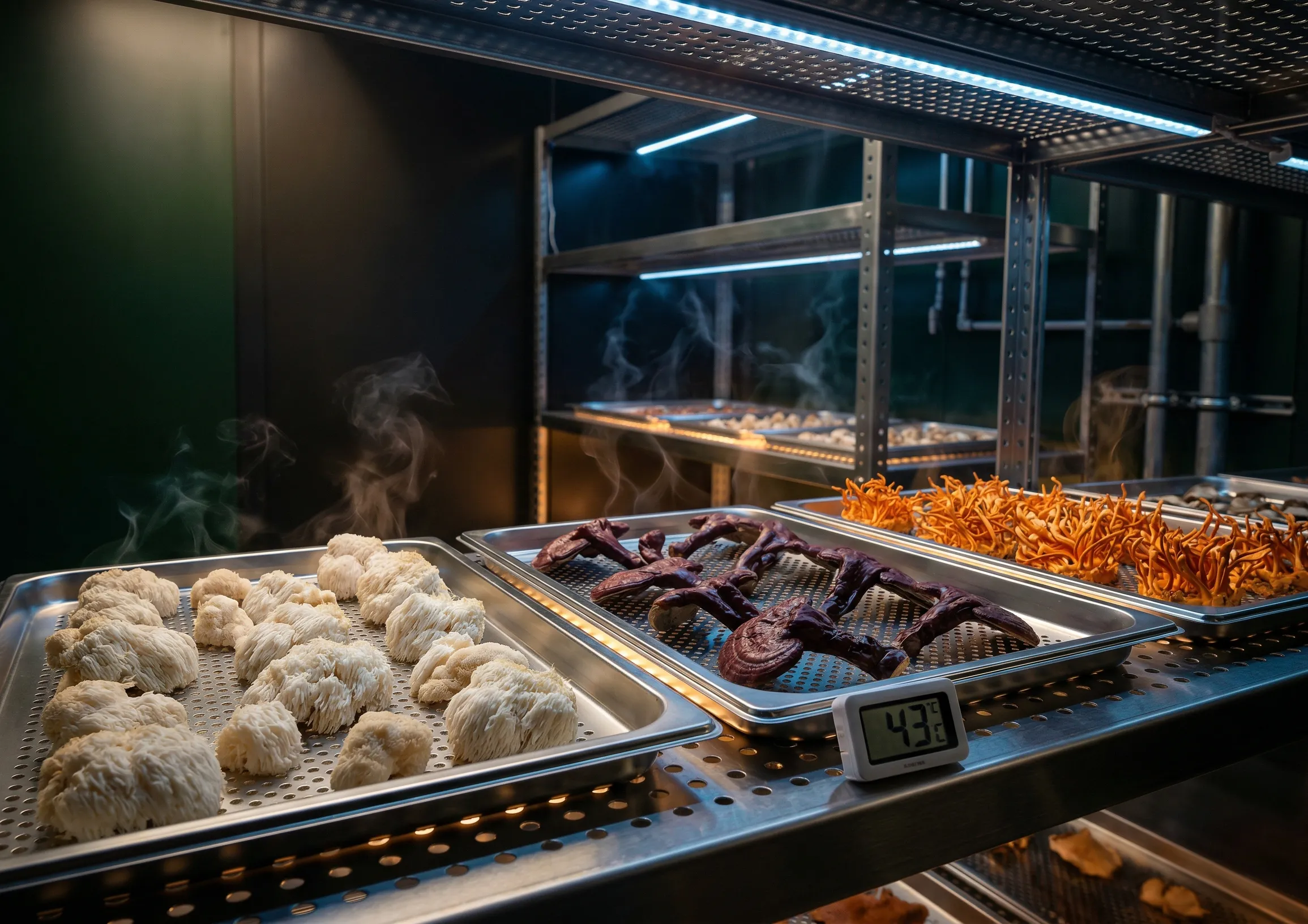
Stage 1 — Pre-Drying. The initial 4–6 hours. Controlled removal of surface moisture with gentle air circulation. Temperature: 38–40°C.
Stage 2 — Primary Drying. Extended, steady-temperature air flow for gradual evacuation of internal moisture. Temperature: 42–45°C. Duration: 18–36 hours, depending on the species.
Stage 3 — Equilibration. Final moisture measurement and resting at ambient temperature. Target moisture content: 8–10%. This range ensures both microbial stability and powder quality.
The final moisture value of every batch is recorded.
Comparison of Methods
The same mushroom becomes a different product under different drying methods.
High-Temperature Drying (industrial standard). Duration: 4–6 hours. Energy cost: Low. Color: Pale. Aroma: Weak. Bioactive profile: Partial loss. Outcome: Functional, but devoid of character.
Freeze-Drying (lyophilization). Duration: 24–48 hours. Energy cost: Very high. Color: Excellent. Aroma: Well preserved. Bioactive profile: Good. Outcome: High quality, yet cost-prohibitive at industrial scale.
MYCOVITA Low-Temperature Drying. Duration: 22–42 hours (species-dependent). Energy cost: Moderate. Color: Preserved. Aroma: Strongly retained. Bioactive profile: Maximal preservation. Outcome: Character, intensity, integrity.
Grinding: The Final Step
Drying is followed by grinding. And here, the same precision applies.
High-speed grinding generates frictional heat — local temperature can momentarily spike to 60–70°C. This can undo, at the final step, all the effort invested in low-temperature drying.
The MYCOVITA grinding protocol: Low RPM, intermittent operation, cooling periods. The target micron range is determined by species — coarser for Gastronomy powders, finer for Apothecary powders — both homogeneous and controlled.
Packaging immediately follows grinding: oxygen-barrier, light-proof packaging. Because all of this effort must be preserved through to the final container.
Conclusion
What distinguishes one powder from another in a jar is rarely the label.
It is the color. The aroma. The trace it leaves when dispersed in water. The depth it leaves on the palate.
These differences begin in the drying room.
42–45°C. 22–42 hours. Every batch analyzed.
Patience, beyond the reach of the best technology, is a deliberate choice.
Related reading: Production Process · Vitamin D and Mushrooms
MYCOVITA's production philosophy and transparency principles: Why MYCOVITA?
Mycelial Library No. 02 — MYCOVITA, Ordu, Türkiye. Knowledge is the purest supplement.
MYCOVITA products are food products. They make no claim to treat, prevent, or cure any disease. If you have a health concern, consult your physician.
You May Also Find Interesting
→ Can Mushrooms Produced in Türkiye Be Trusted?
→ Functional Mushroom Production in Türkiye
→ The Functional Mushroom Market in Türkiye
Quality and Production — Related Resources
A structured content cluster covering every stage of the functional mushroom production chain:
- What Is Substrate? — The grain and wood-based substrate foundation.
- Certified Mycelium — Why spawn source is critical.
- Strain and Intraspecies Variation — The impact of genetic lineage.
- Mycelium vs. Fruiting Body — Differences in constituent profiles.
- Low-Temperature Drying — The science of the 42–45°C threshold.
- Extraction Methods — Hot water, ethanol, dual extraction.
- Beta-Glucan Measurement — Megazyme and alternative methods.
- Reading a COA — How to interpret a certificate of analysis.
- Contamination and Mycotoxins — Safety protocols.
- The Black Sea Climate — The geographic advantage.
- Storage — Shelf life and quality preservation.
This content is for informational purposes only and does not constitute medical advice. Consult your physician before making any health-related decisions. Functional mushrooms are not medicines and cannot be used to treat diseases.
Version: 1.0 | Last updated: 20 Apr 2026 | Sources reviewed: 5+ | Methodology: Editorial Policy | References: Bibliography