Inonotus obliquus (Chaga): The Definitive Species Compendium
A Slow Fungus Dwelling on the Siberian Birch
— HOST —
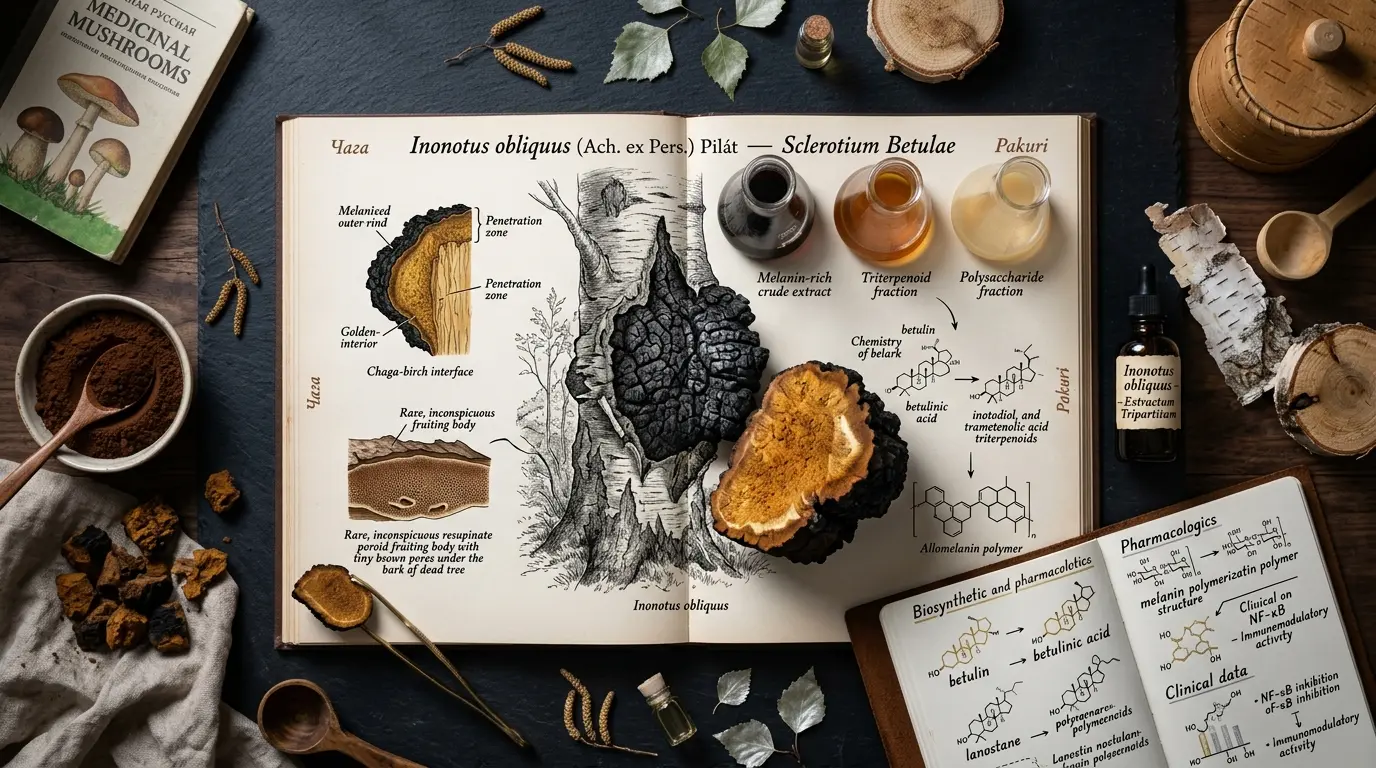
Inonotus obliquus—the species known as Chaga—displays an unusual character among fungi. It rarely produces a capped fruiting body; the material actually harvested is the blackened, sclerotium-like mass that protrudes from the tree trunk. It develops inside the tree over decades, slowly consuming the host, and forges its distinctive chemical profile during this extended life cycle.
Taxonomy and Ecology
Inonotus obliquus is a member of the Hymenochaetaceae family. Its natural range spans the northern temperate and boreal zones: Siberia, Northern Europe, Canada, and the northeastern United States. Natural populations in Turkey are limited; harvested material is mostly imported.
Host tree preference is overwhelmingly for the genus Betula (birch); it rarely colonizes maple, beech, and alder. The choice of host is not merely ecological but also a chemical determinant: Chaga absorbs betulin from birch bark and converts it into betulinic acid (Géry et al., 2018; PMID: 29415104).
Bioactive Profile: Three Principal Lines
Three principal lines define Chaga’s bioactive profile:
- Polyphenol–melanin pigments: Hispidin derivatives, melanin polymers.
- Triterpenes: Inotodiol, betulinic acid, lanosterol derivatives.
- Polysaccharides: β-glucans and heteropolysaccharides.
Of these three, the polyphenol–melanin pigments confer a substantial portion of Chaga’s antioxidant capacity; triterpenes stand out in the modulation of intracellular signaling; polysaccharides serve as the structural substrate for immune interaction (Cui et al., 2005; PMID: 15883025).
Extraction: The Necessity of a Dual Method
Chaga’s two distinct chemical classes—the water-soluble polyphenol–polysaccharide fraction and the lipophilic triterpene fraction—cannot be obtained simultaneously with a single extraction method. For this reason, dual extraction (water + alcohol) is a common approach for Chaga products.
Hot water alone leaves behind much of the triterpene and betulinic acid fraction; alcohol-only extraction weakens the polyphenol–polysaccharide fraction. Dual extraction targets both fractions (Lemieszek et al., 2011; PMID: 21534945).
Sustainability and Harvest Ethics
Chaga is a significant actor in its ecosystem; overharvesting weakens natural populations. Responsible harvest principles include: collecting only from sufficiently large, mature sclerotia (at least 25–30 cm), leaving a portion of the above-ground mass after harvest, and never removing an entire individual from the ecosystem.
Wild Chaga does not enter MYCOVITA’s value chain; controlled-cultivation Chaga is preferred due to harvest ethics and contamination risks (Niemelä, 2005).
Limitations
Human intervention studies on Chaga are limited; the majority of investigations are at the in vitro and animal model level. Potential interactions with blood glucose and coagulation profiles have been reported in individuals taking diabetes medications and anticoagulants; therefore, those under such treatment should consult a physician.
Related Reading
- Inotodiol — Triterpene profile.
- Hispidin — Polyphenol profile.
- Betulinic Acid — The birch connection.
This content is for informational purposes only and does not constitute medical advice. Consult your physician before making any health decisions. Functional mushrooms are not pharmaceuticals and cannot be used to treat diseases.
Version: 1.0 | Last updated: 28 April 2026 | Number of reviewed sources: 12+ | Method: Editorial Policy | References: Bibliography