Mycelium-Infused 3D Bioprinting for Next-Generation Tissue Engineering
Can Mycelium Serve as a Tissue Scaffold?
— ANCHOR —
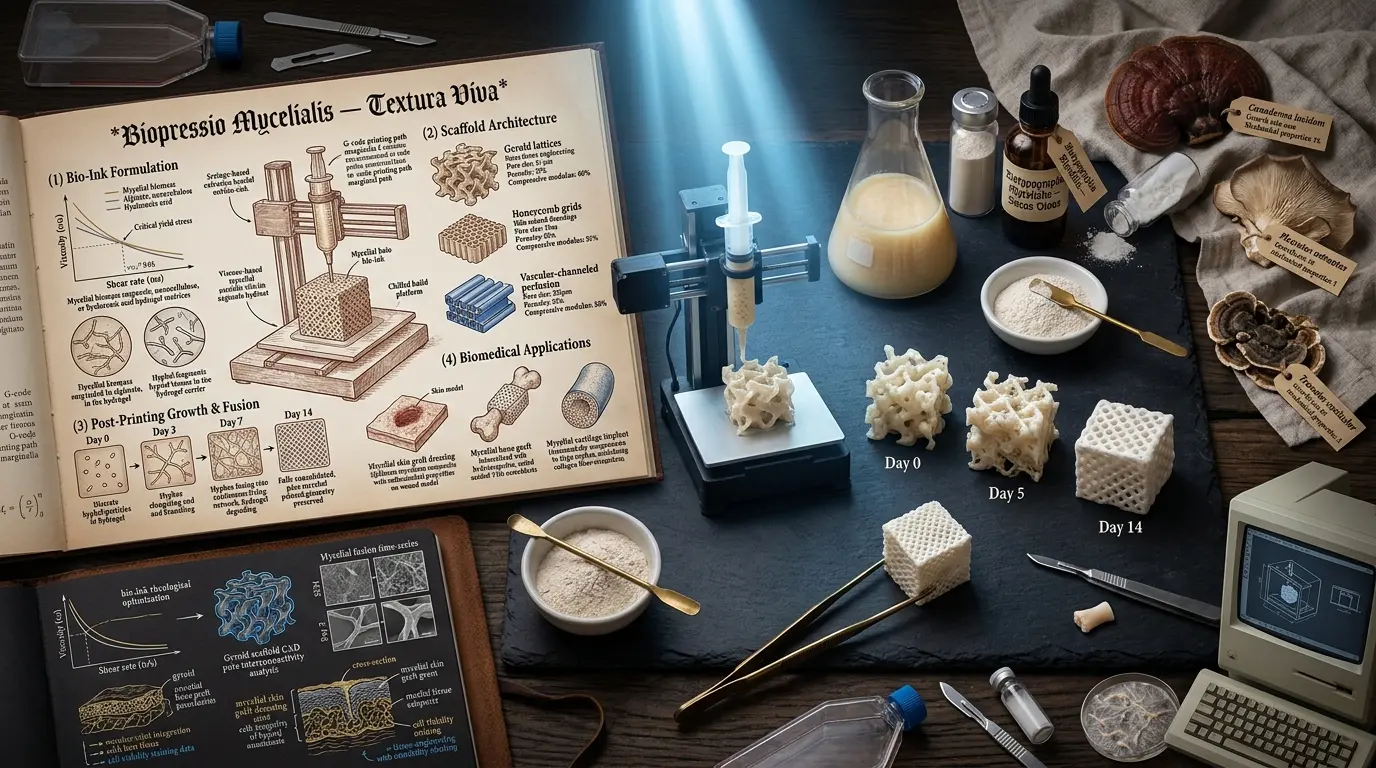
A 3D printer can deposit organ tissue layer by layer. The "ink" used in this domain — bio-ink — contains cell-supportive polymers. The question emerges: can fungal mycelium fibers be incorporated into this bio-ink? With its chitin architecture, growth capacity, and mechanical properties, mycelium has entered the research agenda as a novel raw material for tissue engineering.
Bio-Ink: The Foundation of Tissue Printing
Bio-ink employed in bioprinters is a mixture containing cells and/or cell-supportive biopolymers. An ideal bio-ink must be biocompatible (non-toxic), biodegradable (naturally degrading over time), mechanically appropriate (matching the target tissue), and capable of maintaining shape fidelity during the printing process (viscoelastic). Widely used biopolymers include gelatin, alginate, collagen, hyaluronic acid, and fibrin.
Fungal-derived polymers — specifically chitin and beta-glucan — potentially satisfy these criteria. Unlike chitosan obtained from arthropod exoskeletons, chitin can be derived directly from fungal cell walls; this gives fungal chitin a production advantage over its animal-derived alternatives. Fungal 3D printer bio-ink research examines the technical details of chitin and beta-glucan in bio-ink formulation.
Mycelium Structure: A Bioengineering Perspective
Mycelium consists of interconnected hyphal networks; this web structure naturally forms a porous, vertebrate-like scaffold. Hyphal diameter typically ranges between 2–10 micrometers; the complex network geometry provides a high surface area. These characteristics create a three-dimensional environment favorable for cell attachment and proliferation.
From a bioengineering perspective, the principal advantages of mycelium are as follows: self-organization capacity (it spontaneously forms three-dimensional structures under specific conditions), biodegradability (it undergoes enzymatic degradation over time), mechanical tunability (stiffness can be altered by modifying substrate and growth conditions), and presentation of bioactive components (beta-glucan and chitin modulate cell-tissue interactions). This property set renders mycelium an attractive candidate for tissue scaffold applications.
Skin and Wound Healing Applications
The application area where mycelium-based biomaterial research has reached its most advanced stage is skin tissue engineering. Studies culturing fibroblasts on mycelium scaffolds demonstrate cell attachment and proliferation levels comparable to standard collagen scaffolds. A separate body of literature documenting beta-glucan's wound-healing support further strengthens this application.
Beta-glucan can stimulate macrophage and fibroblast activation via Dectin-1, promoting collagen synthesis and angiogenesis (new blood vessel formation). This dual effect — serving as both a mechanical scaffold and a bioactive signal — potentially renders mycelium-based skin patches superior to synthetic alternatives. Transition to clinical use awaits completion of sterile production protocols, long-term biocompatibility assessments, and in vivo efficacy studies. Beta-glucan measurement methods explains the standardization of this bioactive component.
Bone and Cartilage Tissue Applications
Chitin bears a biomimetic structural resemblance to collagen: both are long-chain polymers providing mechanical support. This similarity has brought chitin-based scaffolds to the forefront of bone and cartilage tissue engineering research. Fungal chitosan (the deacetylated form of chitin) ranks among materials shown to support cell attachment and osteogenic markers in osteoblast culture studies.
The avascular nature of cartilage tissue (see chondrocyte biology literature) renders tissue engineering particularly challenging. The porous architecture of mycelium scaffolds supports nutrient diffusion, thereby preserving chondrocyte viability. Only early-stage research exists for this specific application; the clinical path is long, yet the theoretical foundation is robust.
Scale-Up and Technical Challenges
Several critical barriers stand before the commercialization of mycelium-based biomaterial research. The first is sterilization and biosafety: contamination risk must be managed in products containing living mycelium; devitalized mycelium matrices reduce this risk but partially lose bioactivity. The second is mechanical consistency: batch-to-batch homogeneity of biologically sourced materials is more difficult to achieve than with synthetic polymers. The third is the regulatory approval process: the FDA and EMA approval pathways for a novel biomaterial category demand both time and resources.
Despite these obstacles, fungal-based biomaterial companies continue to secure investment and advance research. The convergence of biomimicry, sustainability, and functional advantages makes this field one of the most exciting arms of tissue engineering research. Fungal-based bioceramic substrates presents the broader context of fungal components in advanced material applications.
Related Reading
- Fungal 3D Printer Bio-Ink — research on bio-ink formulation using chitin and beta-glucan.
- Fungal-Based Bioceramic Substrates — advanced material applications of fungal components.
- Synthetic Biology and Fungal Chassis Cells — the broader framework of fungal bioengineering.
Mechanical Properties of Mycelium: Tissue Compatibility
Among the most critical mechanical parameters for a tissue engineering scaffold are the Young's modulus (elasticity coefficient) and tensile strength. A scaffold whose mechanical properties closely approximate the target tissue (biomimetic mechanical compliance) directly influences cell behavior — attachment, proliferation, and differentiation. Soft tissues (skin, muscle) require a low Young's modulus; hard tissues (cartilage, bone) demand a higher modulus.
The mechanical properties of mycelium-based materials can be tuned across a broad range depending on the fungal species used, substrate composition, growth duration, and thermal treatment parameters. Reishi mycelium, with its denser and stiffer network architecture, carries potential for cartilage-like applications, whereas Oyster mushroom mycelium exhibits a more flexible and softer profile, currently being evaluated for skin and wound dressing applications. This tunability transforms mycelium matrices into an adaptable platform for multiple tissue engineering targets. Fungal acoustic panels demonstrates how mycelium's mechanical properties are deployed in a different application domain.
The Vascularization Problem: The Universal Hurdle of Tissue Engineering
The shared critical challenge for all scaffold systems in tissue engineering is vascularization — the ingrowth of a blood vessel network into the scaffold. It is established that cells within any tissue construct cannot survive beyond 200 micrometers from a capillary; cells beyond this distance die from oxygen and nutrient insufficiency. Without solving this problem, large tissue constructs cannot transition to in vivo application.
Two potential approaches are under investigation for mycelium-based scaffolds. The first uses the natural hyphal network architecture of mycelium as a vascular channel analog; hyphal diameters (2–10 micrometers) overlap with capillary dimensions, and these channels could theoretically be employed for endothelial cell seeding. The second approach involves loading angiogenic growth factors (VEGF, FGF) into the mycelium scaffold to stimulate neo-vascularization. Both approaches remain in early experimental stages, and comprehensive in vivo data are required before clinical translation can proceed.
The Sustainability Advantage: Why Mycelium?
A powerful argument supporting mycelium-based biomaterial research lies on the sustainability axis. Conventional tissue engineering materials — animal-derived collagen, petrochemical-based synthetic polymers — face mounting environmental and ethical criticism. Mycelium, by contrast, is positioned as a resource that grows rapidly on agricultural waste substrates (corn cobs, straw, sawdust), offers a carbon-neutral production profile, and requires no animal-derived raw materials.
This sustainability profile also confers a competitive advantage for mycelium biomaterials in funding and investment contexts. The approach, which merges environmentally friendly material development with medical biomaterial research, garners support from both health and environmental ecosystems. Consequently, mycelium tissue engineering secures a firm place on the research agenda not solely due to its technical potential but because of its systemic advantages.
Summary: Mycelium Tissue Engineering — Where Do We Stand?
Mycelium-based biomaterial research is a rapidly growing field that has not yet progressed beyond the laboratory proof-of-concept stage but rests on a strong theoretical foundation. The biocompatibility of chitin and beta-glucan, the mechanical tunability of mycelium, its natural porous architecture, and its sustainable production profile render these materials compelling candidates for tissue engineering. The vascularization problem, sterilization difficulties, and regulatory uncertainty remain obstacles. In the near term, the transition of skin wound dressing applications to the clinical research phase stands as the most proximate expectation; bone and cartilage applications possess a longer research horizon. The project continues: transporting the structural and scaffolding roles that fungi have performed in nature for millennia — supporting tree roots, lending texture to the forest floor — into humanity's tissue repair laboratory. Fungal 3D printer bio-ink addresses the bio-ink dimension of this journey in detail.
Mycelium tissue engineering represents the organic transformation of biomaterial science. The hyphal network architecture that a fungus has refined over millions of years naturally delivers the porous scaffold structure that bioengineers strive to replicate in the laboratory. This parallel pursuit signifies moving beyond drawing inspiration from nature toward directly utilizing nature itself. While the road to clinical application remains long, mycelium has indisputably entered the tissue engineering toolbox. The research ahead will determine how far this tool can reach.
Research into fungal components deepens with each passing year; mechanistic evidence is laying the groundwork for clinical trials. As the science accelerates, this field will be able to offer clearer recommendations.
The most exciting developments in mycelium-based biomaterials are anticipated within the next five to ten years. Relatively simpler applications such as skin wound dressings will enter the clinical phase, while complex organ engineering occupies a longer research horizon.
The future of mycelium tissue engineering is intertwined with both biotechnology and sustainable materials science. Fungal fibers have been performing engineering in nature for millions of years; researchers are now working to convert this accumulated expertise into a clinical tool. The therapeutic potential of chitin and beta-glucan opens an exciting frontier not only in supplement forms but also in biomaterial applications. This field will continue to expand.
This content is for informational purposes only and does not constitute medical advice. Consult your physician before making any health-related decisions. Functional mushrooms are not medicines and cannot be used for the treatment of diseases.
Version: 1.0 | Last updated: May 2026 | Method: Editorial Policy | References: Bibliography