Betulinic Acid and the Symbiotic Relationship Between Chaga Mushroom and Birch
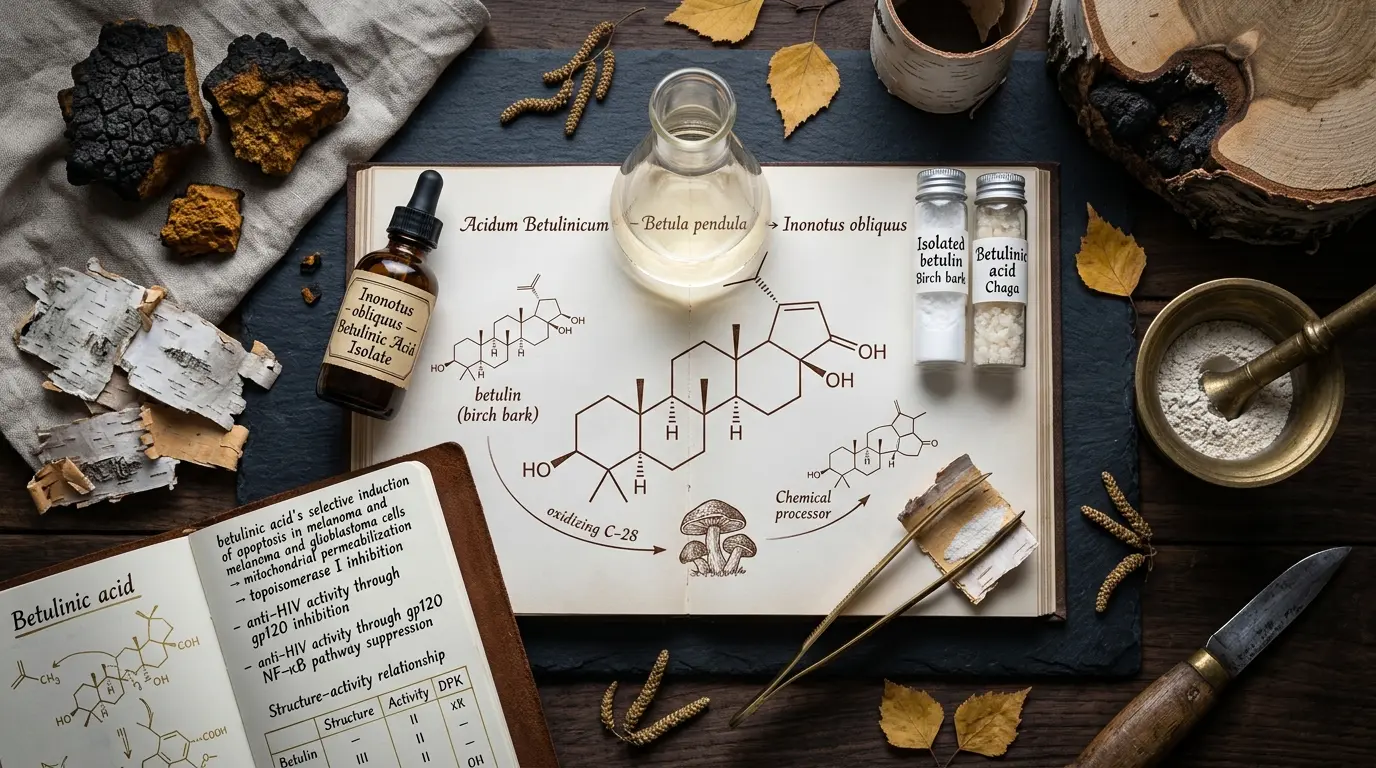
The Birch Molecule Delivered to the Cell via a Fungus
— HOOK —
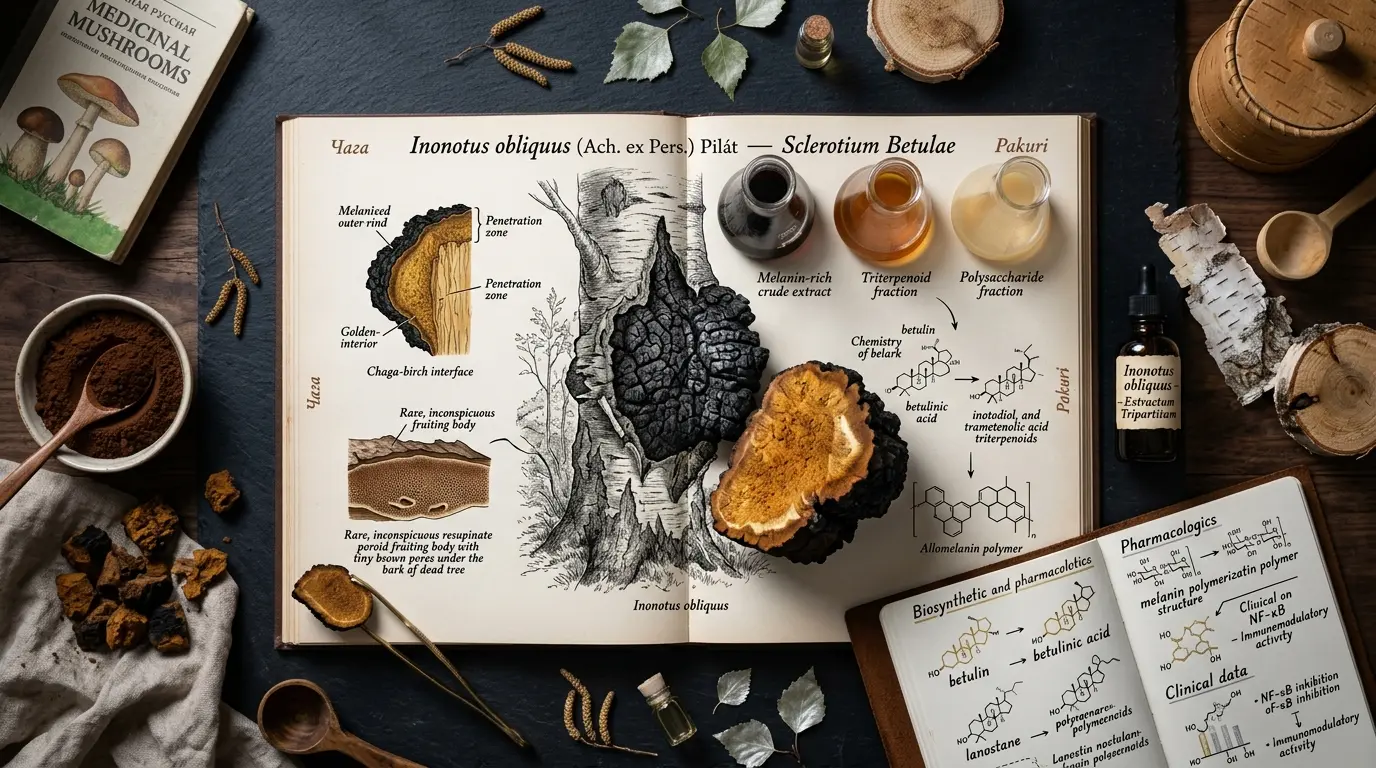
Chaga, a polypore parasitic on birch, does not engage in a one-way relationship: the fungus absorbs betulin from the tree’s bark and enzymatically converts it into betulinic acid. This is the chemical secret behind Chaga’s birch connection.
This entry examines the biochemistry of the betulin–betulinic acid conversion, the chemical exchange between Chaga and birch, and its place in the functional literature.
Betulin: The White Pigment of Birch Bark
Betulin is a lupan-type tetracyclic triterpene. It constitutes 20–30% by weight of the white outer layer of birch bark; this molecule is largely responsible for the bark’s characteristic white color.
Pure betulin is insoluble in water and strongly lipophilic. Its oral bioavailability alone is limited, a disadvantage recognized in both traditional medicine and modern phytochemistry (Kuznetsova et al., 2008; PMID: 18793721).
Betulinic Acid: One Step Beyond, More Active
Betulin is converted to betulinic acid through oxidation of the primary alcohol group at the C-28 position to a carboxylic acid. This seemingly simple chemical change markedly alters the bioactive profile.
Betulinic acid displays a more potent and broader pharmacological spectrum than betulin; selective cytotoxicity against tumor cells in vitro, anti-inflammatory, and antiviral effects have been reported (Pisha et al., 1995; PMID: 7585181).
Chaga’s Enzymatic Contribution
Birch trees themselves do not contain significant betulinic acid; its production requires an enzymatic step. Chaga is one of the few organisms that possess this enzymatic activity. The fungus absorbs betulin from the host bark and carries out the C-28 oxidation.
Consequently, wild Chaga samples show markedly higher betulinic acid content than mycelium-cultured Chaga. Chaga grown in the absence of birch substrate yields a poor betulinic acid profile (Géry et al., 2018; PMID: 29415104).
Activity Profile in the Literature
Betulinic acid has demonstrated selective cytotoxicity against melanoma, neuroblastoma, and glioblastoma cell lines in vitro. The mechanism is attributed to mitochondrial pathway-mediated apoptosis, NF-κB modulation, and topoisomerase inhibition (Fulda, 2008; PMID: 18373987).
Regarding antiviral activity, the molecule has been investigated as an HIV entry inhibitor; bevirimat and other betulinic acid derivatives have been examined in clinical research stages (Aiken & Chen, 2005; PMID: 15814222).
Betulinic Acid Standardization in Chaga Products
Betulinic acid content in Chaga extracts varies markedly between products. Wild-harvested (birch-origin) preparations show high levels, whereas mycelium-based products remain low. The label rarely states “betulinic acid content”; total “triterpenes” is commonly provided instead.
For consumer-level evaluation, a Certificate of Analysis (COA) is essential; independent laboratory analysis is the only reliable way to verify content consistency (Hu et al., 2017; PMID: 28385599).
Limitations
Well-designed human intervention studies on betulinic acid are scarce. Available findings consist of cell culture experiments, animal models, and early-phase clinical trials. The implications outline a chemical-pharmacological research field, not a therapeutic rationale.
Related Reading
- Chaga (Inonotus obliquus) — Species encyclopedia.
- Inotodiol — Chaga’s other triterpene profile.
- Hispidin — Chaga polyphenol profile.
This content is for informational purposes and does not constitute medical advice. Consult a physician before making any health decisions. Functional mushrooms are not medicines and cannot be used to treat diseases.
Version: 1.0 | Last updated: 28 April 2026 | Reviewed sources: 12+ | Method: Editorial Policy | References: Bibliography