Fungal Melanins: The Chemical Nature of Chaga’s Dark Pigment
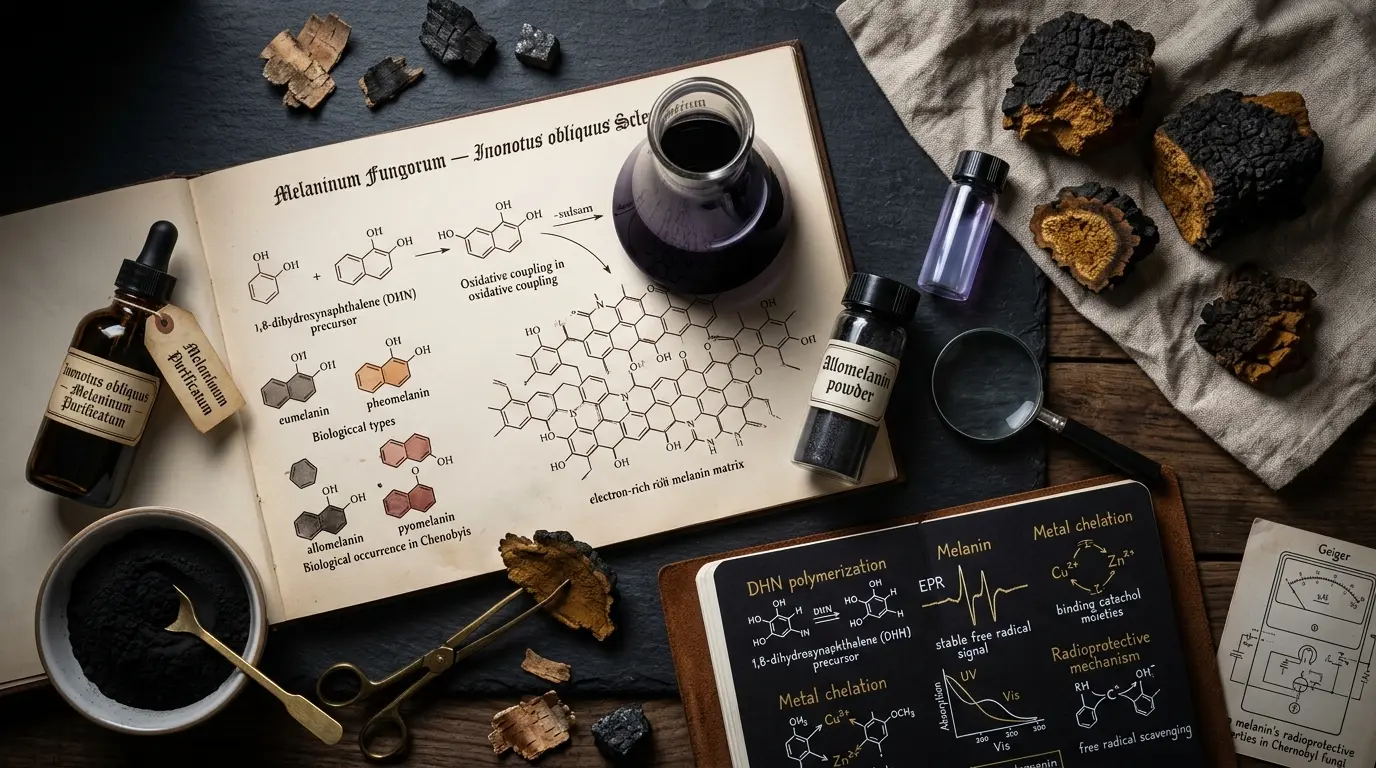
The Black Pigment of Fungi: A Scientific Account
— KANCA —
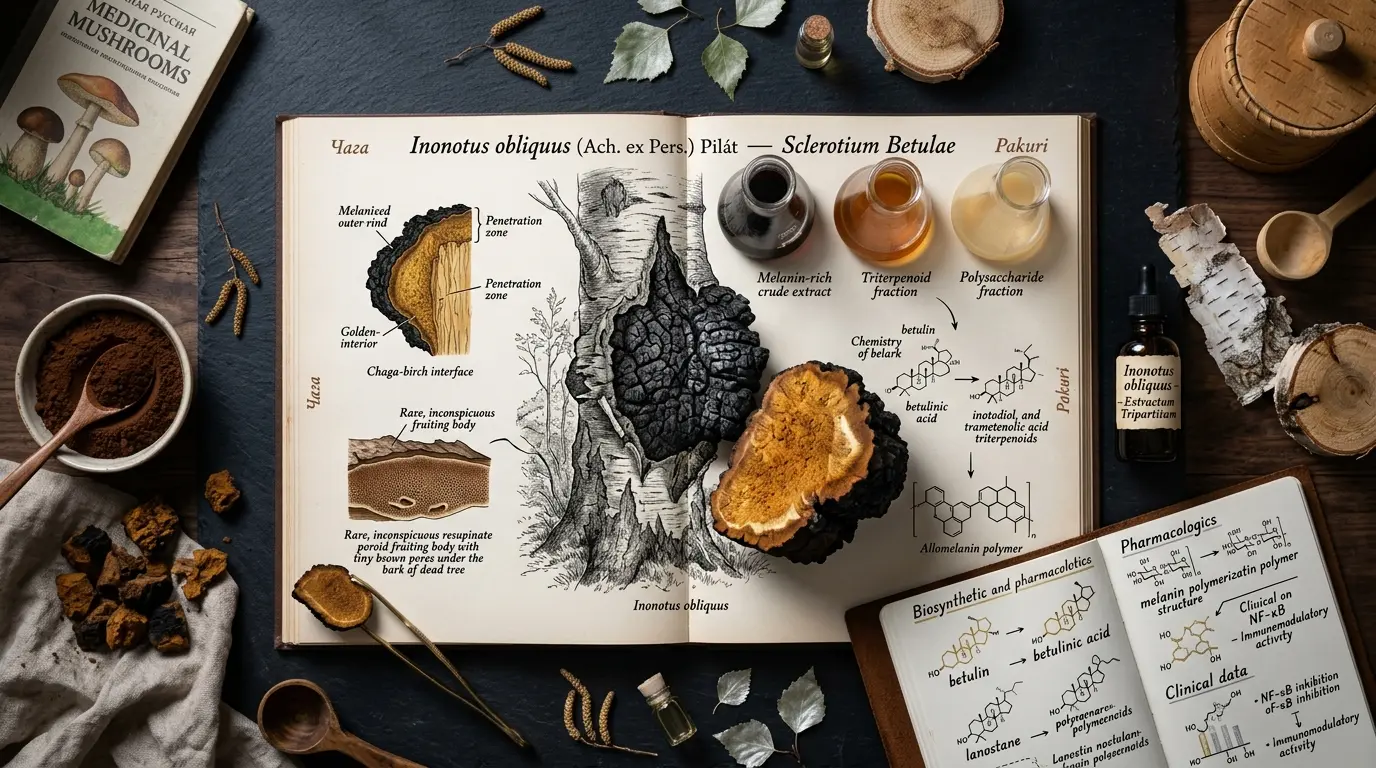
The jet-black outer crust of Chaga, the brownish tint of Calvatia spores, the deep black of Aspergillus niger — all derive from the same pigment family: fungal melanin. It bears structural resemblance to melanin in human skin, yet is synthesized through biochemically distinct routes, and stands today as a compelling subject of radiobiological research.
This article examines the chemical structure of fungal melanin, its biosynthetic pathways, and its place in the functional literature.
Melanin: Not a Single Polymer, But a Family
Melanins are heterogeneous polymers. Eumelanin in human skin originates from tyrosine; a significant portion of fungal melanins, by contrast, is produced via the DHN-melanin (1,8-dihydroxynaphthalene) pathway or through L-DOPA intermediates.
The melanin-like pigments in Chaga are high-molecular-weight polymers formed through the oxidative coupling of phenolic precursors — particularly hispidin derivatives. For this reason, Chaga melanin is referred to in some sources as "polyphenol-melanin" or "hispidomelanin" (Babitskaya et al., 2002; PMID: 12382436).
Biosynthetic Pathways
Fungal melanin biosynthesis proceeds chiefly through three routes: the DOPA-melanin pathway starting from tyrosine, the DHN-melanin pathway starting from acetyl-CoA, and the polyphenol-coupling pathway starting from phenolic compounds. In most functional fungi, the latter two pathways predominate (Eisenman & Casadevall, 2012; PMID: 22327894).
This distinction matters because melanins arising from different pathways exhibit differing antioxidant capacities, metal-chelating behaviors, and UV absorption profiles.
Antioxidant and Radioprotective Profile
Melanin polymers possess a high free-radical-scavenging capacity. The discovery of melanin-rich fungal colonies proliferating around the Chernobyl sarcophagus suggested that melanin may play a radioprotective and even radiotrophic role — utilizing radiation as an energy source. This remains an active area of investigation in modern mycological literature (Dadachova et al., 2007; PMID: 17569570).
The elevated ORAC and FRAP values measured in Chaga extracts are largely attributable to the melanin-like pigment fraction (Cui et al., 2005; PMID: 15883025).
The Bioavailability Question
Fungal melanin is not lipophilic; it is a high-molecular-weight polymer. After oral ingestion, it passes through the gastrointestinal tract largely unaltered. This complicates any direct translation of high in vitro antioxidant capacity into systemic effects.
Local antioxidant activity within the intestinal lumen, interaction with the gut microbiota, and modulation at the mucosal level are plausible mechanisms; however, direct evidence remains limited (Géry et al., 2018; PMID: 29415104).
Limitations
Well-designed human intervention trials for fungal melanin do not exist. The available findings derive from cell culture studies, animal models, and ecological observations. The inferences presented here offer a window into a noteworthy research domain, not a therapeutic rationale.
Related Readings
- Chaga (Inonotus obliquus) — Species profile.
- Hispidin — Polymerization precursor.
- ORAC and FRAP — Antioxidant measurement methods.
This content is provided for informational purposes only and does not constitute medical advice. Consult a physician before making any health-related decisions. Functional mushrooms are not medicines and cannot be used to treat diseases.
Version: 1.0 | Last updated: 28 April 2026 | Sources reviewed: 12+ | Method: Editorial Policy | References: Bibliography