Polysaccharide-Peptide (PSP): How It Differs from PSK
The Lesser-Known Relative of PSK
— KANCA —
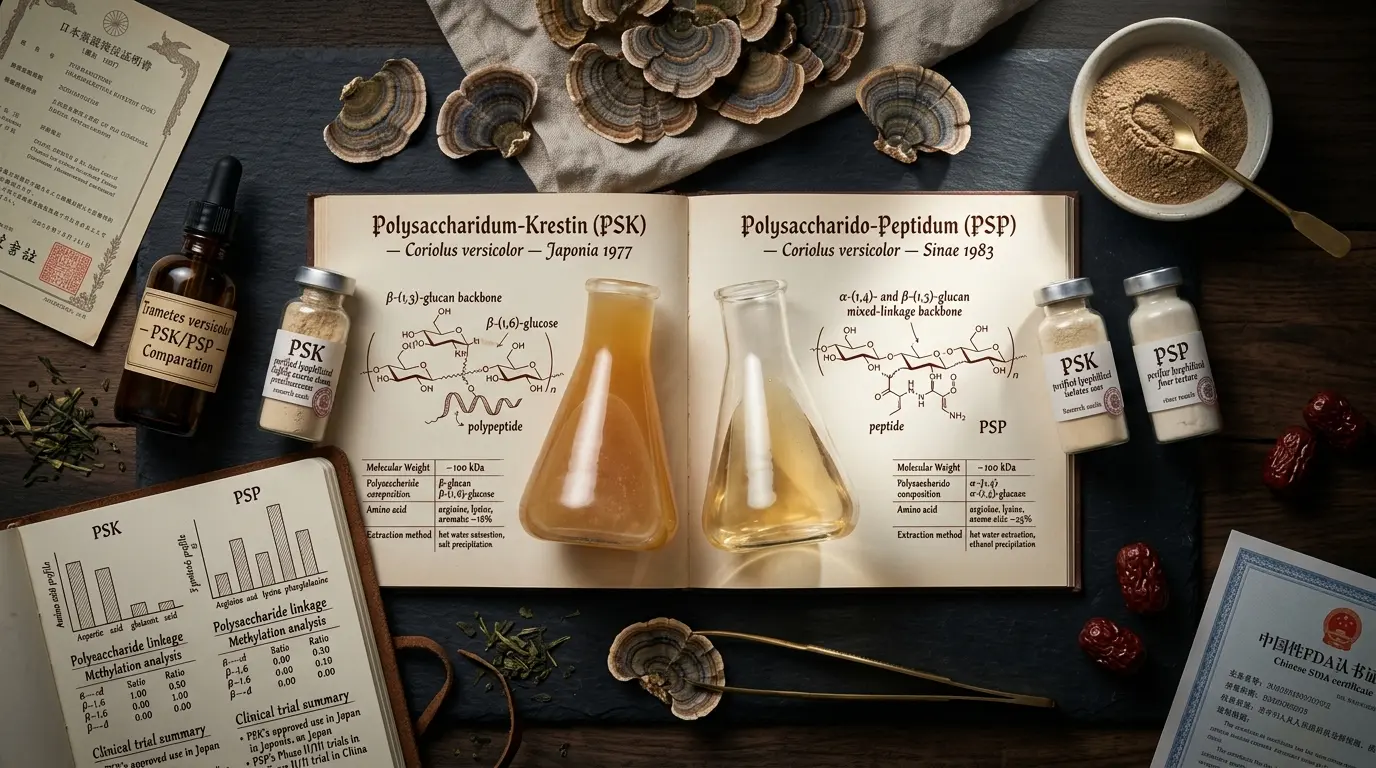
The key molecule in the Coriolus versicolor (Trametes versicolor, Turkey Tail) literature is PSK (polysaccharide-K, Krestin), which originates from Japan. Its cousin, developed in China during the 1980s from a different strain, is PSP (polysaccharide-peptid). Both compounds derive from the same species and are chemically close, yet they are not identical.
This entry examines the structural profile of PSP, compares it with PSK, and situates it within the functional literature.
PSP: Polysaccharide-Peptid
PSP is a polysaccharide-peptide complex obtained from the Trametes versicolor COV-1 strain via hot water extraction. Its molecular weight is approximately 100 kDa; the polysaccharide backbone consists of a β-(1→4)-glucan main chain with β-(1→3) and β-(1→6) side branches, to which a protein chain is covalently bound.
Developed at Shanghai University in the 1980s, PSP received approval from the Chinese health authority for clinical use in specific indications (Yang et al., 1992).
PSK and PSP: Same Species, Different Strain, Different Profile
PSK is produced from the Coriolus versicolor CM-101 strain and holds regulatory approval in Japan. PSP is produced from the COV-1 strain and holds approval in China. The two products originate from the same taxonomic species but emerge from distinct strains and manufacturing conditions; their chemical profiles are not identical in every detail.
Structural differences manifest in the peptide-to-protein content ratio, branching density, and molecular weight distribution. At a practical level, these differences translate into measurable variations in immunological activity profiles (Cui & Chisti, 2003; PMID: 12727377).
Clinical Profile in the Literature
PSP has been investigated in multiple clinical studies conducted in China, primarily in the context of chemotherapy support. Trends toward improvement have been reported across outcome variables including hematological parameters, quality-of-life measures, and immune cell profiles (Tsang et al., 2003; PMID: 12745547).
A substantial portion of these studies exists within the Chinese-language literature and has received limited exposure in Western medical journals. This circumstance keeps PSP's standing in international pharmacological discourse more subdued compared to that of PSK.
Availability in Turkey
Pure PSK or PSP products are not widespread in the Turkish market. Trametes versicolor extracts are sold under the "Turkey Tail" label; standardized PSP or PSK fractions are rarely specified in these products. Consumers should understand that a "Turkey Tail" label does not denote PSP equivalence.
Limitations
A significant portion of the PSP clinical literature belongs to the Chinese oncology tradition; large-scale randomized trials conducted according to Western medical methodology remain limited. The available evidence describes the profile of a polysaccharide-peptide complex that merits further clinical investigation; it does not constitute a therapeutic prescription.
Further Reading
- Vitality: Turkey Tail — Species profile.
- Lentinan, PSK, and β-glucan — Comparison of standardized fractions.
- What Is β-glucan? — Polysaccharide profiles.
This content is provided for informational purposes and does not constitute medical advice. Consult a physician before making any health-related decisions. Functional mushrooms are not pharmaceutical drugs and cannot be used to treat diseases.
Version: 1.0 | Last updated: 28 April 2026 | Sources reviewed: 12+ | Methodology: Editorial Policy | References: Bibliography