Grifolin and Neogrifolin: Unveiling the Overlooked Bioactives of Maitake
Maitake’s Chemical Face Outside the D-Fraction
— HOOK —
Maitake (Grifola frondosa) literature primarily advances through the D-fraction polysaccharide. Yet this mushroom possesses another bioactive lineage: grifolin and neogrifolin derivatives. Low-molecular-weight and lipophilic, they offer a pharmacological profile entirely distinct from the polysaccharides.
This entry examines the structural chemistry of grifolin/neogrifolin and their place in Maitake’s bioactive portrait.
Grifolin: A Farnesene–Orcinol Derivative
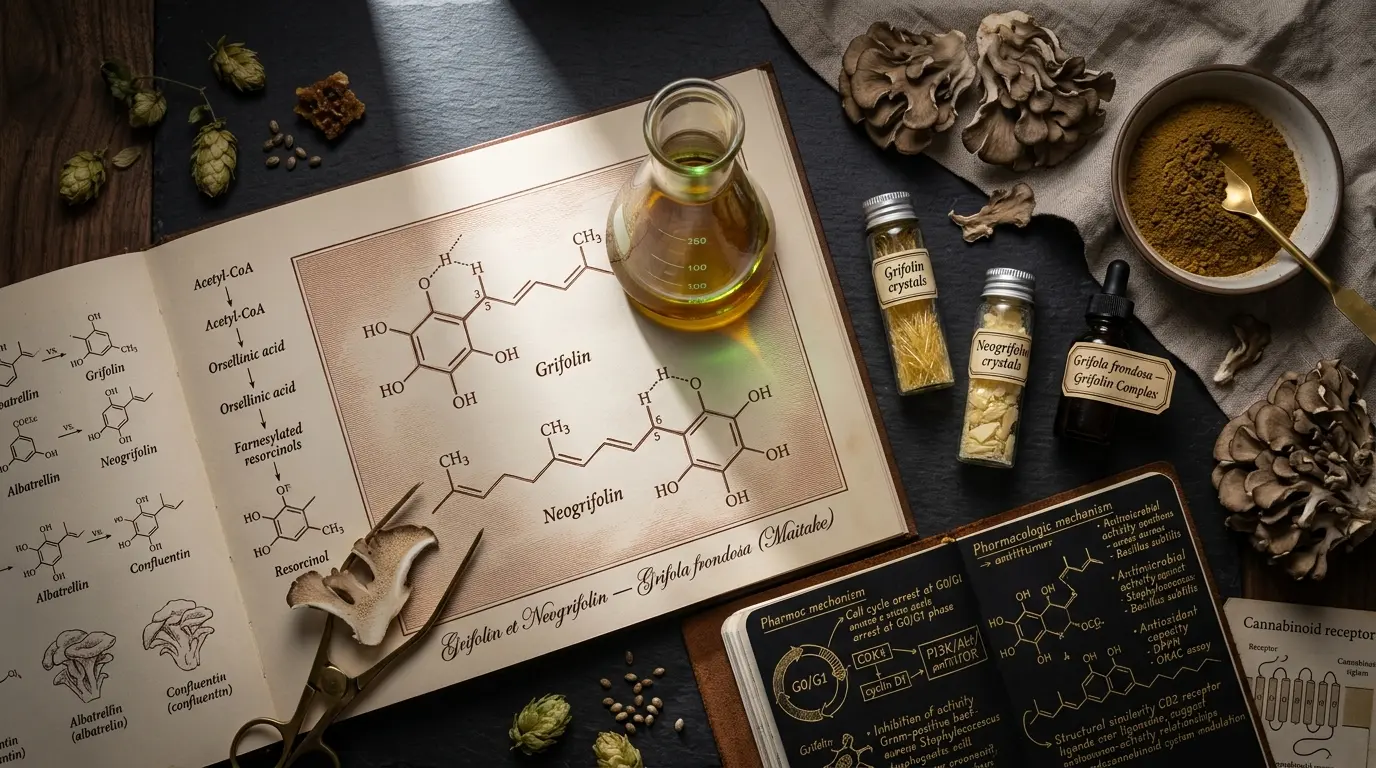
Grifolin is structurally a terpenoid–polyphenol hybrid compound comprising an orcinol (3,5-dihydroxytoluene) ring attached to a farnesene side chain. It is low-molecular-weight and distinctly lipophilic.
Neogrifolin is an isomer of grifolin differing in the geometry of the side chain. Both compounds co-occur in the Maitake fruiting body; their concentrations vary with the harvest period (Mori et al., 2009; PMID: 19473055).
Activity Profile in the Literature
Grifolin has demonstrated apoptosis induction in vitro in tumor cell cultures. The mechanism is interpreted partly through modulation of the ERK1/2 signaling pathway and partly via DAPK1-mediated routes (Luo et al., 2011; PMID: 21532012).
Anti-inflammatory and neuroprotective tendencies have been reported in animal models. The selectivity and tissue distribution of the effects remain poorly characterized, positioning grifolin as a mechanistic research molecule.
Extraction: Absent from Water Extracts
Grifolin is lipophilic; hot-water extraction largely leaves it behind. It concentrates appreciably in ethanol or ethyl acetate extracts.
This brings the “which extract” question to the forefront in Maitake products: a hot-water extract predominantly delivers D-fraction, whereas alcoholic extracts deliver the grifolin/neogrifolin profile. Dual-extraction products aim for both fractions (Nanba et al., 1987; PMID: 2436838).
Practical Standardization
On the Turkish market, the majority of Maitake products are labeled by β-glucan content; grifolin/neogrifolin levels rarely appear on Certificates of Analysis. This complicates practical evaluation of the grifolin literature.
Limitations
Well-designed human intervention studies do not exist for grifolin/neogrifolin. Current evidence rests at the cell-culture and animal-model level. The findings do not justify therapeutic claims; they present a mechanistic research field.
Related Reading
- Vitality: Maitake — Species profile.
- D-Fraction — Polysaccharide profile.
- Dual Extraction — Lipophilic fraction extraction.
This content is for informational purposes only and does not constitute medical advice. Consult your physician before making any health decisions. Functional mushrooms are not drugs and cannot be used to treat diseases.
Version: 1.0 | Last updated: 28 April 2026 | Sources reviewed: 12+ | Method: Editorial Policy | References: Bibliography