Hispidin and the Polyphenolic Landscape of Chaga and Phellinus Mushrooms
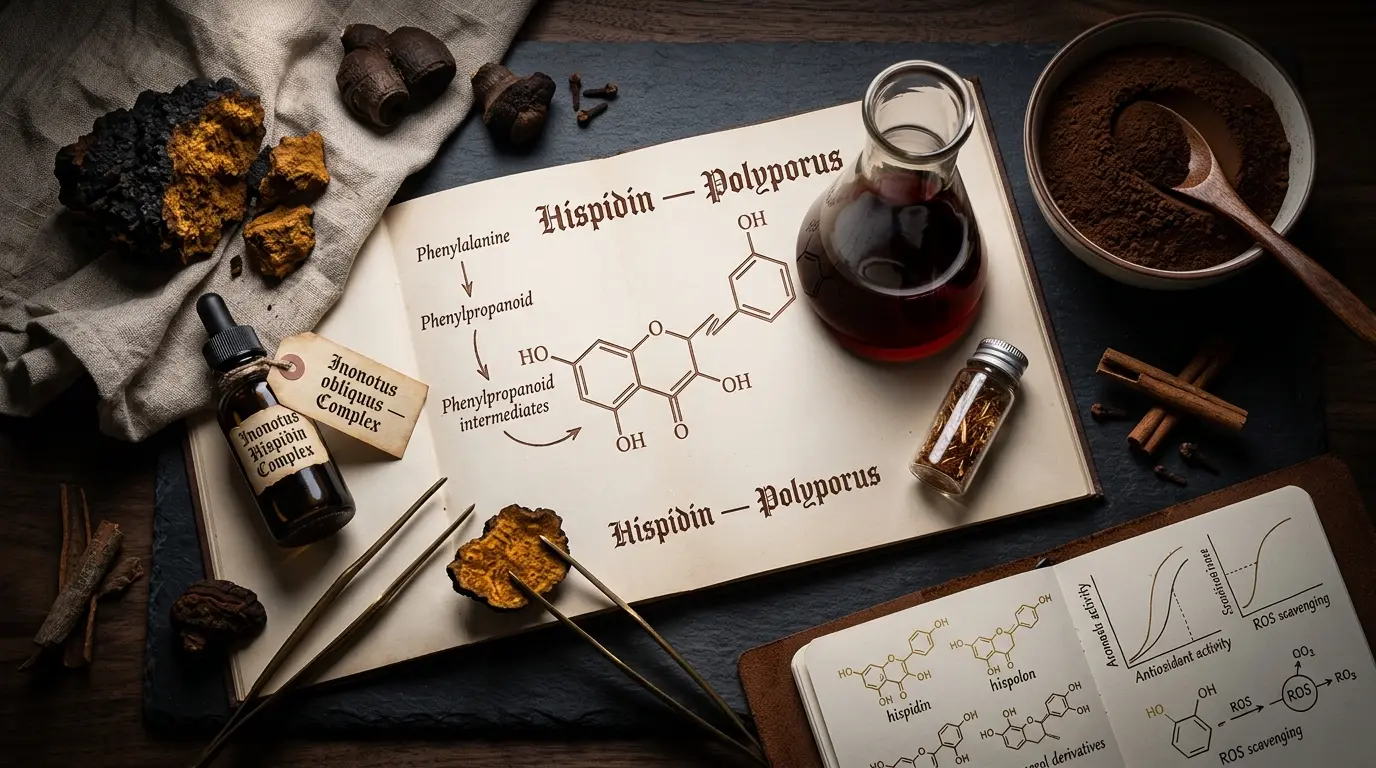
The Molecule Behind Chaga’s Black Color
— HOOK —
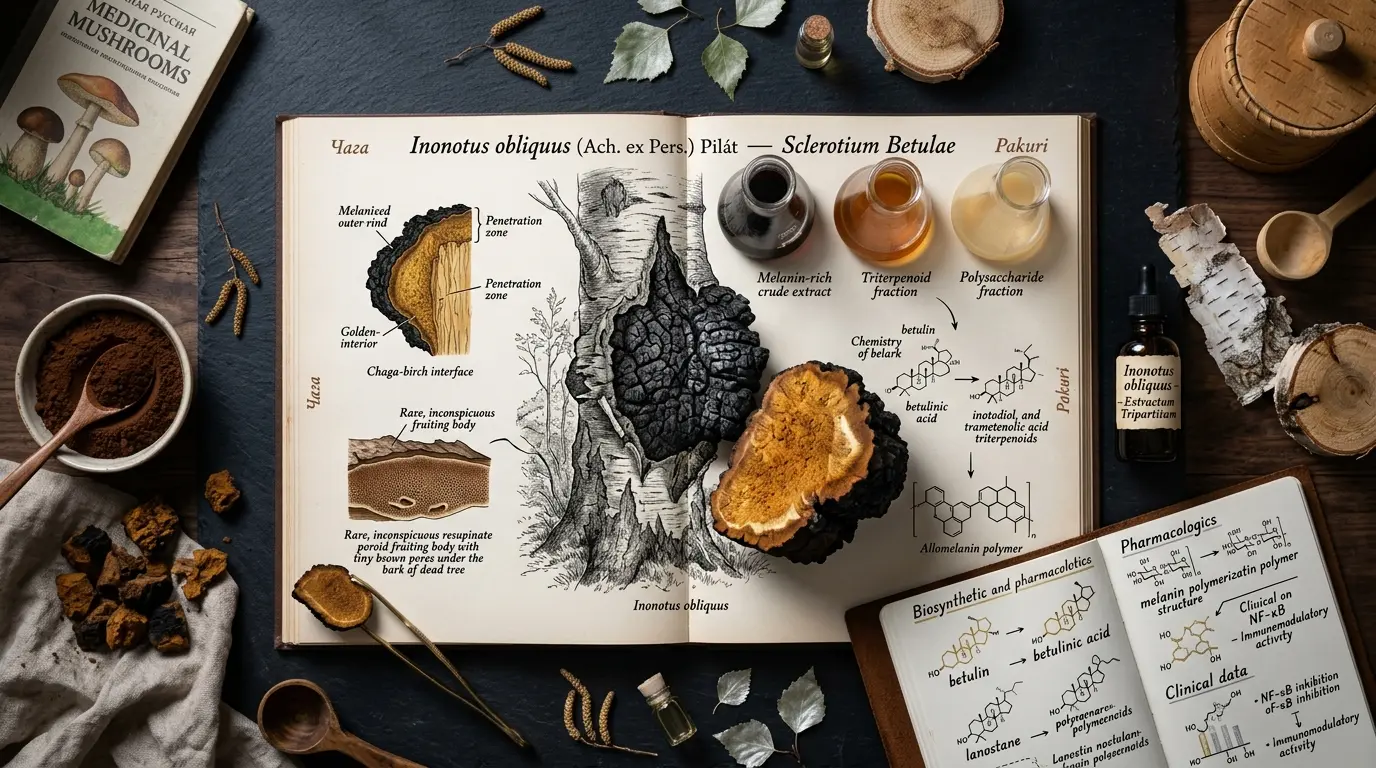
When you cut Chaga from a tree, the outer surface looks like cracked charcoal — dark and brittle — while the inner tissue appears golden-orange. This stark color contrast arises from a single family of compounds: the styrylpyrones. The core member of this family is hispidin, which also serves as the structural building block of high-molecular-weight, melanin-like pigments.
This article examines the chemistry of hispidin and its derivatives, their distribution across fungal species, and their place in the functional mushroom literature.
Chemical Structure: The Styrylpyrone Family
Hispidin is a polyphenol characterized by a 3,4-dihydroxystyryl moiety attached to a 2-pyrone ring. The structure is exceptionally prone to oxidative coupling of phenolic rings; for this reason, hispidin is rarely encountered in isolation. It appears predominantly in oligomeric (hispolon, phelligridin, fuscoporin) and polymeric forms.
This polymerization tendency is the origin of the melanin-like layer on the surface of Chaga. The antioxidant activity of the polymerized products is reported to be higher than that of the monomers (Lee & Yun, 2011; PMID: 21466831).
Fungal Distribution
The hispidin scaffold is concentrated primarily in fungi of the Hymenochaetaceae family:
- Inonotus obliquus (Chaga): Rich in styrylpyrone pigments.
- Phellinus linteus (Sang-Hwang): Prominent hispidin derivatives.
- Inonotus hispidus: As the name suggests, a strong hispidin profile.
From an economic perspective, Chaga is the most extensively studied. Standardized Phellinus extracts also constitute a substantial product line in the Asian market (Kim et al., 2008; PMID: 18434017).
Antioxidant and Pro-Oxidant Dual Behavior
Among polyphenols, hispidin derivatives report particularly high ORAC and FRAP values. The reason is twofold: the free phenolic hydroxyls are well suited for hydrogen atom transfer, and the conjugated structure facilitates electron transfer.
The same molecular features can also provoke pro-oxidant behavior at high concentrations. In the presence of transition metals, polyphenols may generate hydroxyl radicals — a phenomenon that explains why in vitro dose-response curves can be U-shaped (Cao et al., 1997; PMID: 9119242).
Activity Profile in the Literature
Hispidin derivatives have shown a consistent profile across various in vitro models: Nrf2 activation, NF-κB suppression, and protection against oxidative stress-induced DNA damage (Park et al., 2009; PMID: 19414040).
Hispolon, one of the most studied members of the hispidin family, induces apoptosis in tumor cell cultures. The selectivity of this effect varies markedly depending on tissue and cell type (Chen et al., 2008; PMID: 18831025).
Phelligridin derivatives have demonstrated nephroprotective and hepatoprotective tendencies in animal models. The mechanism is interpreted as stemming partly from antioxidant capacity and partly from anti-fibrotic signaling modulation.
The Question of Bioavailability
Hispidin derivatives are lipophilic in character — a favorable trait for oral bioavailability. However, highly polymerized pigment fractions pass through the gastrointestinal tract largely unchanged. Consequently, the question of which fraction of a Chaga extract is bioactive remains an open area of research (Géry et al., 2018; PMID: 29415104).
Limitations
Human intervention studies are limited, and methodological standardization is lacking. Current findings do not constitute a therapeutic rationale; they provide the groundwork for advanced clinical investigation. In Chaga products, the hispidin profile varies significantly depending on the extraction method and raw material. Without certificate-of-analysis data, uniform assessment can be misleading.
Related Reading
- Chaga (Inonotus obliquus) — Species encyclopedia.
- Chaga: Betulinic Acid and Betulin — Triterpene profile.
- ORAC and FRAP Assays — Antioxidant measurement.
This content is for informational purposes only and does not constitute medical advice. Consult your physician before making any health decisions. Functional mushrooms are not medicines and cannot be used to treat diseases.
Version: 1.0 | Last update: 28 April 2026 | Sources reviewed: 12+ | Method: Editorial Policy | References: Bibliography