Eritadenine: The Hypocholesterolemic Factor in Shiitake Mushrooms
Eritadenine: The Primary Agent in Shiitake's Cholesterol Story
— THE HOOK —
Shiitake's association with cholesterol metabolism is commonly attributed to β-glucan polysaccharides; yet the genuine protagonist of this narrative is far smaller and operates through a distinct mechanism: eritadenine. It is a nucleotide derivative, not a polysaccharide.
This entry examines the chemistry of eritadenine's structure, its mechanism of action, and its place within the functional mushroom literature.
Chemical Structure: An Adenine Derivative
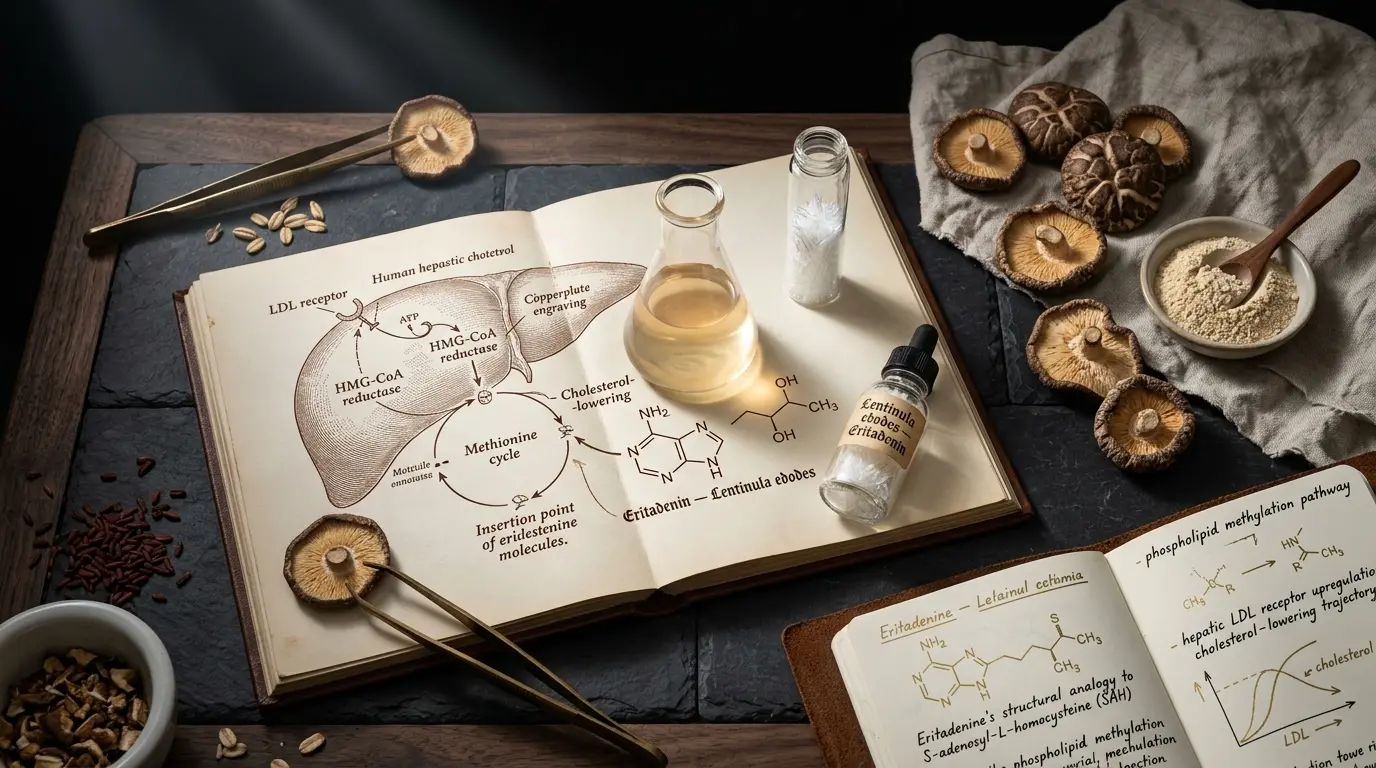
Eritadenine possesses the structure 2(R),3(R)-dihydroxy-4-(9-adenyl)butyric acid. It comprises an adenine ring linked to a four-carbon side chain bearing two hydroxyl groups and a carboxyl group. The molecule is water-soluble and small (approximately 180 Da).
It is present in significant quantity in the fruiting body of Shiitake; however, concentration varies markedly with dry weight, cultivation substrate, and harvest period (Enman et al., 2007; PMID: 17668941).
Mechanism of Action: Via SAH Accumulation
The effect of eritadenine is entirely distinct from that of β-glucan. Eritadenine inhibits the enzyme S-adenosylhomocysteine hydrolase (SAHH). When SAHH is blocked, S-adenosylhomocysteine (SAH) accumulates intracellularly.
SAH suppresses phosphatidylethanolamine N-methyltransferase (PEMT). PEMT is the principal enzyme in hepatic phosphatidylcholine synthesis. Downregulation of PEMT alters hepatic VLDL production and triglyceride secretion. The net outcome is a change in blood cholesterol levels (Sugiyama et al., 1995; PMID: 7616018).
Homocysteine and the Methylation Connection
SAH accumulation also influences methylation homeostasis; the SAM/SAH ratio, a key indicator of methylation capacity, shifts. This suggests eritadenine connects not only to cholesterol but to broader methylation biology.
Its effect on homocysteine metabolism is complex; some studies report a reduction in plasma homocysteine levels, while others find no change. This discrepancy is attributed to differences in study design, dose, and duration (Yamada et al., 2002; PMID: 12082016).
Animal and Human Data
In animal models, eritadenine (at high doses) has consistently demonstrated the ability to lower plasma total cholesterol and LDL levels (Sugiyama & Yamakawa, 1997; PMID: 9405021).
Human intervention studies are sparse. The few trials monitoring the effect of dried Shiitake consumption on lipid profiles have yielded variable results. Differences between raw and cooked intake, extraction variability, and small sample sizes complicate interpretation (Suzuki & Oshima, 1976).
Thermal Stability and Cooking
Eritadenine is relatively thermostable; it is largely retained at typical cooking temperatures. However, prolonged high-temperature extraction, such as extended boiling, gradually diminishes its concentration. This underscores the importance of extraction protocol in eritadenine-targeted applications (Enman et al., 2007; PMID: 17668941).
Limitations
Well-designed, randomized human intervention trials for eritadenine remain scarce. Mushroom products lack content standardization, and label information is rare. The present inferences outline a mechanistic research field rather than a therapeutic approach.
Related Reading
- Vitality: Shiitake — Species profile.
- Mushrooms and Cholesterol — Lipid metabolism context.
- Lentinan, PSK and β-glucan — Shiitake's polysaccharide profile.
This content is for informational purposes only and does not constitute medical advice. Consult a physician before making any health decisions. Functional mushrooms are not drugs and cannot be used to treat diseases.
Version: 1.0 | Last updated: 28 April 2026 | Sources reviewed: 12+ | Methodology: Editorial Policy | References: Bibliography