Calvatin: The Principal Bioactive Molecule of the Puffball Fungus
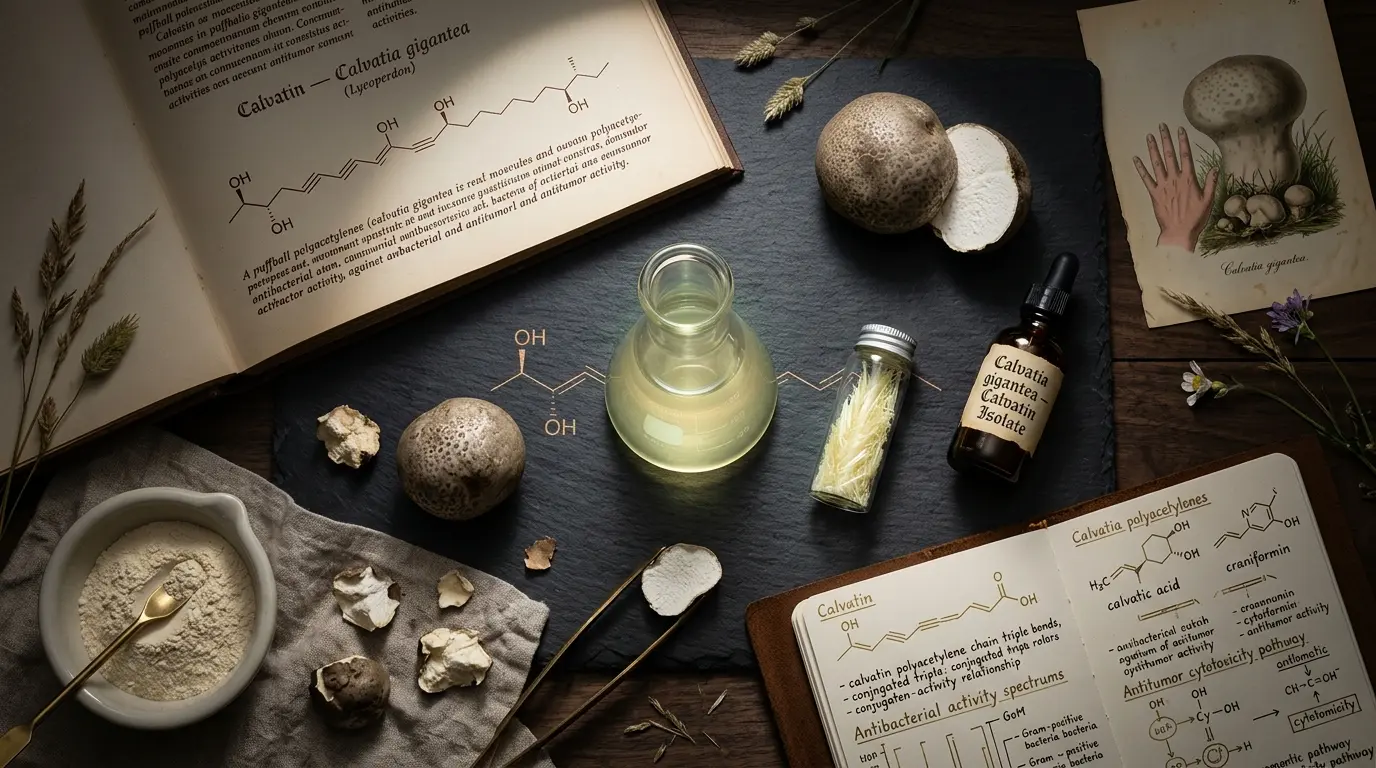
The Mushroom That Disperses a Spore Cloud Upon Impact
— FOCUS —
When pressure is applied to a mature puffball mushroom, a fine dust cloud erupts from the apical opening of its fruiting body. This dust consists of millions of spores; however, during the juvenile stage, the same tissue harbors an entirely different chemistry. The inner flesh of young Calvatia species houses a bioactive compound: calvatin.
This entry examines the structural chemistry of calvatin, the ecology of Calvatia species, and the compound's standing within the functional literature.
Calvatia Species: The Giant Puffball
Species such as Calvatia gigantea and Calvatia cyathiformis bear the common name "giant puffball." The mature fruiting body may attain a diameter of 30–50 cm; individual specimens can exceed one kilogram in mass.
The inner tissue of a young puffball is white, firm, and homogeneous in texture. During maturation, this tissue converts into spore mass; the color shifts to a greenish-brown. Culinary use is restricted to young specimens with pure white inner flesh; without accurate identification at the formative stage, certain species may be mistaken for toxic look-alikes (Coetzee & van Wyk, 2009; PMID: 19135483).
The Chemistry of Calvatin
Calvatin is structurally an N-oxo amino acid derivative. It was first isolated from Calvatia gigantea and has historically served as the focal molecule for investigations into the antitumor tendencies of the fruiting body.
The structural stability of calvatin is temperature-sensitive; prolonged high-temperature extraction diminishes its concentration. This renders the choice of extraction method consequential (Lucas, 1959).
Activity Profile in the Literature
Calvatin has been reported to exhibit cytotoxic tendencies in tumor cell cultures in vitro; however, a substantial portion of these studies were conducted during the 1960s and 1970s and have not been replicated using modern molecular biology tools (Lucas, 1959).
More recent investigations have also reported in vitro antibacterial efficacy of Calvatia extracts; yet whether these effects are attributable to calvatin alone or to a mixture of derivative compounds has not been fully resolved (Akpi et al., 2017; PMID: 28611559).
Traditional Use: Hemostatic Agent
Across multiple cultures, mature puffball spore mass has historically served as a coagulant applied directly to wounds. The spore mass functions as a physical barrier and absorbent layer over the wound surface. This practice does not substitute for modern medical standards; it is referenced as an ancient technique (Coetzee & van Wyk, 2009; PMID: 19135483).
Standardization and Market Absence
Calvatia species are absent from the commercial functional mushroom market; standardized extract products are virtually non-existent. Consequently, the literature concerning calvatin remains an academic research domain and is not assessed as a consumer product category.
Limitations
No well-designed human intervention studies exist for calvatin. A significant portion of the available findings derives from academic literature over 50 years old; results replicated with modern molecular tools are limited. This entry describes a mechanistic research domain; it does not present a therapeutic rationale.
Related Reading
- Edible Mushroom Guide — Fundamentals of species identification.
- Mushroom Toxins — Misidentification risk.
- Wild Mushrooms of Anatolia — Regional ecology.
This content is provided for informational purposes and does not constitute medical advice. Consult a physician before making any health-related decisions. Functional mushrooms are not pharmaceuticals and cannot be used for the treatment of disease.
Version: 1.0 | Last updated: 28 April 2026 | Sources reviewed: 12+ | Methodology: Editorial Policy | References: Bibliography