The Neurochemistry of Fly Agaric: Ibotenic Acid and Muscimol
The Two-Faced Molecule of the Fly Agaric
— OVERVIEW —
The crimson cap and white flecks of Amanita muscaria evoke a "fairy-tale mushroom" aesthetic, yet this species harbors serious toxicity. The toxin chemistry comprises not a single compound but a dual profile: ibotenic acid and its decarboxylation product, muscimol.
This article examines ibotenic acid–muscimol chemistry and pharmacological properties solely within the framework of the chemistry and toxicology literature. Amanita muscaria is toxic; this article contains no information regarding consumption, preparation, or procurement.
Amanita muscaria: A Toxic Species
Amanita muscaria is a widely distributed mycorrhizal fungus found across Europe, Asia, and North America. It is clinically toxic; ingestion can produce nausea, vomiting, ataxia, hallucinations, and, in rare cases, seizure presentations.
Amanita muscaria does not appear in the MYCOVITA value chain. This article conveys publicly available toxicology and phytochemistry literature for intellectual purposes (Michelot & Melendez-Howell, 2003; PMID: 12624005).
Two Toxins, One Transformation
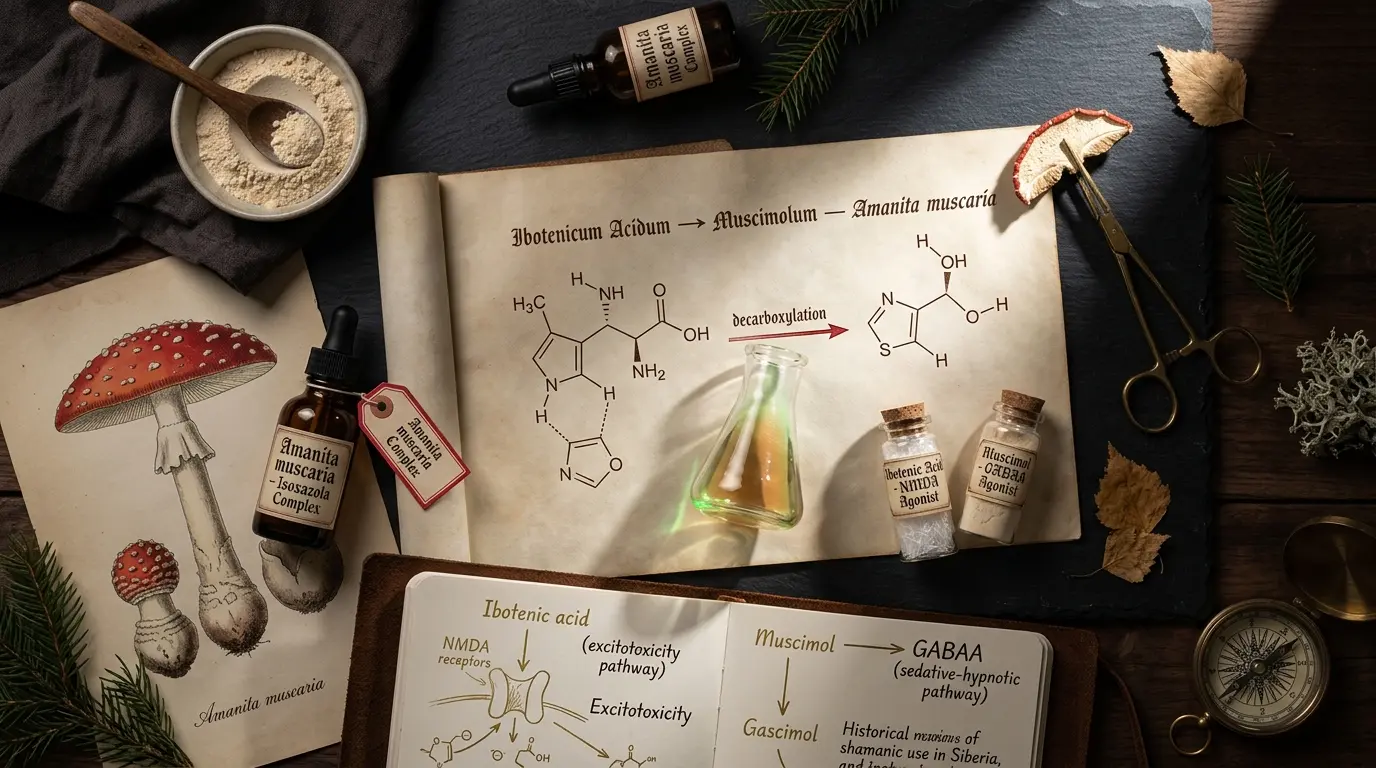
The dominant toxin in the cap is ibotenic acid, a glutamate analog and isoxazole-derived amino acid. When the mushroom is dried or heated, ibotenic acid undergoes gradual decarboxylation; the product is muscimol. Muscimol is approximately five times more potent as a neurotoxin than ibotenic acid (Eugster et al., 1965).
This transformation explains why fresh and dried material exhibit markedly different toxicity profiles; when the two compounds coexist, predicting toxicity becomes challenging.
Receptor Profile: Glutamate and GABA
Ibotenic acid acts as a glutamate NMDA receptor agonist, producing excitotoxic effects. Muscimol, by contrast, is a GABAA receptor agonist, exerting inhibitory influence on the central nervous system.
The co-occurrence of these two compounds within the same material accounts for the complexity of the clinical presentation: excessive excitation (excitotoxic) and excessive suppression (sedation) signals operate simultaneously. For this reason, Amanita muscaria poisoning manifests as neither a pure "sedation" syndrome nor a pure "excitation" syndrome (Krogsgaard-Larsen et al., 2002; PMID: 12106002).
The Muscarine Misconception
Historically, the species name Amanita muscaria led to the assumption that it contained the muscarine alkaloid; modern analysis has demonstrated that actual muscarine concentrations are exceedingly low and do not account for the clinical picture. The species' toxicity is explained by the ibotenic acid–muscimol combination (Eugster, 1968).
Extraction and Concentration Variability
Ibotenic acid and muscimol concentrations vary markedly according to the age of the fruiting body, geographic origin, and degree of desiccation. This chemical variability constitutes a structural feature of the species that renders it resistant to standardization in both experimental research and toxicology.
The Modern Research Framework
Muscimol serves as an experimental tool in neuroscience laboratories as a GABAA agonist; it features prominently as a probe compound for investigating signaling pathways in epilepsy, pain, and movement disorder models. This application falls strictly within the domain of experimental pharmacology, not clinical practice (Johnston, 1996; PMID: 8941935).
Limitations
This article constitutes toxicology and neurochemistry literature exclusively. Amanita muscaria is a toxic species, and its consumption is hazardous. The article contains no information whatsoever regarding methods of consumption, preparation, or procurement; it does not constitute medical advice.
Related Reading
- Mushroom Toxins: Amatoxin and Orellanine — Classical toxicology.
- Mycophobia — The cultural impact of toxic species.
- Siberian Shamanism and Fly Agaric — Ethnomycological context.
This content is for informational purposes only and does not constitute medical advice. Consult your physician before making any health-related decisions. Functional mushrooms are not pharmaceuticals and cannot be used to treat diseases.
Version: 1.0 | Last updated: 28 April 2026 | Sources reviewed: 12+ | Methodology: Editorial Policy | References: Bibliography