Turkey Tail (Trametes versicolor): The Definitive Species Guide
— THE HOOK —
The body endures constant exposure. Stress, atmospheric shifts, fatigue. Your defense line operates — but it no longer responds with its former agility. Recovery stretches longer.
Within the world of functional mushrooms, one species alone possesses the most extensive clinical literature.
Very few in Turkey know its name. Japan has produced it through a pharmaceutical company for forty years.
— THE STORY —
- Japan. A researcher from the Kureha Chemical Company noted the unexpected recovery of a factory worker diagnosed with late-stage gastric cancer. The worker's sole distinguishing habit was a mushroom tea he drank regularly.
That mushroom was Trametes versicolor. Turkey Tail.
This single observation ignited decades of research. In 1977, Japan's Ministry of Health approved PSK — Polysaccharide-K, commercially named Krestin — a compound isolated from that mushroom, as an official cancer adjuvant. It marked the first instance in medical mycology history of a mushroom-derived compound attaining this status.
Today, PSK remains in standard protocol use in Japan following surgery for gastric, lung, and colorectal cancers.
This is not a treatment claim. PSK is a pharmaceutical substance isolated from the mushroom and processed through clinical pathways. MYCOVITA Turkey Tail, by contrast, is a food. But stating the following is accurate: No functional mushroom species possesses a research history as broad as Turkey Tail.
In China, records from 200 AD onward document it as Yun Zhi — 云芝, the Cloud Mushroom. Ming Dynasty texts transformed this species into a tonic that regulates Qi flow and fortifies the liver. In Japan, it is known as the riverbank mushroom — Kawaratake. Inhabiting decayed oak stumps on every continent, this species is the most widespread functional mushroom on Earth.
— DEFINITION AND MORPHOLOGY —
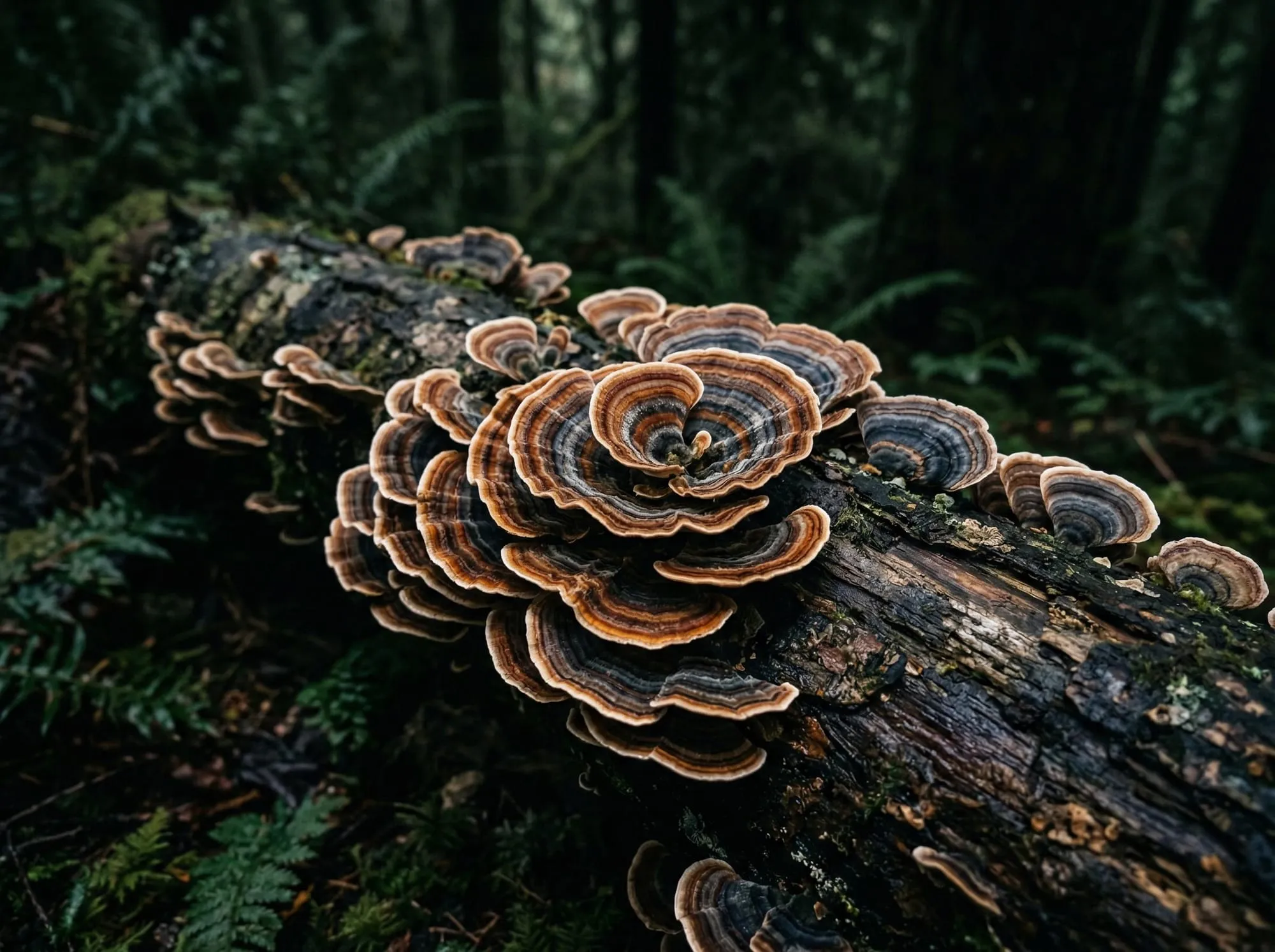
Trametes versicolor (L.) Lloyd — a member of the Polyporaceae family, stands among the most widespread and intensely researched medicinal mushroom species in the world. The genus name Trametes derives from Latin meaning "thin." Versicolor means "of many colors" — a direct reference to the distinctly zoned color bands of its cap.
Cap diameter ranges 3–10 cm, thickness merely 1–3 mm. The surface is velvety in texture, matte. Color bands shift depending on growth phase: dark brown, orange-red, beige, gray, even blue-green — all coexisting on a single fruiting body. This chromatic diversity is not accidental; it serves as a visual indicator of secondary metabolite richness. A colorless or monotone Turkey Tail signals biochemically weak production conditions.
MYCOVITA cultivates this species at its production center in Ordu on an oak sawdust-based substrate.
— BIOACTIVE COMPOUNDS —
PSK — Polysaccharide-K (Krestin) The most comprehensively studied compound in Turkey Tail. Approved and actively used in pharmaceutical form in Japan. It stimulates dendritic cell maturation via Toll-like receptors and enhances NK cell activity and cytokine production.
Reference: Tsukagoshi, S. et al. (1984). Krestin (PSK). Cancer Treatment Reviews, 11(2), 131-155.
PSP — Polysaccharide-Peptide Isolated by Chinese researchers in 1983, PSP shares structural similarities with PSK yet presents a distinct fractional profile.
Reference: Yang, Q.Y. & Kwok, C.Y. (1992). PSP from Coriolus versicolor. Journal of Immunology.
Beta-Glucan 15–25% The polysaccharide fraction referenced in immune modulation research.
Quercetin and Phenolic Compounds A flavonoid group notable for potent antioxidant activity.
Reference: Janjušević, L. et al. (2017). Trametes versicolor as source of antiradical agents. Journal of Fungi, 3(3), 45.
Critical Note: PSK and PSP extraction demands extended steeping. If duration falls below 8 minutes, a significant portion of these fractions remains insoluble.
— CURRENT RESEARCH —
Oncology — Clinical Studies Multi-center randomized controlled trials conducted in Japan have reported positive survival effects from PSK adjuvant therapy following colorectal and gastric cancer surgery.
Reference: Ohwada, S. et al. (2004). Adjuvant immunochemotherapy with PSK in colorectal cancer. British Journal of Cancer, 90(5), 1003-1010.
Breast Cancer — United States A Phase 1 clinical trial conducted at the University of Oregon reported increased NK cell activity and a favorable safety profile.
Reference: Torkelson, C.J. et al. (2012). Phase 1 Clinical Trial of Trametes versicolor in Women with Breast Cancer. ISRN Oncology.
Gut Microbiome Clinical findings indicate that T. versicolor intake increases Bifidobacterium and Lactobacillus populations.
Reference: Pallav, K. et al. (2014). Effects of polysaccharopeptide from Trametes versicolor on gut microbiome. Gut Microbes, 5(4), 458-467.
— MYCOVITA —
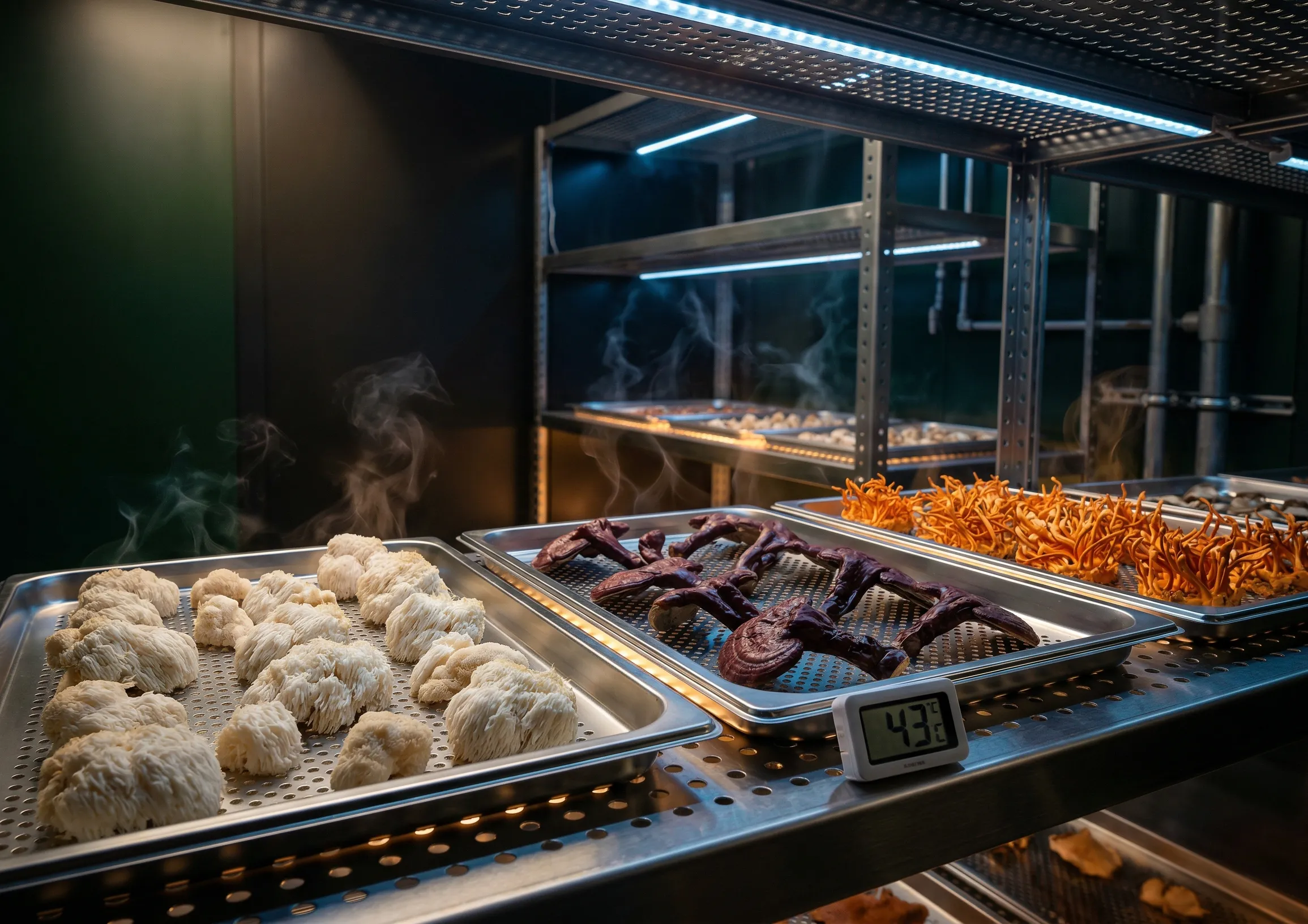
MYCOVITA cultivates in Room 1 on oak sawdust substrate at 20–21°C and 85–90% humidity. Harvest occurs before sporulation — the point at which PSK and PSP reach peak concentration.
Drying at 45°C — polysaccharide structures retain integrity up to this threshold. 100% fruiting body. Holland-certified strain. Every batch documented with a Certificate of Analysis.
— HOW TO USE —
Turkey Tail demands extended steeping. Patience constitutes this species' protocol.
Classic Tea — Foundational Protocol 1–1.5 g / 250 ml · 85–90°C · 10–12 minutes · Strain Target a deep amber color. A pale brew = incomplete PSK extraction.
Strong Decoction — Maximum PSK 2 g / 300 ml · 90°C · 15–18 minutes The highest polysaccharide yield. A dense earthy and dry-hay finish.
Yunzhi Green Tea (Asian tradition) 1 g Turkey Tail + 1 teaspoon Sencha or Gyokuro · 80°C · 8 minutes The traditional pairing of Turkey Tail and green tea. Two umami sources balancing one another.
Winter Immune Tea 0.75 g Turkey Tail + 0.75 g Sparassis · 85°C · 10 minutes Two distinct beta-glucan fractions. The standard protocol for winter months.
Mushroom Dashi (culinary use) Boil 3–4 g Turkey Tail in 500 ml water for 20 minutes. Strain. Use as a soup, risotto, or sauce base. PSK is water-soluble — never discard this liquid.
Winter Protocol Daily 1.5–2 g from November through March, with consistent adherence. Research has based its findings on cumulative use.
Flavor profile: A mildly sweet opening, followed by a dry-hay and earthy finish. Compatible with all teas, it ranks among the most neutral-tasting species.
Related reading: What Is PSK? · How Does the Immune System Work? · Combined Use Protocols
On MYCOVITA's production philosophy, technical infrastructure, and transparency principles: Why MYCOVITA?
Trametes versicolor is classified as a food under the Turkish Food Codex. The scientific research presented on this page is compiled from the academic literature and serves informational purposes. The PSK preparation approved for clinical use in Japan is a pharmaceutical product distinct from MYCOVITA products.
MYCOVITA's Trametes versicolor products are food products. They carry no claim to treat, prevent, or cure any disease. Individuals undergoing chemotherapy or immunosuppressive therapy must consult their physician.
— SCIENTIFIC REFERENCES —
Tsukagoshi, S. et al. (1984). Krestin (PSK). Cancer Treatment Reviews, 11(2), 131-155. Ohwada, S. et al. (2004). Adjuvant immunochemotherapy with PSK in colorectal cancer. British Journal of Cancer, 90(5), 1003-1010. Torkelson, C.J. et al. (2012). Phase 1 Clinical Trial of Trametes versicolor in Women with Breast Cancer. ISRN Oncology. Pallav, K. et al. (2014). Effects of polysaccharopeptide from Trametes versicolor on gut microbiome. Gut Microbes, 5(4), 458-467. Janjušević, L. et al. (2017). Trametes versicolor as source of antiradical agents. Journal of Fungi, 3(3), 45. Yang, Q.Y. & Kwok, C.Y. (1992). PSP from Coriolus versicolor. Journal of Immunology. Collins, R.A. & Ng, T.B. (1997). Polysaccharopeptide from Coriolus versicolor in anti-HIV activity. Life Sciences, 60(25), 383-387.
Corporate & B2B: Restaurants, hotels, wellness centers, and bulk supply inquiries: [email protected].
You May Also Find Interesting
→ Travel Protocol — How Do I Use It While Traveling?
This content is for informational purposes and does not constitute medical advice. Consult your physician before making any health-related decisions. Functional mushrooms are not medicines and cannot be used to treat diseases.
Version: 1.0 | Last updated: 20 Apr 2026 | Sources reviewed: 10+ | Method: Editorial Policy | References: Bibliography