Tremella vs. Hyaluronic Acid: Comparing Their Moisture Retention Power
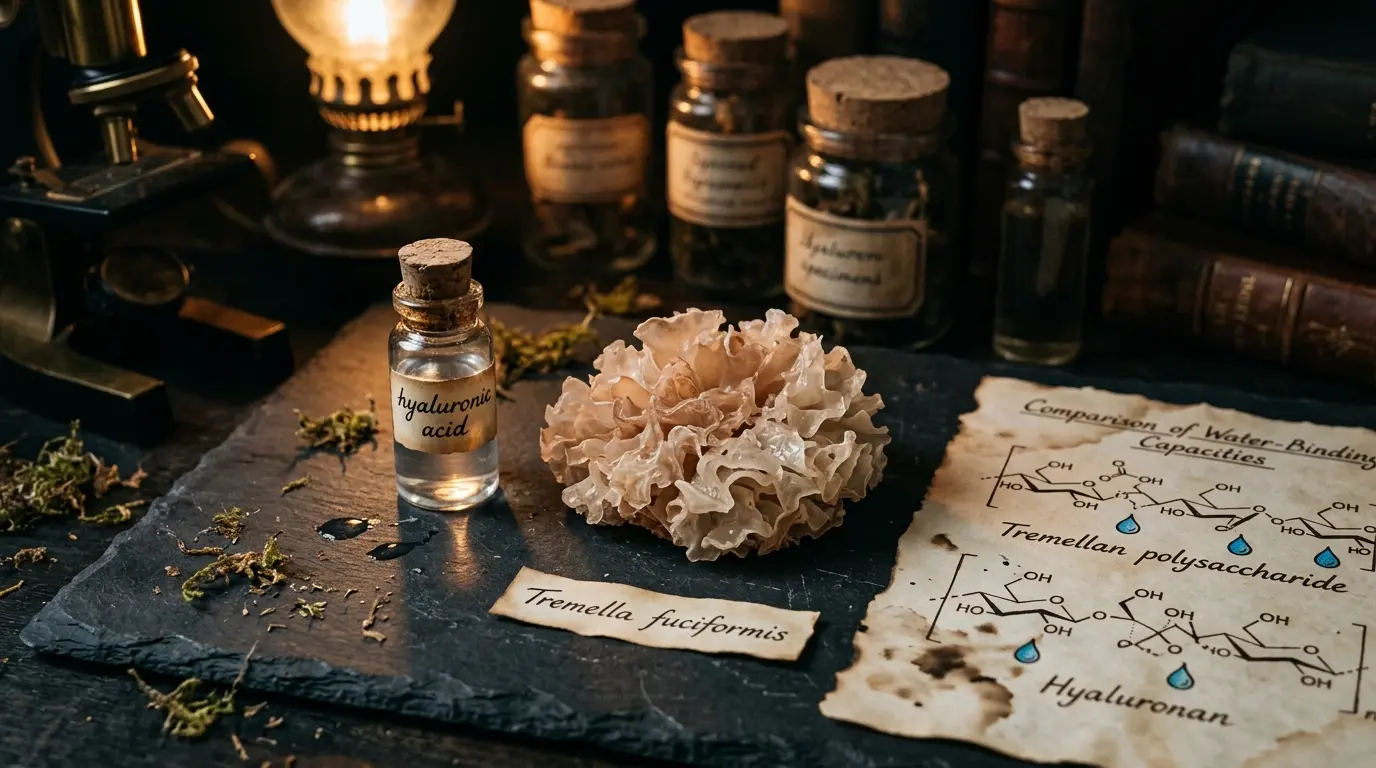
Two Different Polymers Performing the Same Function
— HOOK —
In the world of cosmetic formulation, when the phrase “high molecular weight, high water-binding polymer” is spoken, the first molecule that comes to mind is hyaluronic acid (HA). This is a glycosaminoglycan of animal origin (traditionally obtained from rooster combs, and through fermentation in modern practice). It occurs naturally in the skin, synovial fluid, and the vitreous humor of the eye.
Yet HA is not the only polymer that performs this job. The polysaccharide derived from the Tremella mushroom (commonly called tremellan) exhibits a profile that is structurally different from HA but functionally parallel. It binds water, forms viscous solutions, and possesses high molecular weight. In this article we place the two polymers side by side and examine their structural and applicational differences.
Chemical Structure
Hyaluronic acid: A glycosaminoglycan.
- Disaccharide repeat unit: D-glucuronic acid + N-acetylglucosamine.
- A long, linear backbone with alternating β-(1→4) and β-(1→3) glycosidic bonds.
- No side branches; entirely linear polymer.
- Natural molecular weight ranges from 500 kDa to 6,000 kDa.
- Anionic (negatively charged) character due to glucuronic acid groups.
Tremella polysaccharide (tremellan): An acidic heteropolysaccharide.
- An α-(1→3)-linked mannose backbone.
- Side branches contain xylose and glucuronic acid units.
- Structurally belongs to the glucuronoxylomannan (GXM) family.
- Natural molecular weight in the range of 200 kDa to 2,000 kDa.
- Anionic character conferred by glucuronic acid side groups.
The two polymers possess different backbones; they are not structural relatives. Their shared attributes are high molecular weight, anionic character, and — owing to their hydrophilic architecture — a high water-holding capacity.
Mechanism of Water Retention
Both polymers retain water through the same fundamental mechanism:
- Negatively charged groups (glucuronic acid) interact with the oxygen-hydrogen polarization of water molecules.
- High molecular weight allows the polymer chain to span a large area, making it possible to trap numerous water molecules within the intermolecular space.
- An open, branched (Tremella) or open, linear (HA) structure gives the polymer network the volume needed to immobilize water.
This mechanism is the physical basis for the claim that both polymers can bind “hundreds of times their own weight in water.” In practice, this capacity varies depending on formulation conditions and the method of measurement.
Source and Production
- Hyaluronic acid: Modern production relies predominantly on fermentation using Streptococcus equi or similar strains. Historically it was extracted from rooster combs; because of its animal origin, this method has been largely replaced by fermentation-derived HA in contemporary formulations.
- Tremella polysaccharide: Obtained by hot-water extraction of the fruiting body of Tremella fuciformis. Purification is carried out through ethanol precipitation and dialysis. It is vegan and mushroom-sourced; it contains no animal-derived components.
This difference in source is an influential parameter in cosmetic formulation decisions. In products carrying a vegan label, Tremella polysaccharide is evaluated as a natural alternative to HA.
Formulation Behavior
- Viscosity: Both high-molecular-weight polymers impart noticeable viscosity even at low concentrations. Tremella may exhibit a more complex rheological profile due to its broader molecular weight distribution.
- pH stability: Both polymers are stable in the moderate pH range (5–8). The rate of hydrolysis increases at low pH.
- Thermal stability: High temperature leads to chain scission in both polymers. Prolonged heating above 60°C reduces molecular weight.
- Behavior on the skin surface: Both form a film and display humectant film properties. The film characteristics of Tremella vary with formulation conditions.
A practical formulation distinction: HA is an exceedingly standardized raw material in the cosmetic industry. Tremella polysaccharide has not yet been standardized to a comparable degree; its molecular weight distribution can vary from supplier to supplier.
Literature Context
The two polymers occupy different positions in the literature:
- HA has an extensive body of clinical-use literature; it is a standard raw material in both cosmetic and medical (e.g., intra-articular injection) contexts.
- Literature on Tremella polysaccharide is predominantly at the level of in vitro studies and animal models. In the context of skin moisturization, comparative studies involve small sample sizes and are methodologically heterogeneous.
The statement “Tremella is an alternative to HA” is structurally inaccurate; the two molecules have different backbones. A functional parallelism does exist, but the decision to substitute one for the other depends on the direction of the formulation decision (vegan source, cost, sustainability, formulation compatibility).
Related Readings
- Tremella Fuciformis Species Encyclopedia — The biological and chemical profile of the species.
- What Is Beta-Glucan — Fundamental classification of mushroom polysaccharides.
- Mushroom Ingredients in Cosmetics — Industry trends and formulation context.
This content is for informational purposes only and does not constitute medical advice. Consult your physician before making any health-related decisions. Functional mushrooms are not drugs and cannot be used to treat diseases.
Version: 1.0 | Last updated: April 27, 2026 | Number of sources reviewed: 16+ | Method: Editorial Policy | References: Bibliography