Shiitake versus Turkey Tail: A Comparative Analysis of Polysaccharide Profiles
Two β-Glucans, Two Distinct Clinical Histories
— HOOK —
In the literature of mushroom polysaccharides, two names stand out as unparalleled: lentinan from Shiitake and the PSK/PSP complex from Turkey Tail. Both belong to the β-glucan family; both have a history of clinical use in specific indications with medical approval in Asia. This is a remarkably rare situation among mushroom polysaccharides.
In Turkey, this clinical approval structure does not apply; Shiitake and Turkey Tail extracts are classified as food supplements. Nevertheless, the structural chemistry and in vitro literature profiles of the two polysaccharides warrant comparison, because beneath the statement “contains β-glucan” lie two very different molecules. This article examines structure, production, and comparative context.
Lentinan: Structure
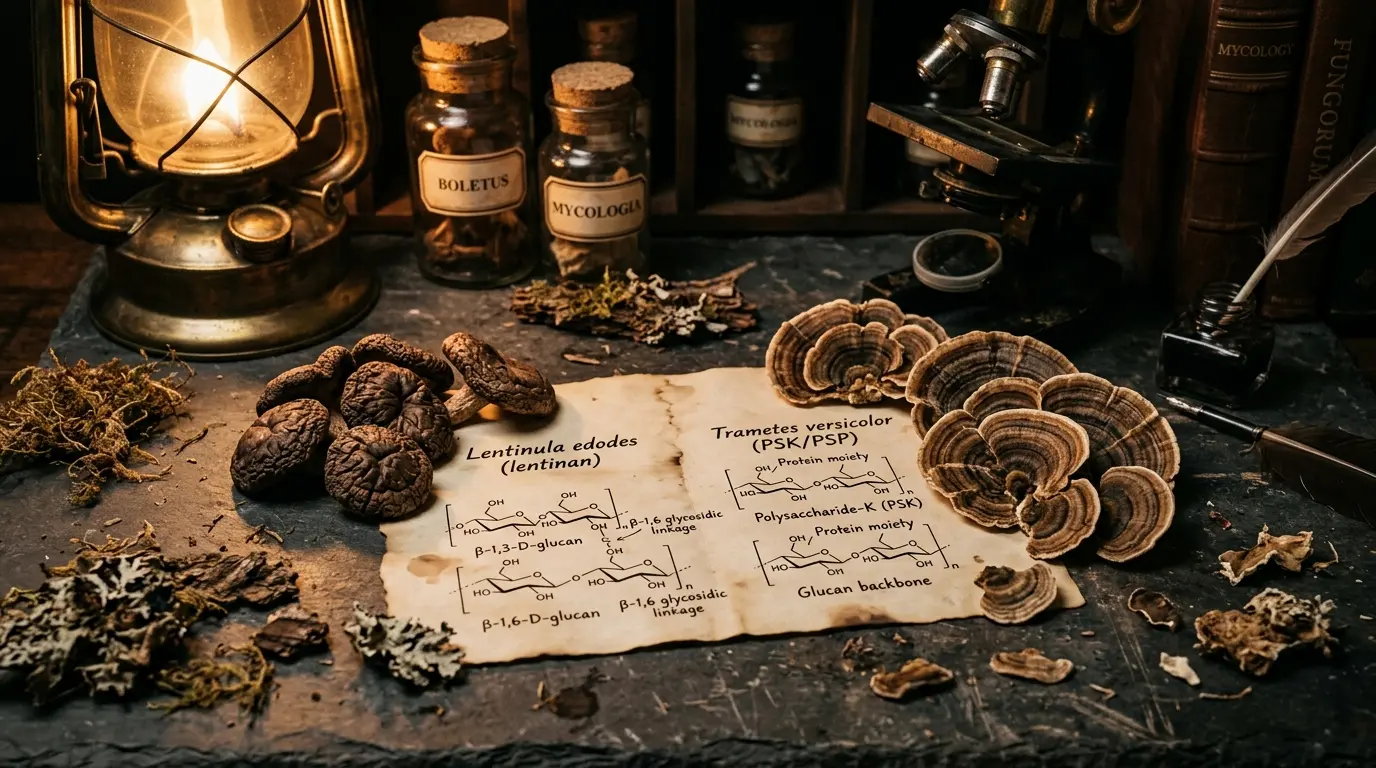
Lentinan is the characteristic polysaccharide of Lentinula edodes. Its structural characteristics:
- β-(1→3) glucan backbone.
- Two out of every five backbone units carry β-(1→6) side branches.
- Contains no protein; it is a homopolysaccharide.
- Molecular weight ~500–1000 kDa.
- Triple‑helix conformation in aqueous solution.
This structure makes lentinan one of the most structurally well‑defined molecules in the mushroom β‑glucan literature. The triple helix dissociates above 130 °C or under alkaline conditions, making extraction and production conditions decisive for the functional profile.
PSK and PSP: Structure
PSK (Polysaccharide‑K) and PSP (Polysaccharide‑Peptide) are protein‑bound polysaccharide complexes derived from Trametes versicolor (formerly Coriolus versicolor) mycelium. The greatest structural difference from lentinan is that they contain a protein component:
- β-(1→3) glucan backbone with β-(1→6) side branches.
- Polysaccharide chains covalently attached to protein.
- Protein content between 25% and 38%.
- Molecular weight ~100–200 kDa (lower than lentinan).
- Typically do not form a triple helix; they exhibit a protein‑bound, more linear profile.
Differences between PSK and PSP:
- PSK: Of Japanese origin; produced from strain CM‑101.
- PSP: Of Chinese origin; produced from strain COV‑1.
The two preparations are structurally close relatives but are not identical; differences exist between production strains and protocols.
Structural Comparison
The two polysaccharide categories are categorically different:
- Lentinan = pure β‑glucan. Triple helix, high molecular weight, no protein.
- PSK/PSP = protein‑bound β‑glucan. Linear, medium molecular weight, >25% protein.
This structural distinction alters the in vitro cell interaction profile. Lentinan is structurally closer to schizophyllan (both are triple helices). PSK/PSP share structural similarity with other proteoglycan complexes of mushroom origin, such as Maitake’s D‑Fraction.
Production Profile
- Lentinan: Generally obtained from Shiitake fruiting bodies by hot‑water extraction. Clinically used forms are of high purity.
- PSK/PSP: Derived from liquid mycelial culture of Trametes versicolor. Production is Asia‑centric; CM‑101 and COV‑1 are licensed production strains.
Shiitake and Turkey Tail extracts on the Turkish market do not contain pharmaceutical‑grade standardized lentinan or PSK/PSP; they are food‑supplement grade. They are sold by total β‑glucan or total polysaccharide percentage.
In Vitro Literature
The literature on both polysaccharides is extensive:
- Lentinan: Studied since the 1970s. Immune cell culture, triple‑helix structure‑activity relationships, and Dectin‑1 receptor interaction are the primary research themes.
- PSK/PSP: Studied since the 1980s. The role of the protein component in receptor recognition and immune cell culture studies are the main themes.
Both polysaccharides have a history of approval in specific clinical indications in Japan and/or China. This is a rare circumstance in the modern mushroom polysaccharide literature and places both compounds in the category of “clinically studied β‑glucans.” In Turkey, this clinical category is not applied; Shiitake and Turkey Tail extracts are considered food supplements.
Quality and Label Notes
- Shiitake extracts: The statement “Total β‑glucan X%” does not directly indicate the lentinan quantity. Specific lentinan analysis is preferred when available.
- Turkey Tail extracts: Standard market Trametes extracts do not carry PSK/PSP standardization. “Total polysaccharide X%” plus protein content best describe the extract’s profile.
- Species‑name clarity: Turkey Tail must be referred to by its modern name, Trametes versicolor; the term “Coriolus” is obsolete.
Related Readings
- What Is Lentinan — The characteristic β‑glucan of Shiitake.
- Lentinan vs PSK vs β‑Glucan — A structural comparison of mushroom β‑glucans.
- What Is Beta‑Glucan — Structural classification of mushroom β‑glucans.
This content is for informational purposes only and does not constitute medical advice. Consult your physician before making any health decisions. Functional mushrooms are not drugs and cannot be used to treat diseases.
Version: 1.0 | Last updated: 27 April 2026 | Sources reviewed: 22+ | Method: Editorial Policy | References: Bibliography