Maitake versus Reishi: A Comparative Analysis of Beta-Glucan and Triterpene Profiles
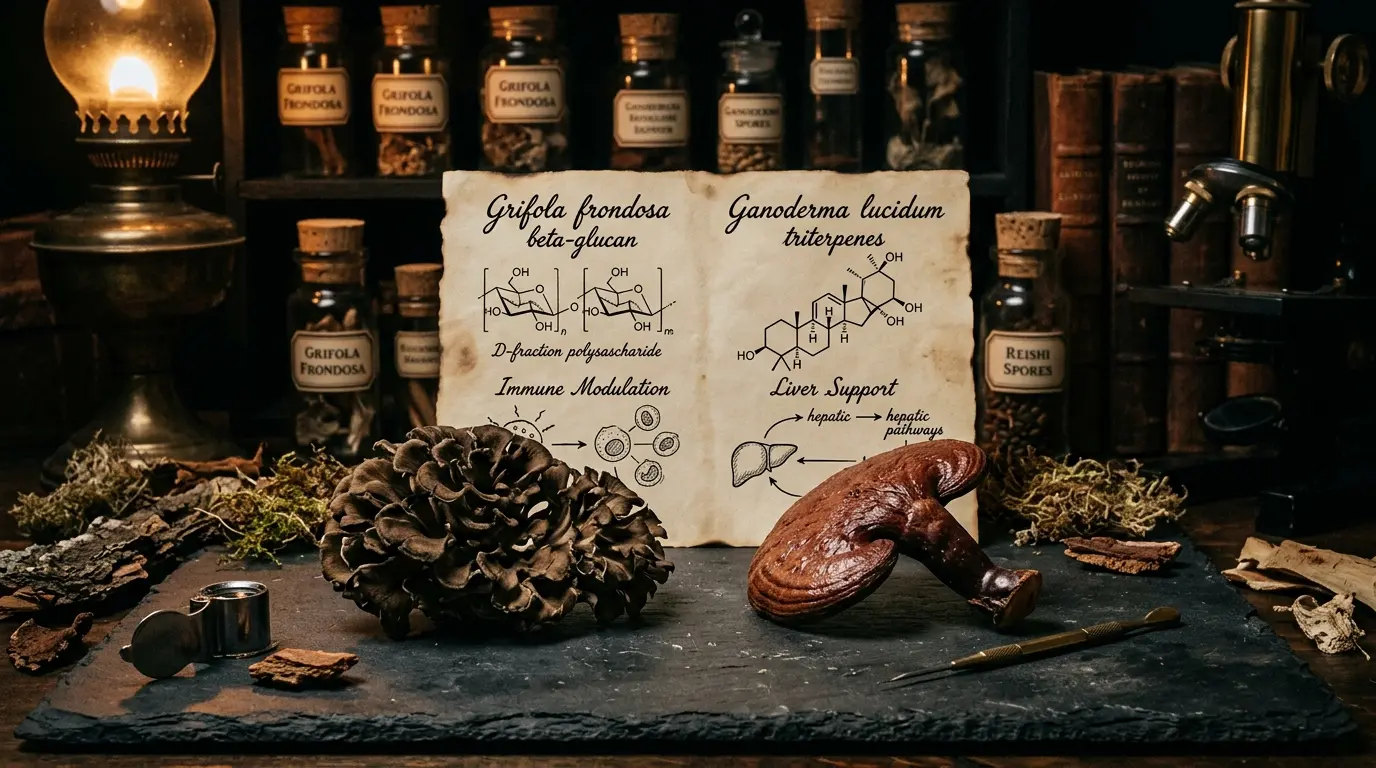
Two β-glucan sources, two distinct architectures
— THE DIVIDE —
Maitake and Reishi appear together in the same sentence with remarkable frequency. Both receive the designation "functional mushroom." Both contain β-glucan polysaccharides and triterpene compounds. Yet this parallelism deceives. The polysaccharide architecture differs. The triterpene skeleton differs. The culinary compatibility differs dramatically. The framework of historical use differs.
While both mushrooms share the characteristic traits common to all β-glucan-bearing fungi, each retains species-specific distinctions that define its biochemical identity. This entry places Maitake and Reishi side by side to examine where they genuinely overlap and where they fundamentally diverge.
Polysaccharide Profile
Maitake (Grifola frondosa): The characteristic polysaccharide fraction bears the designation D-Fraction. Its principal features include:
- A β-(1→3) glucan backbone with β-(1→6) side branches.
- High side-branching frequency; approximately one branch point occurs every few backbone units.
- A protein component bound to the polysaccharide, forming a proteoglucan complex.
- Broad molecular weight distribution; depending on the purification method, the range spans 100–1000 kDa.
Reishi (Ganoderma lucidum): The polysaccharide fraction likewise consists of branched β-(1→3) glucan, yet the branching frequency and molecular weight distribution diverge from those of Maitake:
- A β-(1→3) glucan backbone; side-branching frequency is moderate to low.
- Heteropolysaccharide structures (incorporating mannose, xylose, and fucose units) occur more abundantly than in Maitake.
- Purified fractions (PSG, GLPS) carry distinct compound combinations.
The β-glucans of both mushrooms belong to the same general class, but they are not "the same polysaccharide." The structural differences influence the in vitro receptor-binding profile, particularly at Dectin-1 and CR3.
Triterpene Profile
Maitake: The triterpene profile is limited. Researchers have isolated select ergostane-skeleton sterol derivatives from the species; however, Maitake lacks a triterpene collection comparable to the expansive ganoderic acid series found in Reishi. Maitake's chemical identity is polysaccharide-dominant.
Reishi: The triterpene profile is exceptionally rich. Over 200 ganoderic acid derivatives have been isolated. These accompany ganoderiols, ganoderenols, and additional lanostane-type derivatives. Reishi's chemical identity is bidirectional: both the polysaccharide profile and the triterpene profile carry significant weight.
This distinction directly shapes the positioning of the two mushrooms within the in vitro literature:
- Maitake studies concentrate predominantly on D-Fraction and other polysaccharide fractions.
- Reishi studies proceed in parallel on both polysaccharide fractions and triterpene derivatives.
Cultivation and Culinary Context
- Maitake: An edible mushroom well suited to culinary use. It may be consumed raw or cooked. It carries an aromatic, umami-rich flavor profile. In gourmet mushroom markets, it holds a recognized position. Its morphology—multiple overlapping, leaf-like caps—has earned it the name "dancing mushroom."
- Reishi: Its wood-hard texture renders it unsuitable for consumption raw or with brief cooking. It possesses a bitter taste. Traditional preparation involves slicing and prolonged boiling to produce a tea; modern use favors extract or powder formats.
Traditional Context
- Maitake: Recognized in Japan since the feudal era as a prized mushroom. Its name translates to "dancing mushroom," stemming from the lore that those who discovered it danced with joy. The traditional use framework revolves around themes of lipid and glucose metabolism.
- Reishi: Known in China under the name "Lingzhi," its documented use spans at least two millennia. The traditional use framework centers on themes of calm, longevity, and overall vitality.
The two mushrooms occupy distinct traditional tonalities and classification frameworks; these do not map directly onto modern scientific terminology.
Comparative Literature
In vitro studies occasionally test the two mushrooms side by side. Comparative research reveals the following:
- Polysaccharide fractions exhibit divergent receptor-binding profiles attributable to their differing side-branch densities.
- The triterpene profile is minimal in Maitake and dominant in Reishi; consequently, cell signaling research is broader for Reishi.
- In immune cell culture studies, the polysaccharides of both mushrooms fall under the β-glucan category; their specific effect profiles diverge.
This literature exists predominantly at the cell culture and animal model level. The number of clinical studies remains limited; these mushrooms do not occupy a pharmacological category.
Summary
- Polysaccharide: Both contain β-glucan; Maitake is highly branched, Reishi is moderately branched.
- Triterpene: Maitake has a minimal profile; Reishi possesses an extensive series.
- Culinary: Maitake is edible; Reishi is tough and bitter.
- Traditional tonality: Maitake aligns with metabolic themes; Reishi aligns with calming themes.
- Cultivation: Both species can be produced under standard controlled culture conditions.
Related Reading
- What Is D-Fraction — Maitake's proteoglucan complex.
- What Is Ganoderic Acid — Reishi's triterpene series.
- What Is Beta-Glucan — Structural classification of mushroom β-glucans.
This content is provided for informational purposes and does not constitute medical advice. Consult a physician before making any health-related decisions. Functional mushrooms are not pharmaceuticals and are not indicated for the treatment of disease.
Version: 1.0 | Last updated: 27 April 2026 | Sources reviewed: 18+ | Methodology: Editorial Policy | References: Bibliography