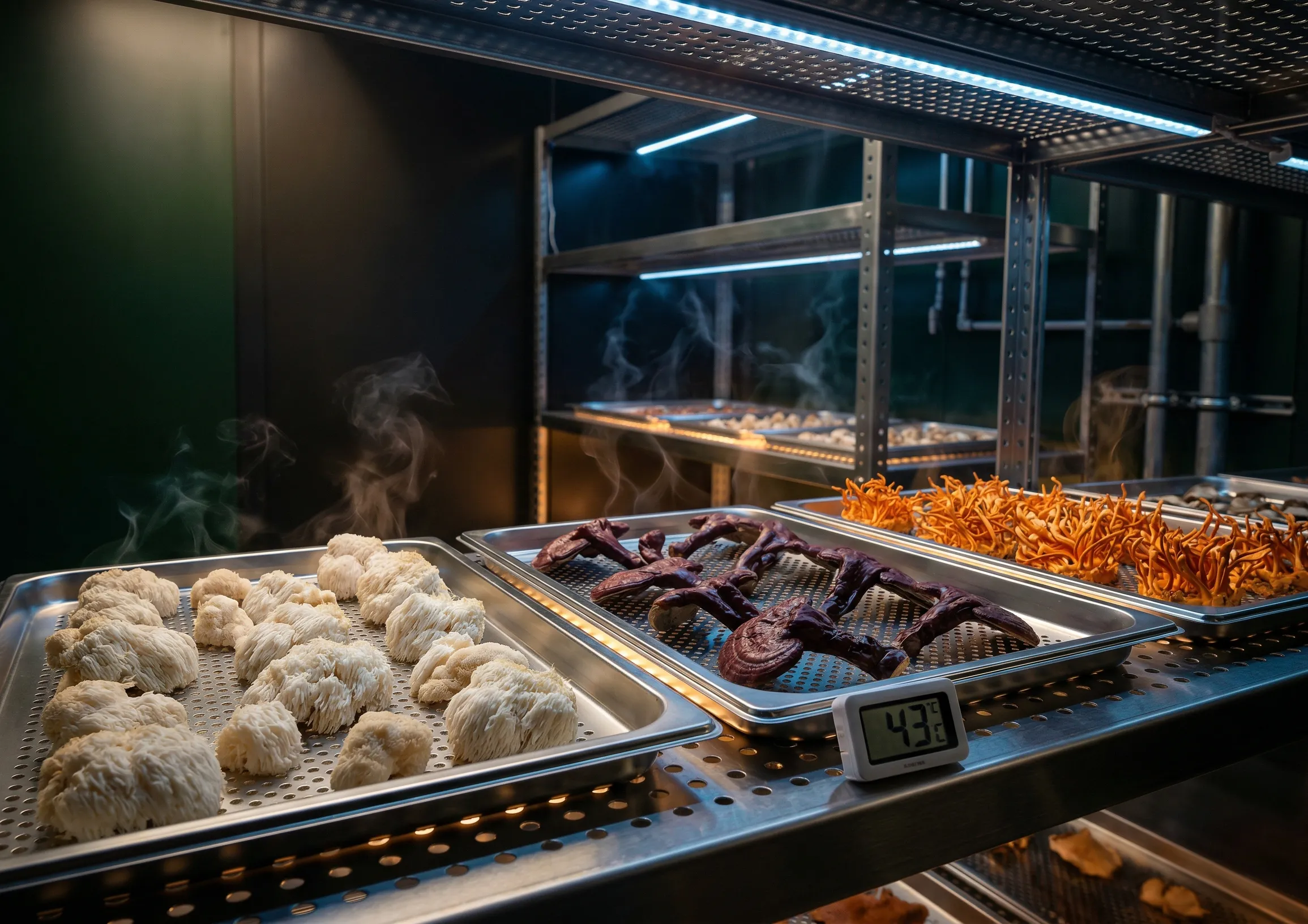
Cognitive and Energy Profiles of Lion’s Mane and Cordyceps: A Comparative Analysis
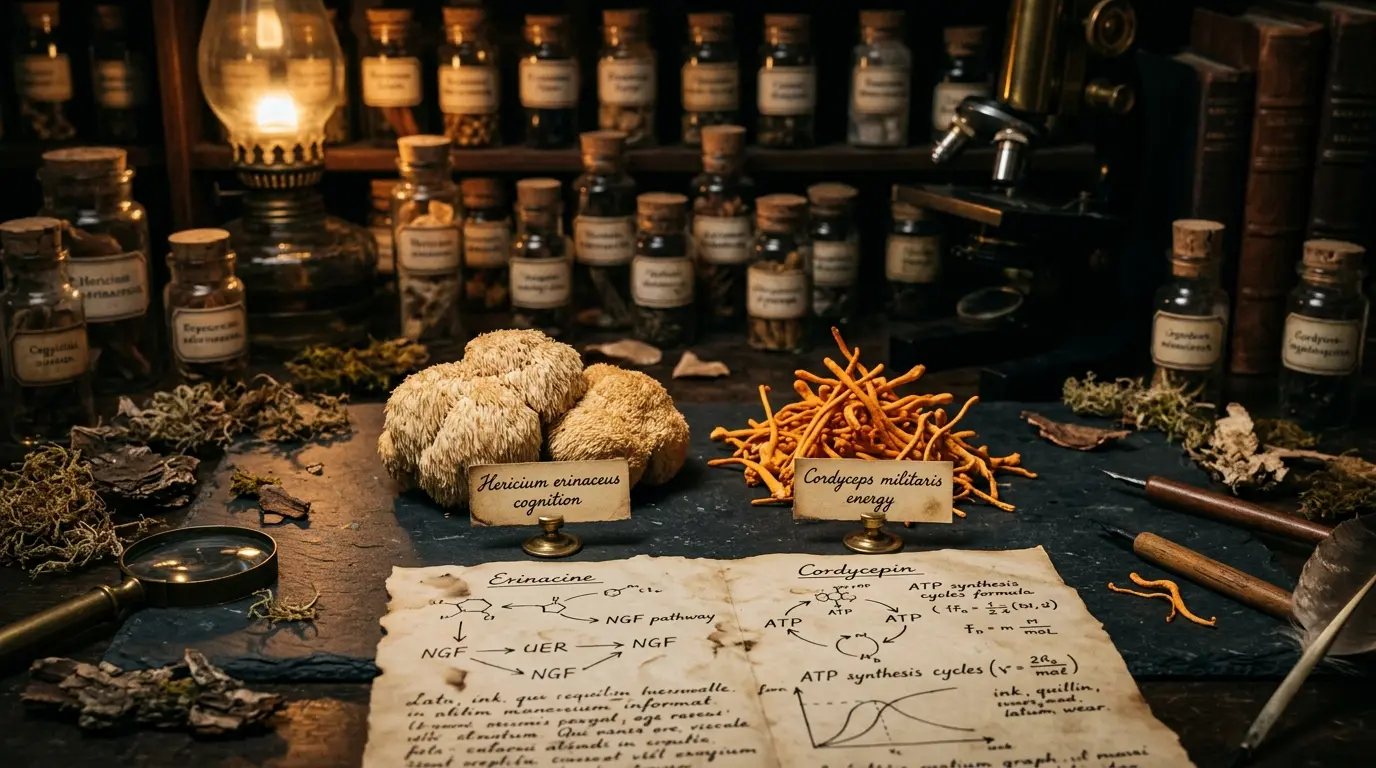
Same Market, Separate Categories
— HOOK —
Two species dominate joint discourse within the functional mushroom market: Lion's Mane and Cordyceps. The former is marketed under "cognitive" themes, the latter under "energy" themes. Chemically, the two mushrooms share no common ground. Lion's Mane is defined by aromatic hericenones and diterpene-derived erinacines. Cordyceps bears nucleoside derivatives. Two products occupying the same counter yet belonging to entirely distinct chemical categories.
The adjectives "cognitive" and "energy" are categorizations forged in the language of advertising; within the scientific literature, the effects of these mushrooms are investigated through a far narrower mechanistic lens. This article compares the two species across chemistry, production methodology, and in vitro research themes.
Chemical Identity
Lion's Mane (Hericium erinaceus): Two principal compound families:
- Hericenones: Aromatic compounds. Isolated from the fruiting body. Derivatives A through H have been characterized.
- Erinacines: Cyathane-skeleton diterpenes. Isolated from the mycelial phase. Derivatives A through K have been characterized.
These two families reside in different production phases: hericenones predominate in the fruiting body, erinacines in the mycelium. On product labels, the terms "fruiting body" or "mycelium" directly signal which compound family is foregrounded. This distinction constitutes a critical parameter for evaluating Lion's Mane products.
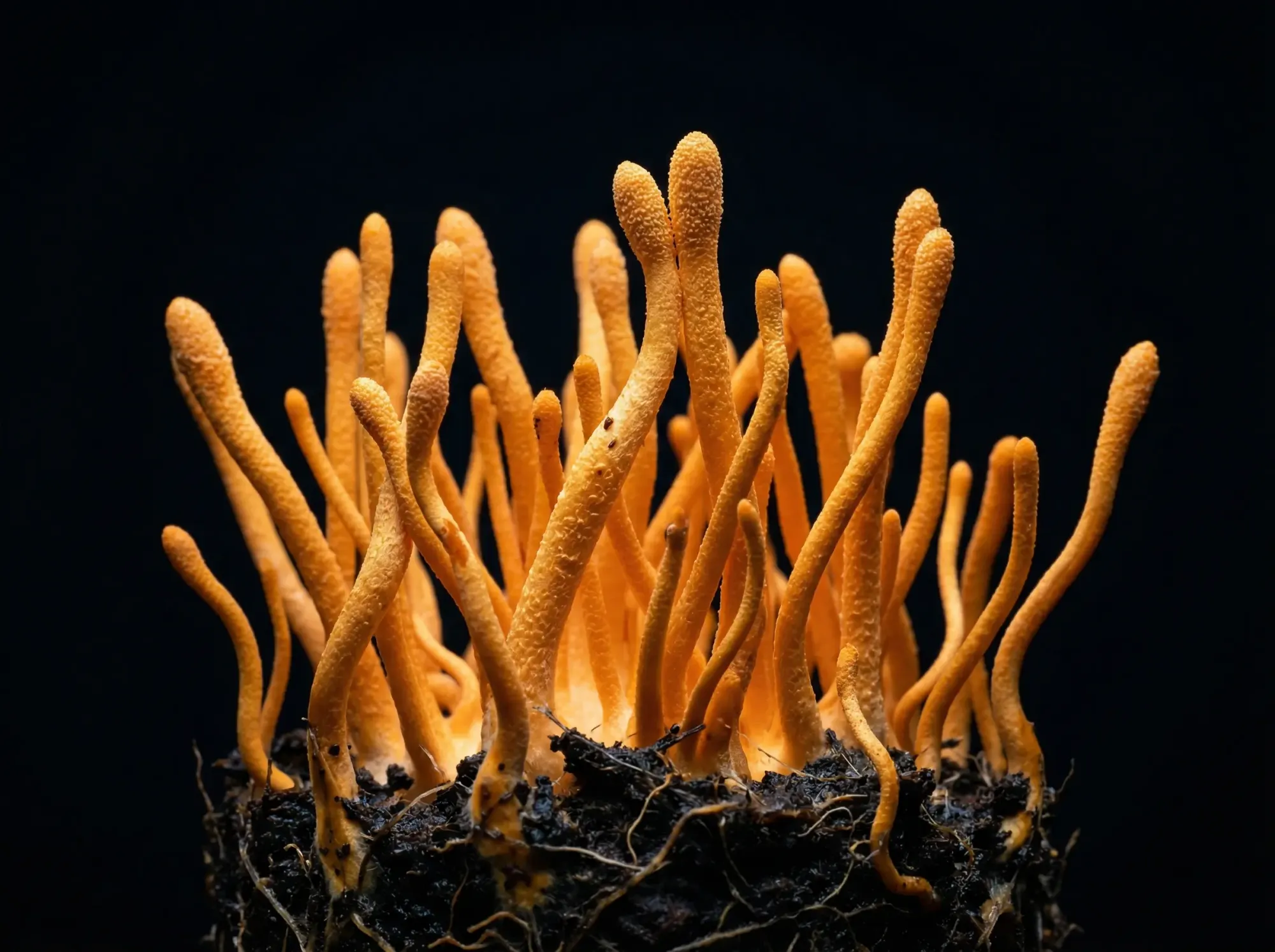
Cordyceps (C. militaris): The characteristic compound family is nucleoside derivatives:
- Cordycepin (3'-deoxyadenosine): The molecule from which the species derives its name.
- Adenosine: A standard nucleoside; metabolically ubiquitous.
- Related nucleosides: Inosine, guanosine, and uridine derivatives.
The compound families of these two mushrooms are structurally unrelated; aromatic organic compounds (hericenone) and purine nucleosides occupy entirely different chemical categories.
Research Themes
Within the in vitro literature, the two mushrooms inhabit separate research clusters:
Lion's Mane:
- Profile of hericenone and erinacine derivatives observed in neuronal cell lines (PC12 and others).
- In vitro studies contextualized around NGF (nerve growth factor); an active area of investigation in the literature.
- Cytokine profile of the polysaccharide fraction in immune cell cultures.
Cordyceps:
- Interaction of cordycepin and other nucleosides with purine metabolism.
- The ATP and adenosine receptor context; actively investigated in the in vitro literature.
- Mitochondrial respiration parameters and cell culture observations related to energy metabolism.
- Immunomodulatory profile of the polysaccharide fraction.
The research themes of the two mushrooms do not overlap. The labels "cognitive" and "energy" are conceptual tags translated from these distinct research themes into advertising language; they do not imply mechanistic equivalence.
Production Profile
- Lion's Mane: Both mycelium and fruiting body can be produced under controlled culture. The hericenone-to-erinacine ratio shifts markedly depending on the production phase. Fruiting body cultivation is feasible in numerous countries, including Turkey.
- Cordyceps: C. militaris is produced via liquid or solid mycelial culture. Naturally occurring C. sinensis is rare on the market; most products derive from cultured C. militaris.
Label literacy: For Lion's Mane, the "fruiting body vs. mycelium" distinction; for Cordyceps, the "C. militaris vs. C. sinensis" distinction — these are fundamental parameters of quality.
Usage Form and Aroma
- Lion's Mane: A mushroom well-suited to culinary use. When cooked, it yields a seafood-like texture. Its dried and powdered form integrates into coffee, smoothie, and tea blends. The aroma profile is neutral-sweet.
- Cordyceps: Naturally small and slender; not a standalone culinary product. Used in powder or extract form. The aroma is mildly umami-mushroom.
Summary
- Characteristic family: Lion's Mane → hericenone + erinacine. Cordyceps → cordycepin + adenosine.
- Significance of production phase: For Lion's Mane, the fruiting body/mycelium distinction is decisive. For Cordyceps, species and substrate.
- Research theme: Lion's Mane → neuronal cell culture. Cordyceps → mitochondrial/energy metabolism.
- Culinary compatibility: Lion's Mane high, Cordyceps low.
When the two mushrooms are used together, they bring biochemically distinct themes into a single formulation — not conceptually merged, but mechanistically separate. Any claim of "combined effect" would require an evidence base beyond the existing in vitro literature.
Related Reading
- What Is Erinacine — The diterpene profile of Lion's Mane mycelium.
- What Is Cordycepin — The characteristic nucleoside of Cordyceps.
- Hericium erinaceus Biological Heritage — Lion's Mane species encyclopedia.
This content is for informational purposes only and does not constitute medical advice. Consult your physician before making any health-related decisions. Functional mushrooms are not pharmaceuticals and cannot be used to treat diseases.
Version: 1.0 | Last updated: 27 April 2026 | Sources reviewed: 16+ | Methodology: Editorial Policy | References: Bibliography