Reishi and Cordyceps: A Comparative Analysis of Adaptogenic Properties

Two Mushrooms, Two Distinct Chemistries
— HOOK —
In the functional mushroom market, two names are routinely mentioned side by side: Reishi and Cordyceps. Both carry the label “adaptogen,” both sit on the same category shelves. Yet from a biochemical identity standpoint, these two mushrooms occupy profoundly different ground. Reishi is known for its lanostane-skeleton triterpenes; Cordyceps for its nucleoside derivatives. The same label glides over very different molecules.
The term “adaptogen” does not correspond to an official category in modern pharmacology; it is a conceptual framework drawn from traditional use and cell-culture stress-response studies. This article places the two mushrooms side by side and compares them in terms of chemistry, production, and usage context.
Chemical Signature
Reishi (Ganoderma lucidum): The characteristic compound family is the ganoderic acid series — lanostane-skeleton triterpenes, mostly oxygenated. Over 200 triterpene derivatives have been isolated from the species. The polysaccharide fraction bears a branched β-(1→3) glucan profile. The spore and the fruiting body exhibit different compound ratios.
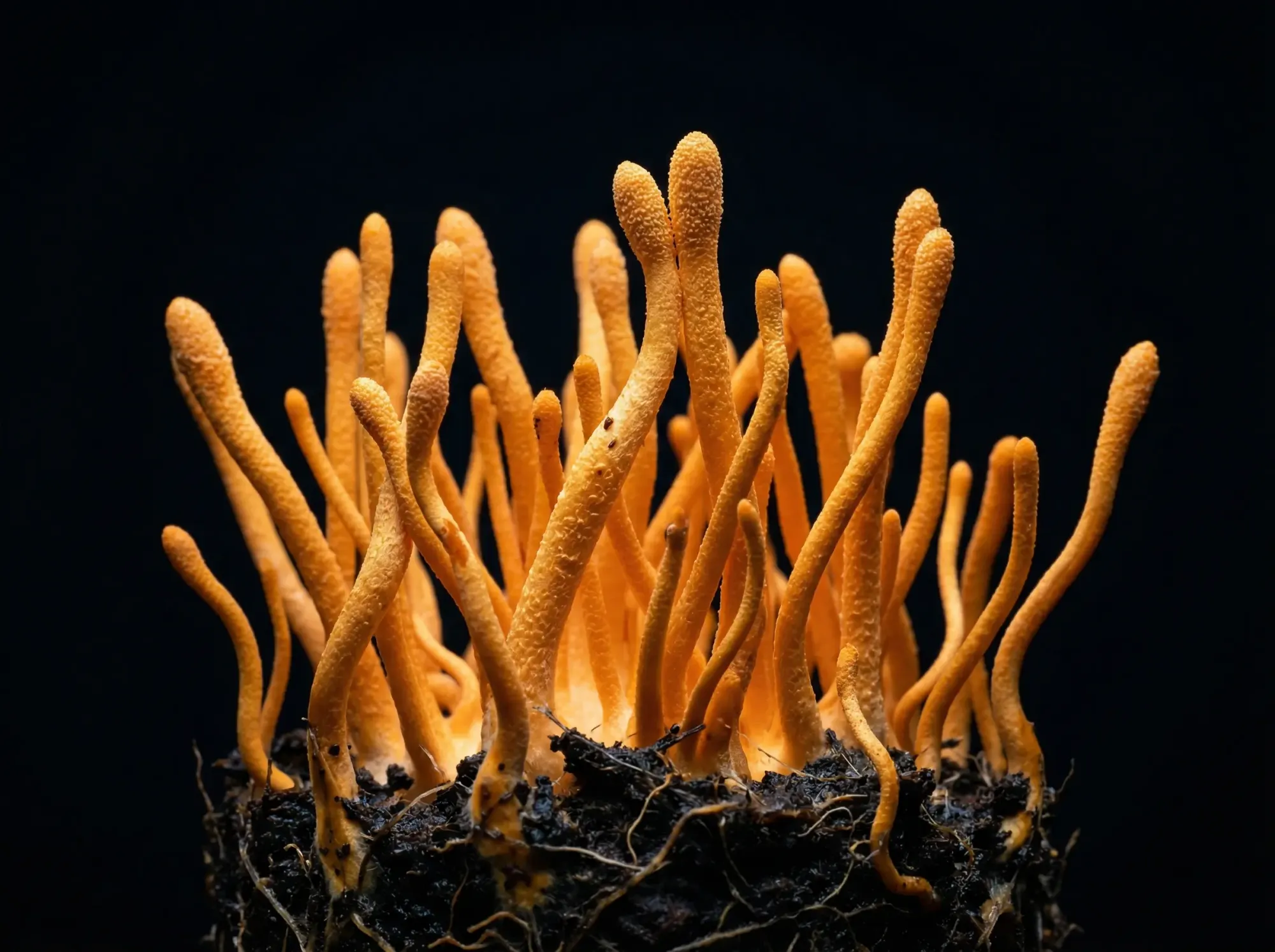
Cordyceps (Cordyceps militaris, C. sinensis): The characteristic molecular signature is nucleoside derivatives. Cordycepin (3′-deoxyadenosine) is the principal marker molecule. Other nucleosides such as adenosine, inosine, and guanosine are also found in high proportions. A polysaccharide fraction exists as well, but the primary signal molecules that carry the species’ chemical identity are the nucleosides.
This difference conceptually separates the two mushrooms’ effect profiles in the in vitro literature. The Reishi triterpenes generate a literature that predominantly touches cell signalling and membrane-bound processes, whereas the Cordyceps nucleosides are investigated in the context of purine metabolism and energy metabolism.
Production Context
The cultivation conditions of the two mushrooms differ markedly:
- Reishi: It is readily grown on standard mycelial culture and wood-based substrate. Controlled production is feasible in many countries, including Turkey. The fruiting body is harvested, dried, and taken to extraction. The spore powder constitutes a separate production layer and carries a distinct compound profile.
- Cordyceps: The production profile of the two species is very different. C. sinensis grows in its natural habitat on caterpillars on the Tibetan plateau; wild collection is rare and prices are extremely high. The vast majority of Cordyceps products on the modern market are obtained from liquid or solid mycelial culture of C. militaris. C. militaris can, under controlled cultivation, yield a nucleoside profile close to that of C. sinensis; however, the two species are not identical.
The production method should be read from the label. The name “Cordyceps” alone is insufficient; the species name (militaris or sinensis) and the production form (liquid mycelium, solid substrate, or fruiting body) are the determining parameters.
Traditional Use Context
The traditional use frameworks of the two mushrooms run parallel but are not identical:
- Reishi: Known as “Lingzhi” in Traditional Chinese Medicine (TCM), it has been used for at least two thousand years. The traditional usage is set within the domains of calmness, balanced ageing, and overall vitality.
- Cordyceps: Known in TCM as “Dong Chong Xia Cao.” Its traditional use is centred on themes of endurance, lung–kidney balance, and physical revitalisation.
The two mushrooms occupy different positions in TCM: Reishi is classified as shen-oriented, Cordyceps as yang-oriented. This is a traditional categorical distinction; it does not translate directly into modern biochemical categories.
In Vitro Literature Profile
In the modern literature, the two mushrooms are examined in distinct thematic clusters:
- Reishi triterpenes: Cell signalling (PI3K/Akt, MAPK, NF-κB modulation), liver cell cultures, immune cell cultures.
- Cordyceps nucleosides: Adenosine receptor interaction, mitochondrial respiration profile, energy metabolism parameters.
- Polysaccharide fractions: Both mushrooms contain a β-glucan profile; the immunomodulatory profile literature forms a shared research theme.
The two mushrooms are not interchangeable in in vitro studies. Comparative studies on the same cell line report distinct molecular target profiles. The practical meaning of the “adaptogen” label is the convergence of the two mushrooms’ usage contexts, not biochemical equivalence.
Summary Comparison
- Characteristic molecule: Reishi → ganoderic acids. Cordyceps → cordycepin and nucleosides.
- Polysaccharide: Both contain β-glucan; structural details differ.
- Production: Reishi fruiting body is standard. Cordyceps predominantly mycelium.
- Traditional tone: Reishi calming, Cordyceps invigorating.
- Aroma: Reishi bitter, Cordyceps mildly sweet-umami.
- Form: Reishi usually as extract; raw consumption limited (due to bitterness). Cordyceps powder and extract are common.
Using the two mushrooms together is a common formulation approach; however, claims of “combined effect” rest on in vitro or traditional context, and evidence of clinically proven synergy is limited.
Related Readings
- What is Ganoderic Acid — The lanostane triterpenes of Reishi.
- What is Cordycepin — The signature nucleoside of Cordyceps.
- The Adaptogen Concept — Conceptual boundaries and modern context of the term.
This content is for informational purposes only and does not constitute medical advice. Consult your physician before making any health decisions. Functional mushrooms are not drugs and cannot be used to treat diseases.
Version: 1.0 | Last updated: 27 April 2026 | Number of sources reviewed: 18+ | Method: Editorial Policy | References: Bibliography