The TRPV1 Receptor and Pain Perception: Insights from Fungal Biology
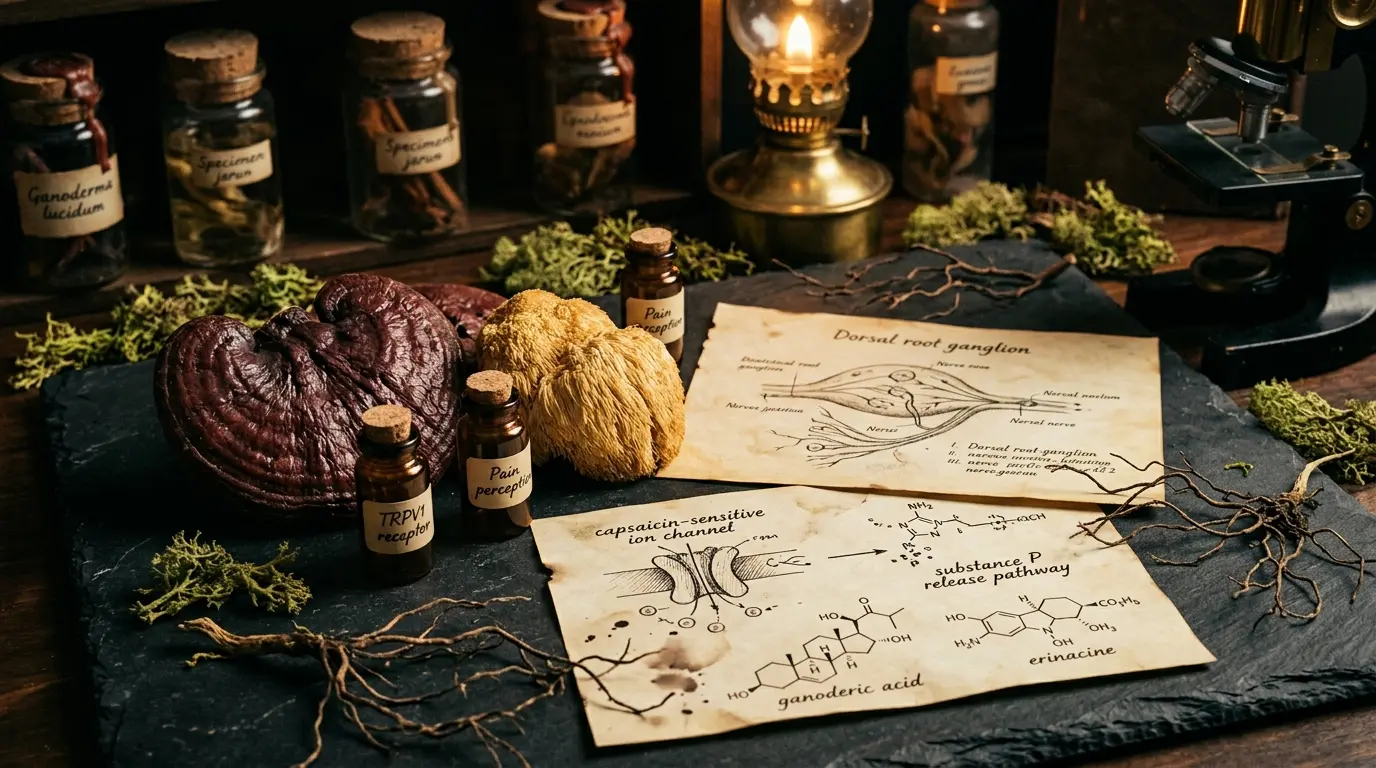
The Receptor Behind Chili Pepper Heat and Its Biological Roles
— THE HOOK —
The burning sensation experienced when eating chili peppers arises from capsaicin activating the TRPV1 receptor. This same receptor is responsible for detecting temperatures above 43°C and for transmitting pain signals when tissue inflammation commences. The molecule that makes chili peppers pungent is, in other words, a central node in a far broader physiological network.
This article examines the biology of the TRPV1 receptor and reviews the literature on functional mushroom compounds in the context of pain perception, neuroinflammation, and sensory modulation.
TRPV1: A Polymodal Stimulus-Sensitive Channel
TRPV1 is the founding member of the transient receptor potential vanilloid family. It is a non-selective cation channel embedded in the neuronal membrane, permeable to calcium. Upon ligand binding or exposure to elevated temperature, the channel opens, permitting calcium influx into the cell.
Its activators are diverse: capsaicin, allyl isothiocyanate, acidic pH, endocannabinoids, lipid derivatives, and inflammatory mediators. This polymodal sensitivity positions TRPV1 as an integration point for pain perception (Caterina et al., 1997; PMID: 9349813).
Function: Beyond Pain
TRPV1 is expressed primarily in nociceptor neurons, yet its distribution is broader. It is also found in the stomach, intestine, bladder, and lung epithelium. Beyond pain perception, it is associated with thermoregulation, the cough reflex, and gastric pH sensing.
In chronic pain conditions—particularly neuropathic pain and inflammatory pain—TRPV1 expression and sensitivity are upregulated. Consequently, TRPV1 is an intensively studied pharmacological target in pain management (Szallasi et al., 2007; PMID: 17464295).
The Sensitization and Desensitization Paradox
TRPV1 exhibits a notable characteristic: sustained exposure to high-dose capsaicin temporarily desensitizes the channel. This is the mechanism underlying the use of capsaicin-containing topical creams for neuropathic pain. Low-dose exposure, by contrast, sensitizes the receptor.
This bidirectional behavior demonstrates that the dose-response relationship is non-linear; this paradox must be accounted for when drawing analogies for mushroom-derived compounds (Anand & Bley, 2011; PMID: 21333473).
Mushroom Compounds and the TRPV1 Literature
The direct interaction between mushroom compounds and TRPV1 has been examined in a limited number of studies. Two indirect axes, however, stand out.
First, neuroinflammation. Hericenone and erinacine derivatives from Lion's Mane (Hericium erinaceus) have demonstrated a tendency to reduce microglial activation in in vitro models. Microglial activation plays a key role in TRPV1 sensitization; attenuation of neuroinflammation may therefore indirectly lower TRPV1 sensitivity (Mori et al., 2011; PMID: 21671193).
Second, the endocannabinoid system. Reishi triterpenes and certain polysaccharide fractions have been proposed to modulate endocannabinoid tone. Endocannabinoids are natural modulators of TRPV1; an indirect connection therefore rests on a plausible mechanistic foundation (Maccarrone et al., 2014; PMID: 24508914).
Gut Mucosal TRPV1 and Mushroom Polysaccharides
TRPV1 in the intestinal wall is associated with visceral hypersensitivity; its activation is increased in the irritable bowel syndrome phenotype. The tendency of mushroom β-glucans to strengthen the mucosal barrier through short-chain fatty acid production suggests a potential indirect mucosal modulation pathway involving TRPV1 (Akbar et al., 2008; PMID: 18305062).
Limitations
Direct evidence for interactions between mushroom compounds and TRPV1 is weak; most hypotheses are inferences drawn through the neuroinflammation and endocannabinoid axes. Human intervention studies are virtually nonexistent. This area should be regarded as a domain of mechanistic interest rather than a basis for clinical usage recommendations.
Related Reading
- The Gut-Brain Axis and Lion's Mane — Neuroinflammation context.
- How the Immune System Works — Inflammatory pathways.
- Stress, Cortisol, and Adaptogenic Mushrooms — Nervous system modulation.
This content is for informational purposes only and does not constitute medical advice. Consult your physician before making any health-related decisions. Functional mushrooms are not drugs and cannot be used to treat diseases.
Version: 1.0 | Last updated: 28 April 2026 | Sources reviewed: 12+ | Methodology: Editorial Policy | References: Bibliography