The Maitake Mushroom (Grifola frondosa): A Comprehensive Species Encyclopedia
— HOOK —
Autumn in the mountains of Japan. A villager walks through the forest.
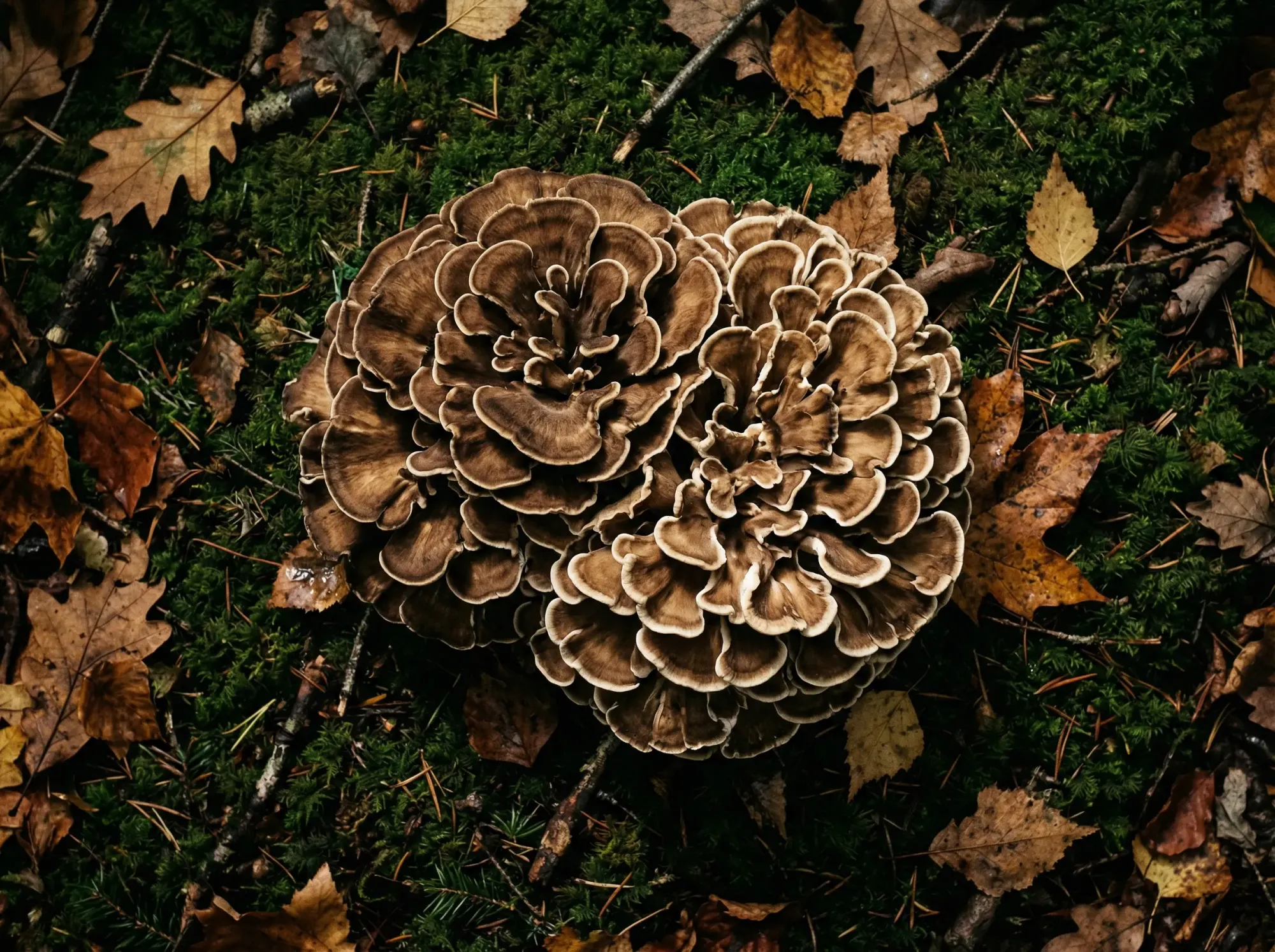
At the base of a tree, he spots it. Fan upon fan, layered and overlapping in dense clusters. Grey-brown. Massive — some specimens reach 50 kilograms.
The villager dances with joy.
Hence the name Maitake — 舞茸 — "The Dancing Mushroom."
And there is good reason to dance.
— HISTORY —
Japan. The Edo Period (1603–1868). Maitake carried a value equal to its weight in silver. Difficult to find, with a short season and restricted habitat, it emerged at the roots of beech, oak, and linden trees during autumn's narrow window.
It became a prestige symbol for the samurai class and aristocracy. For ordinary citizens, finding one meant a genuine fortune — both for sale and for sustenance through the winter months.
Traditional Japanese medicine (Kampo) classified Maitake as adaptogenic: strengthening the body against stress, balancing immunity, supporting blood sugar regulation. This classification aligns with the direction of contemporary research.
In China, it is not 猴头菇 (Hóutóu gū) — rather 灰树花 (Huī shù huā) — "grey tree flower." It appeared in Tang Dynasty court cuisine. Medicinal and gastronomic value were never separated.
— DESCRIPTION AND MORPHOLOGY —
Grifola frondosa (Dicks.) Gray — Grifola derives from the Greek "grif" (mythological creature); frondosa is Latin for "leafy, branching."
Hundreds of small caps emerge from a central stem system, forming overlapping, imbricated layers. Each cap measures 2–7 cm across, thin and elastic. The upper surface is grey-brown; the underside is porous and white. A single fruiting body can reach 10–50 kg.
Natural habitat: root systems of beech, oak, and ash trees. A parasitic-saprophytic transitional species that contributes to the death of the host tree. Natural populations exist in Turkey's mixed deciduous forests along the Black Sea region.
Harvest window: when caps are still unopened, margins curled and pliable, pores closed. Opened and flattened caps lose their aromatic and bioactive profile. MYCOVITA monitors this window within a 24–48 hour timeframe.
— BIOACTIVE COMPOUNDS —
D-Fraction
The focal point of Maitake research. A beta-(1→3), (1→6)-D-glucan fraction — yet its structural characteristics differ from beta-glucans found in other mushrooms.
D-Fraction was isolated and patented by Hiroaki Nanba in 1984. Evidence indicates it activates NK (Natural Killer) cells and macrophages, and it serves as a reference standard in anti-tumor activity research.
D-Fraction exhibits high bioavailability: evidence suggests intestinal absorption following oral intake and systemic activity that exceeds certain other beta-glucan fractions.
Reference: Nanba, H. et al. (1987). Antitumor activity of orally administered D-fraction from maitake mushroom. Journal of Naturopathic Medicine, 1(1), 10-15.
X-Fraction
A separate fraction investigated for its effects on blood sugar metabolism. Animal and in vitro studies exist on insulin sensitivity and glucose tolerance. Clinical data remain limited — research is ongoing.
Reference: Konno, S. et al. (2001). A possible hypoglycaemic effect of maitake mushroom on Type 2 diabetic patients. Diabetic Medicine, 18(12), 1010-1012.
Beta-Glucan 15–30%
A moderate-to-high beta-glucan concentration. The structural specificity of D-Fraction carries significance beyond the numerical value — identical percentages with different structural features yield distinct biological profiles.
— MAITAKE IN THE KITCHEN —
Maitake occupies a distinct place in the kitchen. Neither the neutral taste of Lion's Mane nor the sharp umami of Shiitake. It possesses its own character: deep, earthy, with a subtle oaken note and rich umami.
Sauté — The Fundamental Technique
Break the clusters into large pieces — do not cut too small, or the texture will be lost. Use a cast iron or steel pan, high heat, neutral oil. Leave undisturbed for 3–4 minutes. Turn once the edges brown. Salt, black pepper, fresh thyme.
Do not overcrowd the pan — a single layer with breathing room allows oil and aroma to penetrate between the layers.
Stews and Braises
Maitake does not disintegrate during prolonged cooking — its layered structure withstands heat. Long braises with red wine, stock, and fresh herbs. It comfortably substitutes for meat — texture and umami depth make this possible.
Dashi Base
Maitake dashi combined with Shiitake — two distinct umami sources (GMP + glutamate-based different profiles) converge to multiply depth. Kombu is optional — these two mushrooms alone yield a powerful dashi.
Raw Consumption — Caution
When eaten raw, Maitake may cause mild digestive discomfort in some individuals. Cooking or infusion should always be preferred.
— MYCOVITA GASTRONOMY No.03 —
Maitake cultivation requires a 90–120 day colonization period — the longest process within the MYCOVITA portfolio. It is therefore classified as opportunistic/seasonal production: available when stock is built, subject to waiting periods when depleted.
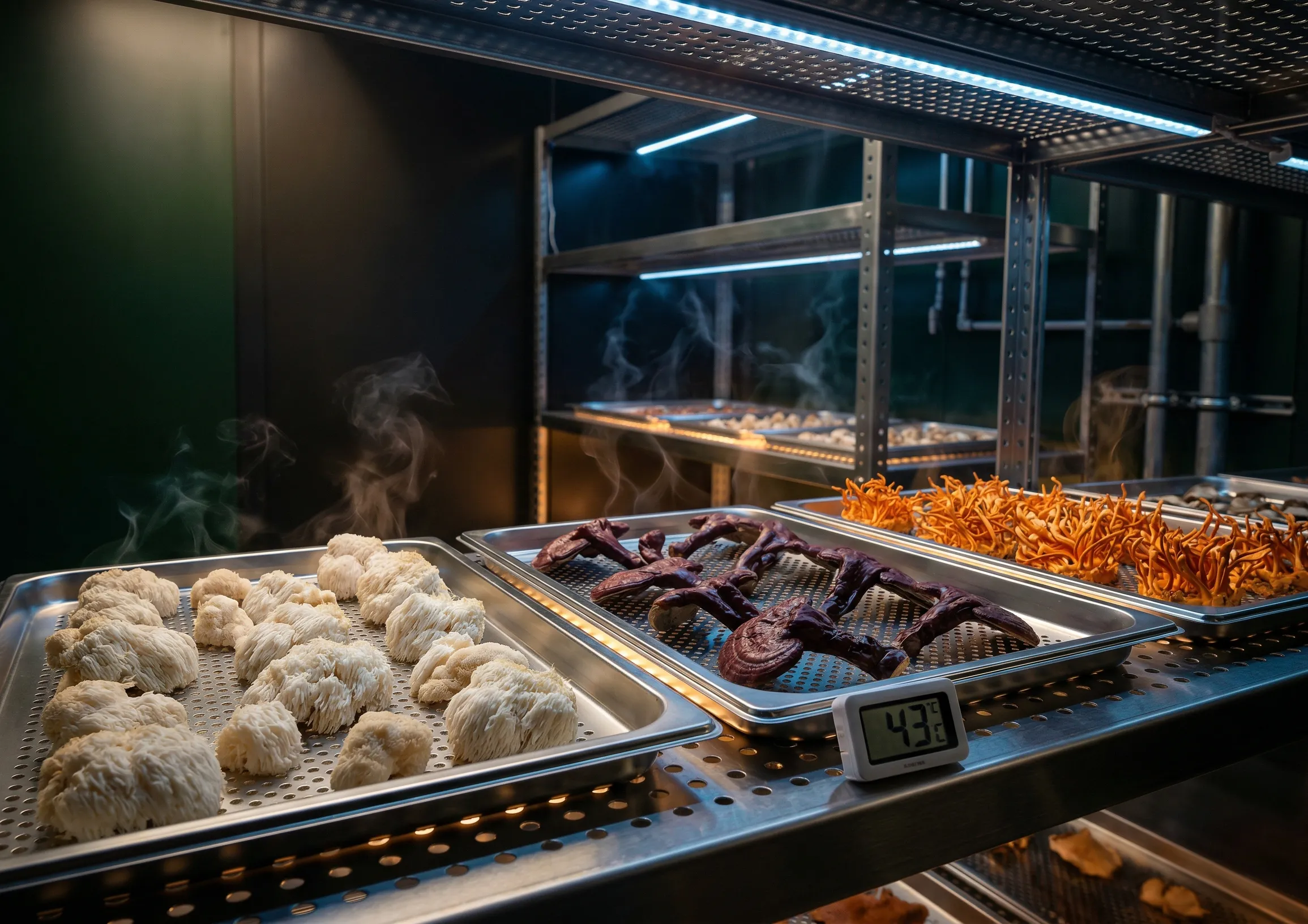
MYCOVITA Maitake: whole dried, low-temperature drying at 42–45°C, D-Fraction profile preserved. Reconstitution: 20–25 minutes in warm water (60°C).
You May Also Find Interesting
→ Can Mushrooms Produced in Turkey Be Trusted?
→ Functional Mushroom Production in Turkey
Related reading: What Is Beta-Glucan? · Seasonal Mushroom Calendar
On MYCOVITA's production philosophy, technical infrastructure, and transparency principles: Why MYCOVITA?
Nanba, H. et al. (1987). Antitumor activity of orally administered D-fraction from maitake mushroom. Journal of Naturopathic Medicine, 1(1), 10-15. Konno, S. et al. (2001). A possible hypoglycaemic effect of maitake mushroom on Type 2 diabetic patients. Diabetic Medicine, 18(12), 1010-1012. Kodama, N. et al. (2002). Can maitake MD-fraction aid cancer patients? Alternative Therapies in Health and Medicine, 8(5), 110-115. Wasser, S.P. (2002). Medicinal mushrooms as a source of polysaccharides. Applied Microbiology and Biotechnology, 60(3), 258-274.
This content is for informational purposes only and does not constitute medical advice. Consult your physician before making any health-related decisions. Functional mushrooms are not pharmaceutical drugs and cannot be used to treat diseases.
Version: 1.0 | Last updated: 20 Apr 2026 | Sources reviewed: 9+ | Methodology: Editorial Policy | References: Bibliography