The Hypothalamic-Pituitary-Adrenal Axis and Fungal Adaptogens: A Review of the Evidence

Three Stops, One Message
— ANCHOR —
The body’s stress response is not a single-cell decision. It is the product of three distinct glands, three distinct hormones, and a stepwise communication network that completes within minutes. This network is the HPA axis: Hypothalamus → Pituitary → Adrenal. The signal travels in one direction, but a feedback mechanism monitors every stop along the way.
Under acute stress, the axis elevates cortisol secretion within minutes; under prolonged stress it operates in a different register. Chronic dysregulation of the HPA axis is one of the central topics of modern stress physiology. Mushroom adaptogens are a research subject discussed within this axis. In this article we examine the HPA axis and the literature profile on mushroom constituents.
Architecture of the HPA Axis
The three stops of the axis:
- Hypothalamus: Located at the base of the brain, a signal integration center. When stress is perceived it secretes corticotropin-releasing hormone (CRH).
- Pituitary (anterior): In response to CRH it secretes adrenocorticotropic hormone (ACTH); this hormone enters the bloodstream and reaches the adrenal glands.
- Adrenal cortex: In response to ACTH it secretes cortisol. Cortisol enters the bloodstream and produces systemic effects.
The “off” mechanism of the axis: cortisol itself feeds back to the hypothalamus and the pituitary. High cortisol → suppression of CRH and ACTH → cortisol decreases. This negative feedback loop ensures that the acute stress response remains self-limiting under normal conditions.
Systemic Role of Cortisol
Cortisol is termed the “stress hormone.” Its systemic effects include:
- Glucose mobilization (activation of hepatic gluconeogenesis).
- Support of lipid and protein catabolism.
- Modulation of the immune response (acute anti‑inflammatory profile).
- Wake–sleep patterning linked to the circadian rhythm.
Cortisol is circadian: it exhibits a high peak just before morning awakening, declines throughout the day, and remains low at sleep onset. Disruption of this rhythm (for example in night‑shift workers, under chronic stress, or after jet lag) is one of the classical indicators of HPA axis dysregulation.
Chronic Stress and the HPA Profile
The HPA axis displays different profiles under acute and chronic stress:
- Acute stress: Rapid cortisol rise, rapid decline via feedback. The system is dynamic and responsive.
- Chronic stress: Typically evolves in two directions. In one group basal cortisol level rises and the rhythm flattens. In the other group a “depletion” profile is observed after prolonged high demand; basal cortisol may be normal or low, but the stress response is blunted.
These two profiles demonstrate the inadequacy of a single “stress” definition. HPA axis modulation is an important research domain in modern stress physiology.
The Adaptogen Concept
The term “adaptogen” was proposed in the 1940s by the Soviet pharmacologist N.V. Lazarev. Its classical definition comprises three criteria:
- Produces a response under non‑specific stress conditions.
- Normalizes bodily functions.
- Exhibits a low side‑effect profile.
Modern pharmacology does not recognize this definition as a formal category; it is more a conceptual framework. In traditional use Reishi, Cordyceps, and certain botanical sources (Rhodiola, Withania) are classified as “adaptogens.” In the scientific literature this classification rests on in vitro and animal‑model studies of HPA axis modulation.
Mushroom Adaptogens and the HPA Literature
Themes in the literature linking mushroom constituents and the HPA axis:
- Reishi triterpenes: Small‑scale studies exist in animal models on cortisol level profiles under stress conditions. The direction of effect varies with the stress model and dosage.
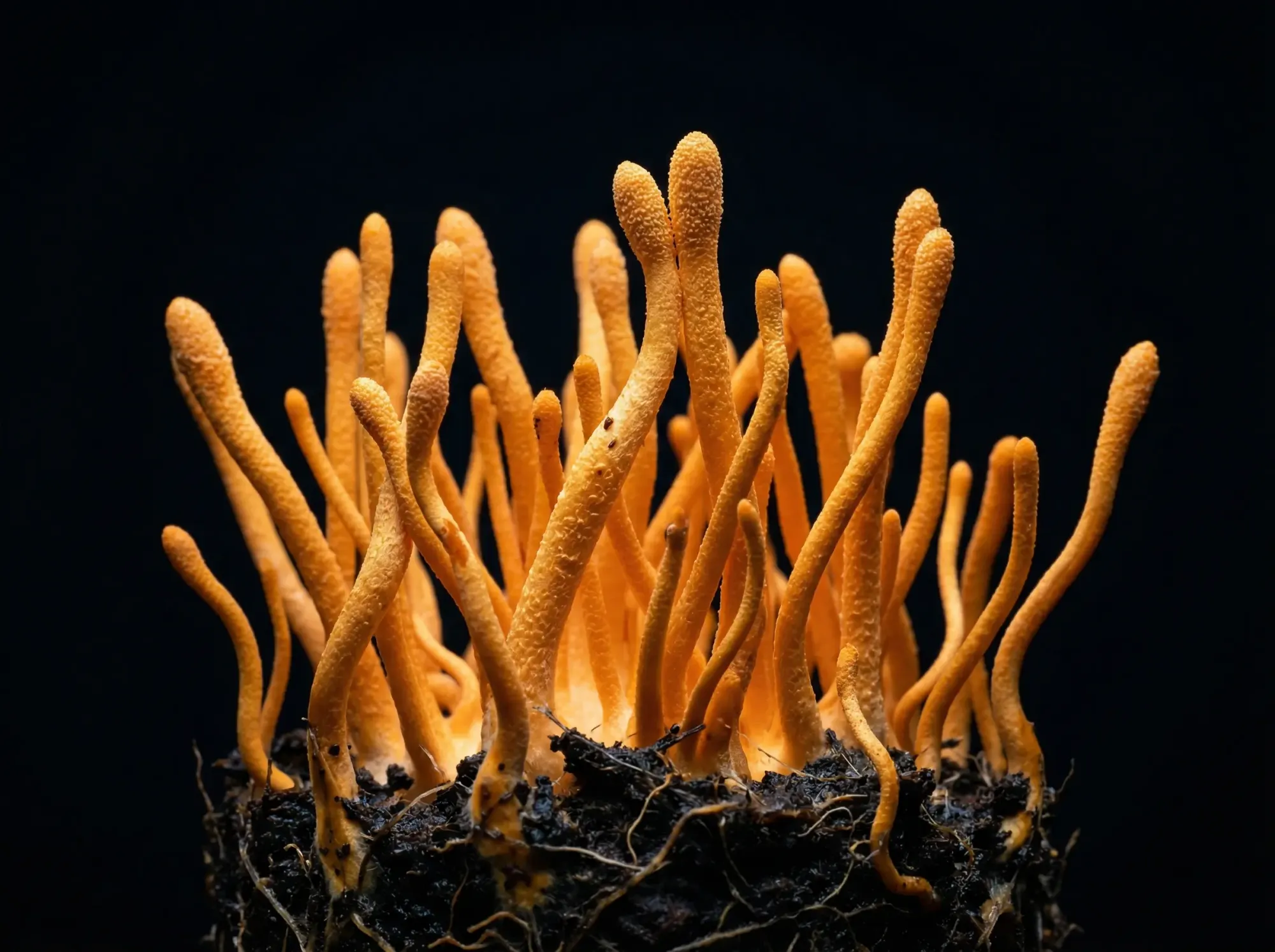
- Cordyceps polysaccharides: In fatigue and endurance models, a profile that affects HPA axis parameters has been observed. This literature is predominantly at the animal‑model level.
- Lion’s Mane constituents: Not addressed directly at the HPA axis but considered indirectly within the sleep–stress context.
Human clinical studies are few. The existing studies are small‑sample, short‑term, and methodologically heterogeneous. The claim of an “adaptogen effect” is not mature at the level of clinical evidence; it is being investigated in vitro and in animal‑model contexts.
Methodological Notes
Points to consider in HPA studies:
- Timing of cortisol measurement: Because of the circadian rhythm, a single time‑point cortisol measurement is insufficient for interpretation. Morning‑evening measurements or salivary cortisol rhythm profiles are the standard approaches.
- Stress model: In animal models, restraint stress, cold stress, and social stress yield different HPA profiles. Cross‑study comparisons require methodological caution.
- Human versus animal: The human stress response includes a social‑cognitive dimension that animal models do not fully reflect.
- Compound complexity: Mushroom extracts are complex mixtures. It is generally impossible to attribute the effect to a single constituent.
Clinical Context and Limitations
Stress and HPA axis dysregulation represent a broad field in modern psychiatry and endocrinology. Diagnostic and therapeutic processes require clinical evaluation. Mushroom extracts belong to the food‑supplement category and cannot substitute for clinical interventions.
In the context of chronic stress, sleep disturbance, or burnout, decision‑making should be conducted with a healthcare professional. The adaptogen context in the literature is a conceptual research framework.
Related Reading
- Reishi vs Cordyceps — Comparison of adaptogenic profiles.
- The Adaptogen Concept — Conceptual boundaries of the term.
- Sleep and Mushroom Constituents — Circadian rhythm context linked to the HPA axis.
This content is for informational purposes only and does not constitute medical advice. Consult your physician before making any health decisions. Functional mushrooms are not drugs and cannot be used to treat diseases.
Version: 1.0 | Last update: 27 April 2026 | Sources reviewed: 18+ | Methodology: Editorial Policy | References: Bibliography