The Chemical Mechanisms Driving Enzymatic Browning in Aged Mushrooms
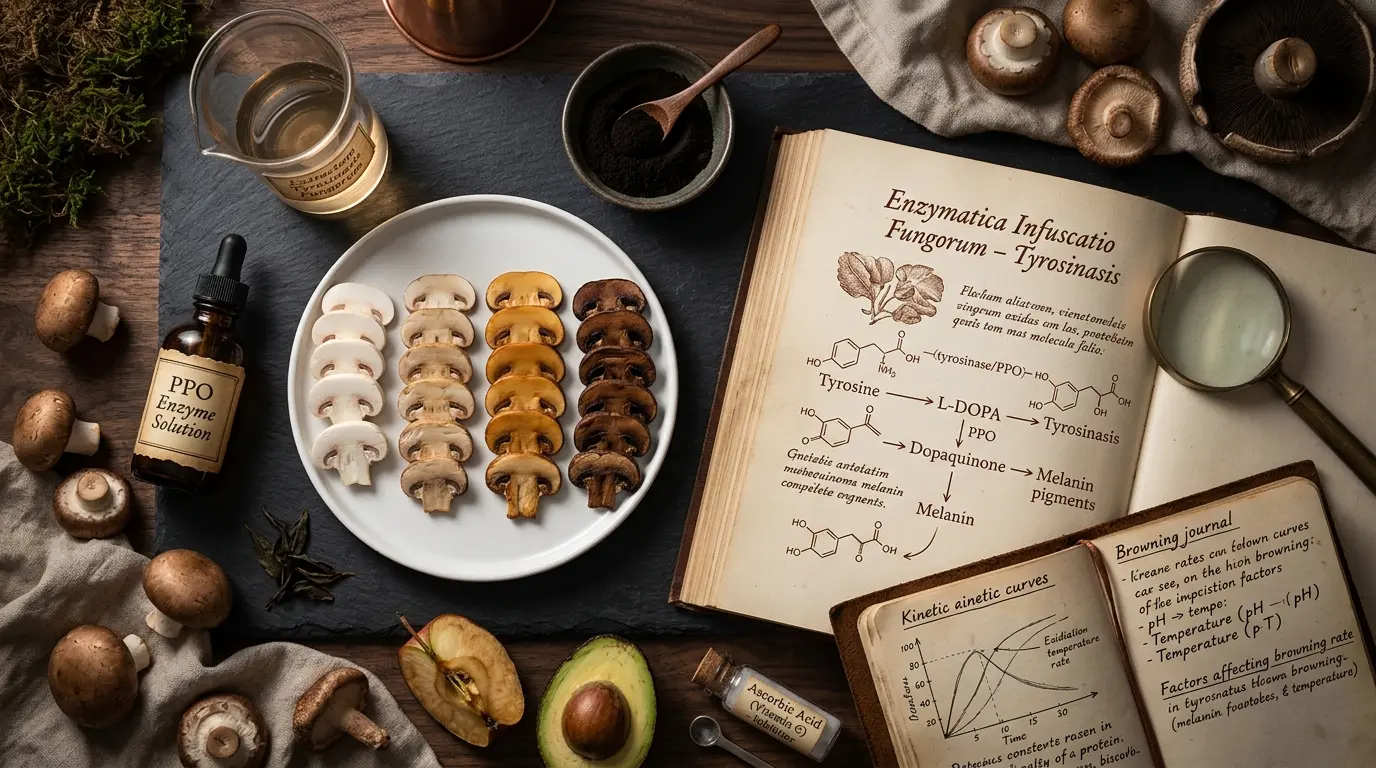
Aged Mushroom: Enzymatic Browning Chemistry
Enzymatic browning is the principal biochemical process responsible for the discoloration observed in fresh and aged mushroom tissues. Unlike non-enzymatic Maillard reactions, which require heat and reducing sugars, enzymatic browning in fungi proceeds at ambient temperatures through the catalytic oxidation of phenolic substrates by polyphenol oxidase (PPO) enzymes, most notably tyrosinase (EC 1.14.18.1) and laccase (EC 1.10.3.2). This reaction cascade transforms colourless monophenolic and diphenolic compounds into reactive quinones, which auto-polymerise into high-molecular-weight melanin pigments. The progressive browning of mushroom fruiting bodies during storage or purposeful ageing directly affects visual quality, consumer acceptance, and the retention of bioactive polysaccharides such as beta-glucan, making the underlying chemistry essential knowledge for medicinal mushroom processors and extract formulators.
Key Enzymatic Players
The dominant PPO in common culinary and medicinal species – including Agaricus bisporus (white button mushroom), Lentinula edodes (shiitake), and Pleurotus ostreatus (oyster mushroom) – is tyrosinase. This copper-containing oxidoreductase catalyses two distinct reactions: the ortho-hydroxylation of L-tyrosine to L-3,4-dihydroxyphenylalanine (L-DOPA) (monophenolase activity), followed by the oxidation of L-DOPA to dopaquinone (diphenolase activity). Laccase, a multi-copper oxidase widely distributed in white-rot basidiomycetes, oxidises a broader range of substrates, including p-diphenols and aromatic amines, accelerating browning in damaged or senescent fungal tissue. Both enzymes are compartmentalised within intact cells; browning initiates only when cellular disruption releases enzymes into contact with vacuolar phenolic substrates.
Substrate Profile and Reaction Cascade
The primary endogenous substrates in mushroom hypae are the amino acid L-tyrosine and the polyphenol γ-L-glutaminyl-4-hydroxybenzene (GHB), a characteristic conjugate unique to Agaricus species. Upon oxidation by tyrosinase, GHB generates 2-hydroxy-4-imino-2,5-cyclohexadienone, a highly reactive quinone that rapidly polymerises to form yellow-brown melanoid compounds. In shiitake and oyster mushrooms, additional substrates include caffeic acid, chlorogenic acid, and catechol derivatives. The intermediate quinones possess strong electrophilic character, enabling non-enzymatic secondary reactions with amino acid side chains, sulfhydryl groups of cysteine, and even β-glucan hydroxyl groups, forming covalent adducts that alter the functional properties of medicinal polysaccharides. This cross-linking can both diminish radical-scavenging capacity and modify the apparent molecular weight of extracted fractions.
Influence of Ageing Conditions on Browning Kinetics
The rate of enzymatic browning in whole mushrooms correlates directly with storage temperature, atmospheric oxygen, and physical bruising. At refrigeration temperatures (4 °C), PPO activity is retarded but not eliminated; controlled atmosphere packaging with elevated CO₂ (10–15 %) further reduces browning by competitive inhibition of tyrosinase and a decrease in cytoplasmic pH. Conversely, deliberate ageing practised in certain traditional mushroom decoctions – such as prolonged low-temperature maceration of Inonotus obliquus (chaga) – exploits slow oxidative polymerisation to alter the organoleptic profile while partially converting phenolic substrates into melanin complexes that exhibit increased aqueous solubility. In a comparative study on aged Agaricus blazei extracts, the IC₅₀ for DPPH radical scavenging declined by 28 % after 72 hours of controlled oxidation, indicating that browning modifies antioxidant capacity in a time-dependent manner (PMID: 30857352).
Melanin Pigment Formation and Biological Implications
Fungal melanins generated through the PPO pathway are not mere visual indicators; they are potent bioactive molecules. DOPA-melanin and GHB-melanin exhibit strong metal-chelating ability, effective UV absorption, and immunomodulatory properties mediated by Toll-like receptor 4 activation (PMID: 26047442). In aged medicinal mushrooms, the progressive accumulation of soluble melanin fractions correlates with an enhanced capacity to scavenge hydroxyl radicals, as measured by electron paramagnetic resonance spectroscopy. Moreover, the melanin polymers themselves have been shown to stimulate tumour necrosis factor alpha (TNF-α) and interleukin-6 (IL-6) release from macrophage cultures at concentrations of 50 μg mL⁻¹, suggesting that controlled enzymatic browning may augment the innate immunostimulatory profile of whole-fruiting-body preparations.
Inhibition Strategies and Quality Control
For medicinal mushroom products where native colour and unoxidised polysaccharide integrity are paramount, processors apply inhibitors of enzymatic browning. Ascorbic acid (vitamin C) acts as a reducing agent that converts quinones back to diphenols, while citric acid chelates the copper cofactor at the tyrosinase active site. Heat blanching (≥90 °C for 120 seconds) irreversibly denatures PPO yet is undesirable for thermolabile β-glucan structures. A promising novel approach involves the use of natural proteasome inhibitors such as lactacystin, which downregulate tyrosinase gene expression at the transcriptional level, preserving the mushroom’s chemical integrity without thermal degradation (PMID: 32764201).
Analytical Assessment of Browning Progress
Quantitative monitoring of enzymatic browning typically employs spectrophotometric measurement at 420–490 nm after ethanolic extraction, coupled with HPLC profiling of individual phenolic substrates. The browning index (BI) defined as ΔOD₄₅₀ × dilution factor correlates with parallel assays of PPO activity using 10 mM L-DOPA as substrate at pH 6.5. Advanced characterisation uses Fourier-transform infrared spectroscopy to track the disappearance of phenolic –OH bending vibrations at 1375 cm⁻¹ and the emergence of quinone carbonyl stretches at 1650 cm⁻¹. These methods permit standardisation of aged mushroom ingredients to a defined melanin content, ensuring batch-to-batch consistency in nutraceutical applications.
Conclusion
Enzymatic browning chemistry is not a simple spoilage reaction but a complex, enzyme-driven polymerisation that fundamentally alters the molecular landscape of aged mushrooms. For MycoVita’s evidence-based approach, precise control over tyrosinase and laccase activity offers a biotechnological lever to tune the balance between preserved β-glucan immunomodulators and newly formed melanin antioxidants. An in-depth understanding of this chemistry informs the design of extraction protocols that maximise the therapeutic potential of aged medicinal mushrooms.