King Oyster Mushroom (Pleurotus eryngii) Species Compendium
— THE HOOK —
What do you place at the centre of a vegan plate?
In the 1990s, three-star restaurants in Paris found an answer: a mushroom from the stony steppes of Puglia, sold for centuries in village markets, now a reference ingredient in Michelin kitchens.
Cardoncello. King Oyster. Medallion.
When seared on a dry pan over high heat, it develops a scallop-like texture, deep Maillard aroma, and fine-dining aesthetics — gastronomy’s protein alternative.
— THE STORY —
Puglia. Southern Italy’s rocky, dry steppes.
In these lands where the eryngo (Eryngium campestre) plant thrives, a mushroom has grown for centuries — locals know it as Cardoncello, sautéed with olive oil and garlic. One of Puglia’s oldest market dishes. Yet the world did not know it.
- Japan. Controlled cultivation commenced. Japanese engineers took this Mediterranean mushroom and converted it into a controlled production format — with thicker stems, greater uniformity, and extended shelf life. The technology spread to Korea and China. Within a decade, it became Japan’s second most consumed mushroom — surpassed only by Shiitake.
Then Italian chefs took notice. This Puglia-origin mushroom was rediscovered in the avant-garde cuisine of the era — now as a protein alternative prized for its scallop-like texture. From the 1990s onward, it became a permanent fixture of European fine dining.
Today: Tokyo markets, Paris restaurants, and MYCOVITA production chambers in Ordu.
— DESCRIPTION AND MORPHOLOGY —
Pleurotus eryngii (DC.) Quél. — from the family Pleurotaceae, one of the most versatile species in the fungal world, both in gastronomy and functional compound profile.
The name Pleurotus derives from the Greek pleuron (side) and otos (ear) — a reference to the lateral growth of the fruiting body. Eryngii refers to the genus Eryngium (eryngo), with which the species forms a parasitic relationship in nature.
In Turkish: Kral İstiridye Mantarı. In Japanese: エリンギ (Eringi). In Italian: Cardoncello.
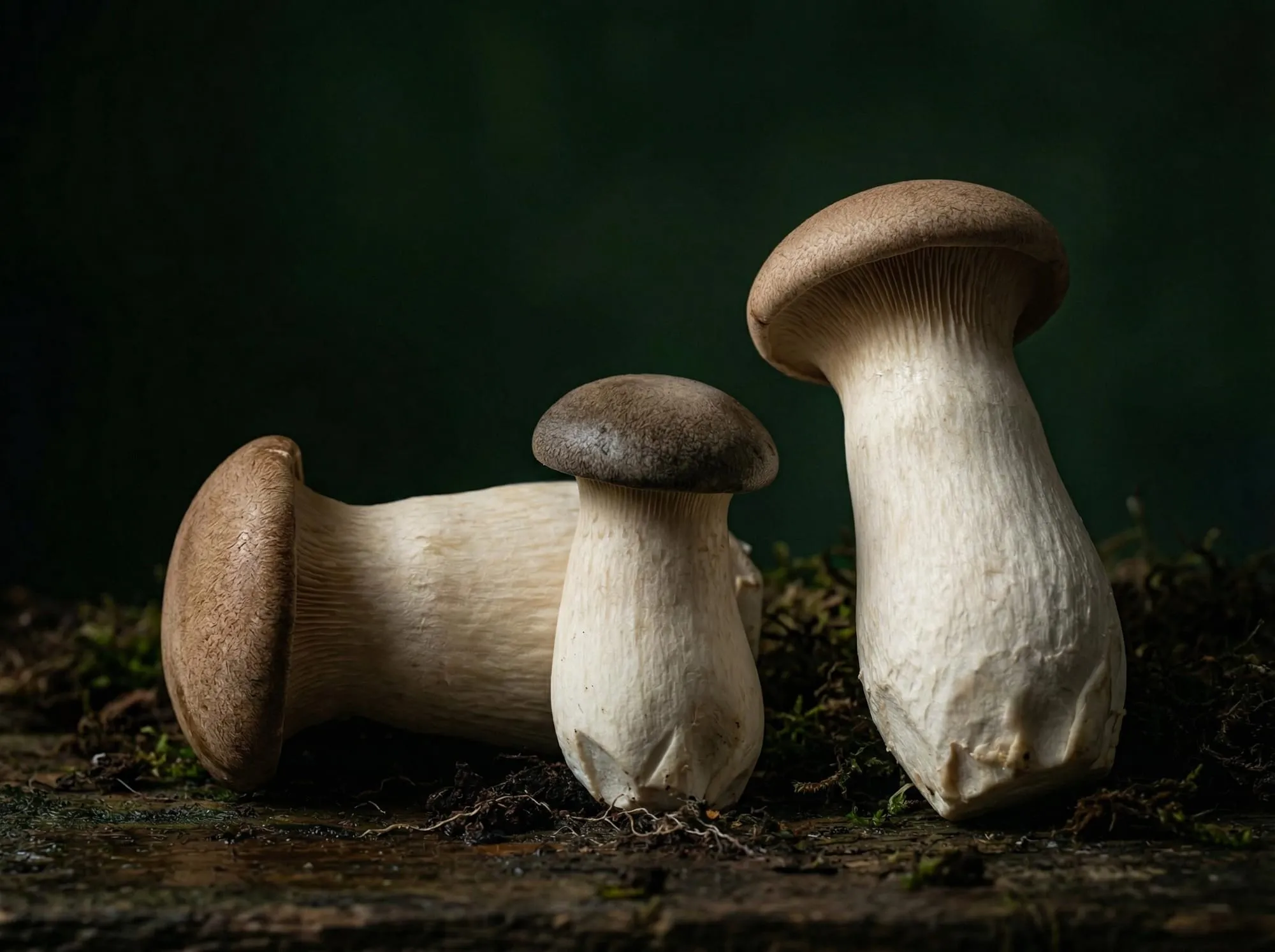
Morphologically, it is distinctly different from other Pleurotus species. The stem is thick, cylindrical, and fleshy — the bulk of its commercial value resides in this stem. The cap is small and flat. Among all Pleurotus species, it possesses the longest shelf life.
Its tissue density is remarkable. When cooked, the stem tissue separates along fibres; under high heat, the Maillard reaction yields a caramelisation and chewiness reminiscent of scallops. This quality makes King Oyster the protein alternative of fine dining.
— BIOACTIVE COMPOUNDS —
Lovastatin — A Natural Statin P. eryngii fruiting bodies naturally contain monacolin. The mechanism — inhibition of the HMG-CoA reductase enzyme — is identical to that of the active ingredient in pharmaceutical statins and is well characterised. The natural presence in mushrooms is significant for research; concentrations fall below pharmaceutical doses.
Reference: Gunde-Cimerman, N. & Cimerman, A. (1995). Pleurotus fruiting bodies contain the inhibitor of HMG-CoA reductase — lovastatin. Experimental Mycology, 19(1), 1-6.
Ergothioneine — The Longevity Amino Acid Among mushroom species, one of the richest sources of ergothioneine. A rare amino acid the body cannot synthesise, obtained only through the diet. Its mechanism of protecting mitochondrial membranes against oxidative damage is under investigation. It is taken up into cells via the OCTN1 transporter protein — a transport system developed for no other molecule.
Reference: Beelman, R.B. et al. (2020). Is ergothioneine a 'longevity vitamin'? Journal of Nutritional Science, 9, e52.
Beta-Glucan 15–25% A polysaccharide fraction with beta-(1→3)/(1→6) linkages. The mushroom beta-glucan referenced in immune receptor interaction studies.
GMP (Guanosine Monophosphate) The molecular source of umami. Formed from RNA breakdown during drying and rehydration — hence the dried form carries more intense umami than fresh.
— CURRENT RESEARCH —
Cardiovascular Profile: The effects of P. eryngii extracts on cholesterol metabolism are under investigation. Lovastatin content is the focal point of this research.
Reference: Hossain, S. et al. (2003). Dietary mushroom Pleurotus ostreatus lowered blood cholesterol. Mymensingh Medical Journal.
Antioxidant Capacity: With its ergothioneine and beta-glucan content, the effects of P. eryngii on oxidative stress markers have been examined.
Reference: Mau, J.L. et al. (2004). Antioxidant properties of several specialty mushrooms. Food Research International.
— MYCOVITA —
MYCOVITA produces King Oyster in Chamber 3 — 15–16°C, 90–95% humidity, mixed hardwood sawdust formulation. For the Gastronomy Series, it is whole dried. Low-temperature drying at 42–45°C preserves tissue integrity and the umami profile.
Harvest: when the cap is still incurved. Once it begins to flatten, the tissue softens and Maillard capacity declines.
Every batch with COA. 100% fruiting body.
— CULINARY USE —
Scallop Technique (Main Course)
- Rehydrate in 50–60°C warm water for 20–30 minutes.
- Pat completely dry with paper towels — a wet surface will not sear; it will steam.
- Optionally, score the surface with a knife tip in a crosshatch pattern.
- Cast iron pan — maximum heat. Place mushroom slices scored side down.
- Do not touch — 3–4 minutes. Until the underside turns golden brown.
- Flip. Add butter, garlic, fresh thyme. Baste with the aromatic fat by spooning it over — 2 minutes.
To serve: On celery root purée, pea mash, or cauliflower purée. Sea salt, fresh lemon.
Soaking liquid: Do not discard the rehydration water — GMP has leached into it. Use as the base for risotto, soup, or sauce.
— CAUTION —
Those taking statin medications should consult their physician (lovastatin content).
You May Also Like
→ Is Mushroom Produced in Turkey Reliable?
→ Functional Mushroom Production in Turkey
Related readings: What is Ergothioneine? · King Oyster in the Kitchen · Vegan Protein Plate — Scallop Technique
About MYCOVITA’s production philosophy, technical infrastructure, and transparency principles: Why MYCOVITA?
Gastronomy Series — No.01 | Library Encyclopedia | MYCOVITA
This content is for informational purposes only and does not constitute medical advice. Consult your physician before making any health decisions. Functional mushrooms are not drugs and cannot be used to treat diseases.
Version: 1.0 | Last updated: 20 Apr 2026 | Sources reviewed: 9+ | Method: Editorial Policy | References: Bibliography