Polysaccharide-K (PSK): The Clinically Recognized Active Compound in Turkey Tail Mushroom
— HOOK —
One mushroom constituent passed one of the most stringent drug approval processes in the world.
- Japan's Ministry of Health. Approved as an official cancer adjuvant.
It remains in use today.
The compound is called PSK. Its story began with a factory worker in 1965.
— STORY —
- Japan. A researcher from Kureha Chemical Industries documented the unexpected recovery of a factory worker diagnosed with late-stage gastric cancer. The worker's only notable habit was regularly drinking a mushroom tea.
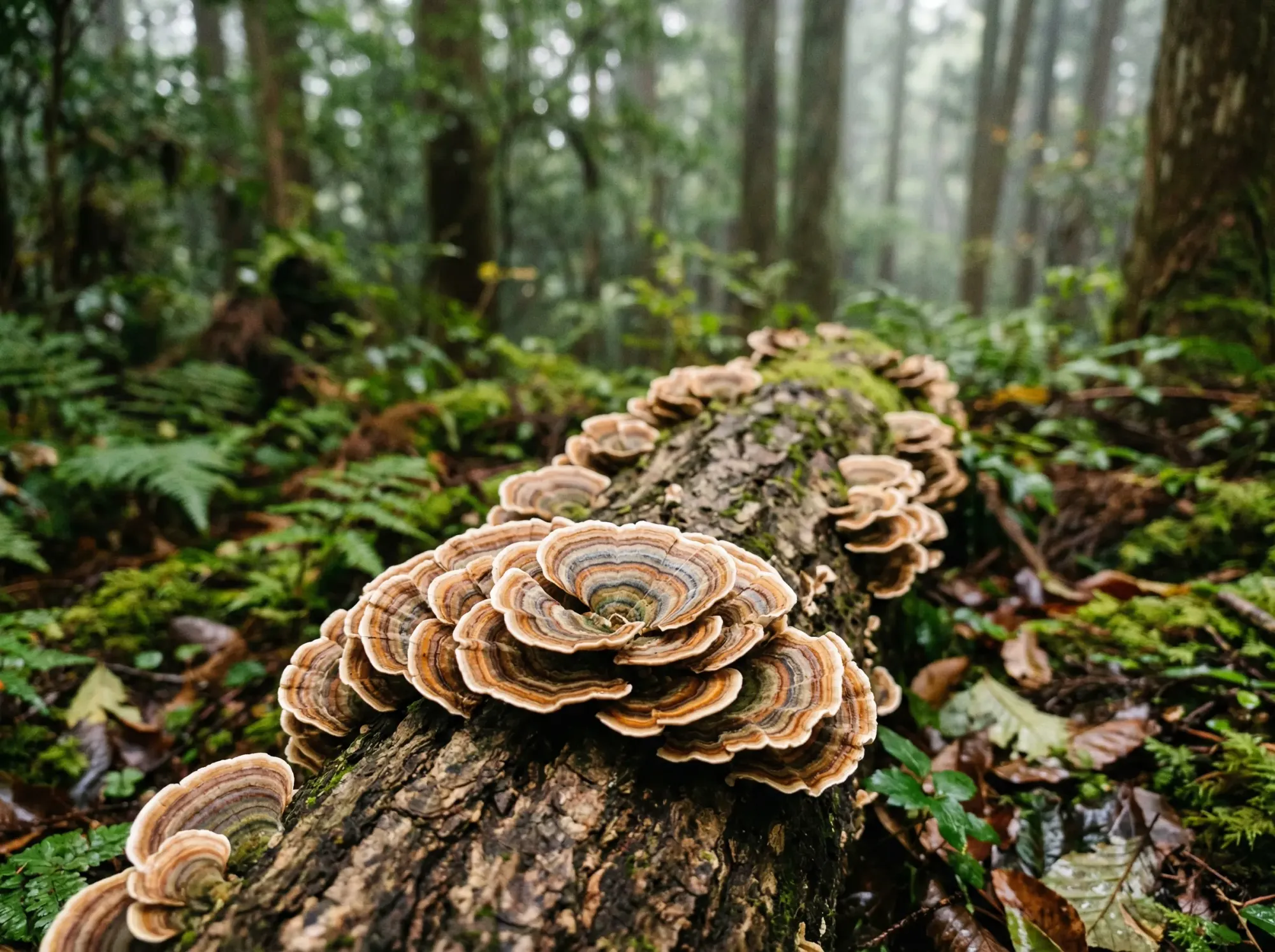
That mushroom was Turkey Tail — Trametes versicolor.
This single observation became the starting point for decades of systematic research. The Kureha team began examining Turkey Tail's bioactive profile. Years later, they gave a name to the compound they isolated: PSK — Polysaccharide-K. Its commercial name is Krestin.
In 1977, Japan's Ministry of Health formally approved PSK. It was the first instance in medical mycology history of a mushroom constituent achieving this status.
Today, PSK continues to be used in Japan as part of standard adjuvant protocols following surgery for gastric, lung, and colorectal cancers.
— WHAT IS PSK? —
PSK is a protein-bound beta-glucan complex obtained from the fruiting body of Turkey Tail. Its chemical structure: beta-(1→4) glycosidic backbone with beta-(1→3) and alpha-(1→6) branches — covalently linked to a protein.
What distinguishes it from standard beta-glucans is this protein bond. The protein linkage allows the molecule to survive passage through the digestive system and influences its interaction with immune receptors.
What is PSP? In 1983, Chinese researchers isolated a different fraction from Turkey Tail: PSP — Polysaccharide-Peptide. Structurally similar to PSK, but it contains a distinct protein fraction. Both are referenced separately in immunomodulation research.
— RESEARCH —
Japan — Colorectal Cancer: A multicenter randomized controlled trial reported positive effects of PSK adjuvant therapy on 5-year survival following colorectal cancer surgery.
Reference: Ohwada, S. et al. (2004). British Journal of Cancer, 90(5), 1003–1010.
United States — Breast Cancer: A Phase 1 clinical trial conducted at Oregon University reported increased NK cell activity and a favorable safety profile.
Reference: Torkelson, C.J. et al. (2012). ISRN Oncology.
Gut Microbiome: Clinical findings indicate that Turkey Tail intake increases Bifidobacterium and Lactobacillus populations.
Reference: Pallav, K. et al. (2014). Gut Microbes, 5(4), 458–467.
— IMPORTANT DISTINCTION —
PSK is a pharmaceutical substance isolated from Turkey Tail and put through a clinical process. In Japan, the Kureha Corporation manufactures it as a drug under the name Krestin.
MYCOVITA Turkey Tail Apothecary No.05, on the other hand, is a food. It contains whole-spectrum fruiting body powder that carries the PSK fraction — it is not an isolated pharmaceutical form.
This distinction matters. Yet one statement holds true: no other functional mushroom species possesses a research history as extensive as that of Turkey Tail.
— WHY BREW? —
PSK and PSP are large molecules trapped within the chitin layer of the mushroom cell wall. The human stomach cannot digest chitin — so if the raw powder is swallowed, these compounds pass through without being absorbed.
The solution: hot water extraction.
Brewing in 85–90 °C water for 10–12 minutes allows PSK and PSP to escape the chitin wall and transfer into the water. This is why timing is critical for Turkey Tail — if you steep for less than 8 minutes, a significant portion of the fractions remains undissolved.
A note specific to Turkey's culture: the Turkish tea tradition offers an advantage here — long steeping is already a habit.
— HOW TO USE —
1–2 g / 250 ml · 85–90 °C · 10–12 minutes · Strain. Taste: a slightly sweet opening, with a dry herbaceous and earthy finish. Neutral — pairs well with any tea, coffee, or soup.
Winter Protocol: consistent daily intake of 1.5–2 g from November through March. The effect is cumulative — regularity matters, not a single dose.
— CAUTION —
Individuals undergoing chemotherapy or immunosuppressive therapy should consult their physician before using Turkey Tail. Immunomodulatory constituents must align with active treatment protocols.
You Might Also Like
→ Mycology Glossary — 130+ Terms from A to Z
→ Can You Trust Mushrooms Produced in Turkey?
→ Functional Mushroom Production in Turkey
→ Mushrooms and Cancer Research
Further reading: Turkey Tail Encyclopedia · How Does the Immune System Work?
MYCOVITA's production philosophy and transparency principles: Why MYCOVITA?
Mycelial Library | MYCOVITA
Beta-Glucan and Immunomodulation — Related Resources
A content cluster on mushroom beta-glucan and immune system interaction:
- What Is Beta-Glucan? — Molecular structure and bond types.
- How Does the Immune System Work — The Dectin-1 receptor and innate immunity.
- Beta-Glucan Measurement Methods — Megazyme and other laboratory techniques.
- Lentinan — Shiitake's approved beta-glucan.
- PSK — Turkey Tail's polysaccharide-protein complex.
- D-Fraction — Maitake's active beta-glucan fraction.
- Lentinan vs PSK vs Beta-Glucan — A comparison.
- Sparassis crispa — Highest natural beta-glucan density.
- Chitin — The cell wall that traps beta-glucan.
- Extraction Methods — Beta-glucan bioavailability.
This content is for informational purposes only and does not constitute medical advice. Consult your physician before making any health decisions. Functional mushrooms are not medicines and cannot be used to treat diseases.
Version: 1.0 | Last updated: 20 Apr 2026 | Number of sources reviewed: 9+ | Method: Editorial Policy | References: Bibliography