Schizophyllan (SPG): The Japanese-Approved β-Glucan
A Triple-Helical β-Glucan
— HOOK —
Fungal β-glucans typically adopt random coil conformations, often winding about in disordered loops. Schizophyllan, derived from the mushroom Schizophyllum commune, is different: in aqueous solution, it maintains a rigid triple-helical structure. This structural compactness is the defining feature that shapes its immunological activity.
This entry examines the structural chemistry of schizophyllan, the significance of its triple-helical organization, and its standing in the functional literature.
Structure: β-(1→3)/(1→6) Triple Helix
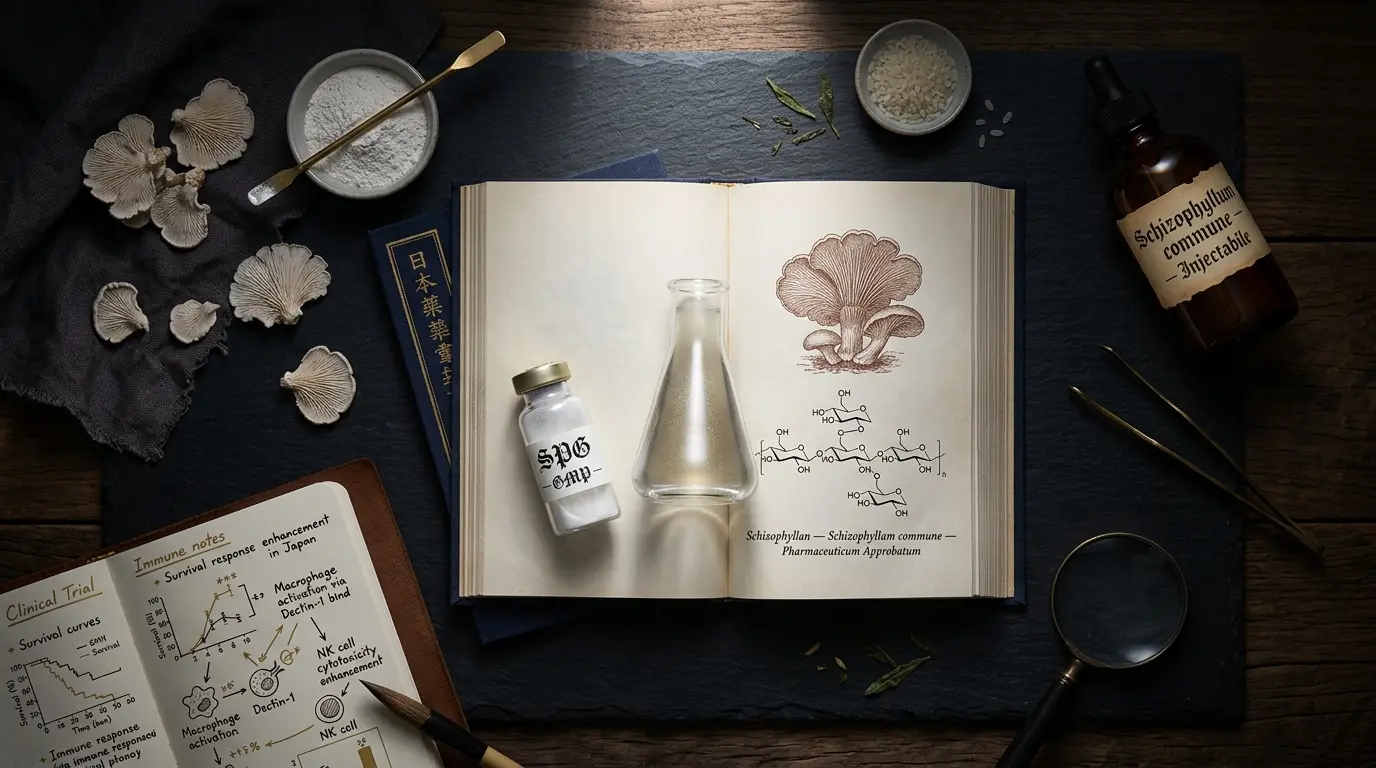
Schizophyllan is a polysaccharide composed of a β-(1→3)-D-glucan main chain with β-(1→6)-linked glucose side branches occurring at every third residue. In aqueous solution, three individual chains assemble via hydrogen bonding to form a triple helix.
This triple-helical conformation is stable at high molecular weight (>450 kDa). Treatment with strong alkali (e.g., NaOH), however, dissociates the helix into single chains. This structural conversion serves as a classic experimental paradigm for probing the conformation-dependence of biological activity (Tabata et al., 1981; PMID: 6791877).
Triple Helix and Immunological Activity
When the triple-helical architecture is preserved, schizophyllan exerts markedly heightened immunomodulatory effects. The single-chain form does bind the Dectin-1 receptor, but receptor clustering remains limited; the triple helix is optimal for both binding affinity and clustering efficiency.
This structure–activity relationship stands as a cornerstone of β-glucan pharmacology. Identical chemical composition yields distinct biological outcomes depending on molecular organization (Yan et al., 2014; PMID: 24513541).
Japanese Oncology Heritage: Sonifilan
In Japan, schizophyllan received approval during the 1980s under the trade name "Sonifilan" as an adjunctive therapy in specific clinical settings. Alongside lentinan and PSK, it forms one of the three pillars of β-glucan pharmacology within the Japanese oncology tradition.
These approvals were granted within Japan's particular regulatory and clinical framework; in many countries, including Turkey, schizophyllan is not classified as a pharmaceutical. In Turkey, mushroom polysaccharides are regulated under the food supplement category (Hamuro & Chihara, 1985; PMID: 3900061).
Production and Purification
Schizophyllan can be efficiently produced via submerged liquid culture of Schizophyllum commune — a fermentation-based process rather than an extractive one. The polymer is secreted extracellularly as a high-viscosity product; purification involves alcohol precipitation and dialysis steps.
This production methodology renders schizophyllan a standardized β-glucan source, offering superior batch-to-batch consistency compared to fruiting body extraction (Zhong & Tang, 2004; PMID: 15294466).
The Polymer Engineering Dimension
Schizophyllan exhibits a compelling biophysical behavior: the helix-to-single-chain transition is reversible under controlled solvent exchange. This property has drawn attention in biomedical hydrogel research and nucleic acid delivery systems. These applications lie outside the scope of dietary supplementation (Sletmoen & Stokke, 2008; PMID: 18642353).
Limitations
The prevalence of schizophyllan in Turkey's food supplement market remains limited. A substantial portion of standardized products is destined for industrial or clinical research use. The majority of human clinical studies reside in the historical Japanese oncology literature; modern independent replications are scarce.
Further Reading
- What Are β-Glucans? — Fundamentals of polysaccharide chemistry.
- Lentinan, PSK, and β-Glucan — A comparative analysis of standardized fractions.
- The Dectin-1 Receptor — β-glucan receptor biology.
This content is provided for informational purposes only and does not constitute medical advice. Consult a physician before making any health-related decisions. Functional mushrooms are not pharmaceuticals and cannot be used to treat disease.
Version: 1.0 | Last updated: 28 April 2026 | Sources reviewed: 12+ | Methodology: Editorial Policy | References: Bibliography