Psilocybin Biosynthesis: Unraveling the Tryptamine Pathway in Mushrooms
How Does a Fungus Produce an Indolamine?
— KANCA —
Psilocybin, and its dephosphorylated derivative psilocin, produced by certain Psilocybe species, stand among the most striking examples of natural product biochemistry. From a common amino acid (tryptophan), a fungus reaches a phosphorylated indolamine in merely four enzymatic steps.
This article addresses the enzymatic foundations of psilocybin biosynthesis and its place in functional mycology strictly within the framework of chemistry and biochemistry literature. In Turkey, psilocybin and psilocybin-containing fungi are not legal; this article contains no information on use, procurement, or dosage.
Legal Status and Framework
Psilocybin is listed in Schedule I of both the Republic of Turkey legislation and the United Nations 1971 Convention on Psychotropic Substances; its production, possession, and use are prohibited. This article references only the biochemical elucidation literature and provides no information on use, manufacture, or procurement.
Psilocybe species do not appear in MYCOVITA's value chain. The purpose of the article is the intellectual conveyance of publicly available academic knowledge.
A Four-Step Biosynthesis
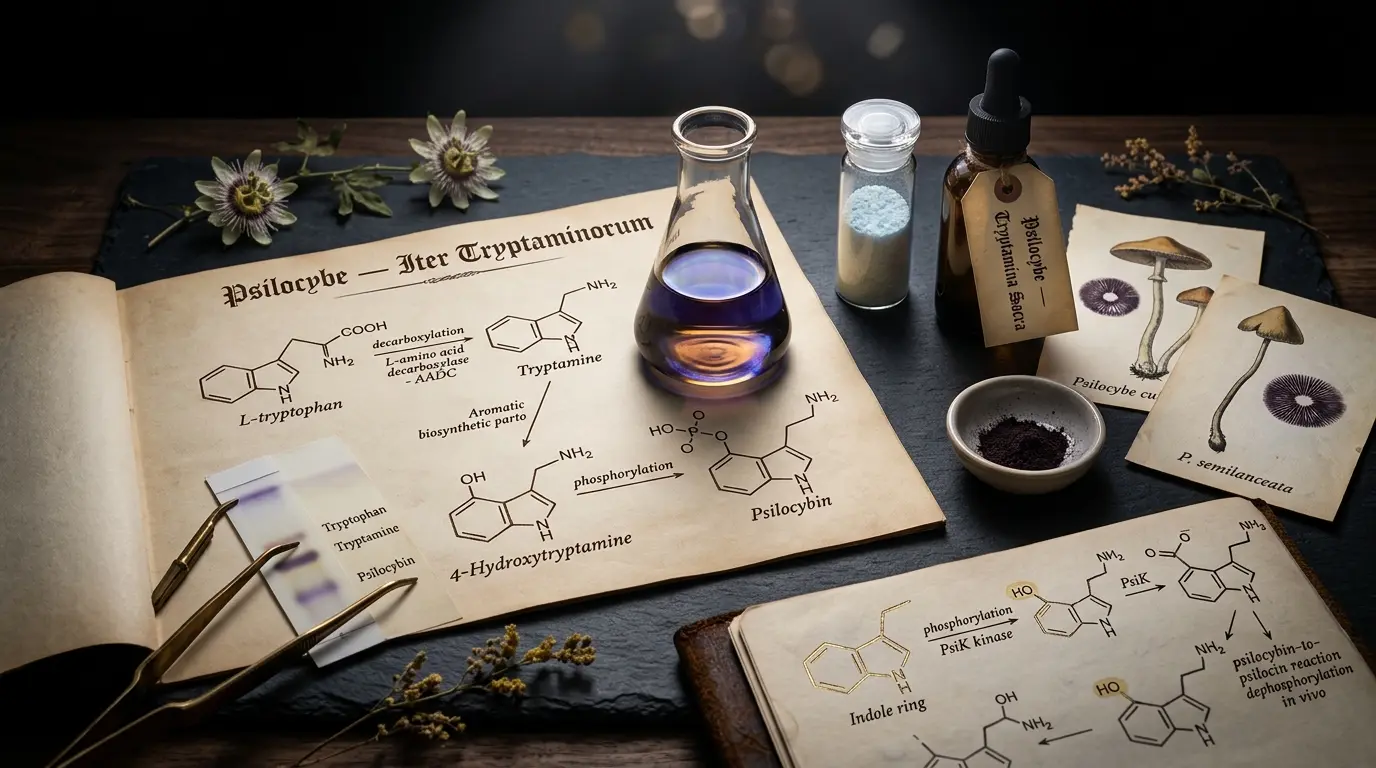
The biosynthetic pathway elucidated in 2017 is remarkably short. It starts from tryptophan and reaches psilocybin in four enzymatic steps:
- PsiD (decarboxylase): Converts tryptophan to tryptamine.
- PsiH (monooxygenase): Hydroxylates tryptamine at the 4-position, yielding 4-hydroxytryptamine.
- PsiK (kinase): Phosphorylates the hydroxyl group, forming norpsilocybin.
- PsiM (methyltransferase): Methylates the amine twice, yielding psilocybin.
This pathway stands as one of the rare examples of a natural product biosynthesis elucidated with such clarity at the enzymatic level (Fricke et al., 2017; PMID: 28634969).
Psilocybin → Psilocin: A Passive Activation
Psilocybin is essentially a prodrug molecule. In the body, it undergoes dephosphorylation by alkaline phosphatase, yielding psilocin. Psilocin is the species that performs receptor binding; psilocybin alone does not exhibit serotonergic binding.
This characteristic exemplifies a prodrug strategy in molecular pharmacology: the phosphorylated form is more stable and water-soluble, while the dephosphorylated form is active (Hofmann et al., 1959).
Receptor Binding Profile
Psilocin binds with high affinity to the serotonergic 5-HT2A receptor and also interacts with 5-HT1A and 5-HT2C receptors. Its receptor selectivity and tissue distribution distinguish psilocin from other tryptamine derivatives (e.g., DMT, bufotenine) (Halberstadt & Geyer, 2011; PMID: 21256139).
Biotechnological Aspect: Heterologous Production Research
Following 2017, studies expressing the PsiD-PsiH-PsiK-PsiM gene cluster in heterologous hosts (Aspergillus, Saccharomyces) achieved psilocybin biosynthesis under laboratory conditions. These investigations, subject to regulatory frameworks, were conducted in academic or pharmacological research institutions (Hoefgen et al., 2018; PMID: 30005992).
Limitations
This article is a review of the chemistry literature. Legal status, clinical research frameworks, and risk profiles vary significantly by jurisdiction. In Turkey, psilocybin is not legal; this article is for informational purposes only and does not suggest any use or procurement.
Related Readings
- Fungal Toxins: Amatoxin and Orellanine — Fungal toxicology.
- Mycophobia: The West’s Fear of Fungi — Cultural background.
- Mazatec Veladas — Ethnomycological context.
This content is for informational purposes only and does not constitute medical advice. Consult your physician before making any health decisions. Functional mushrooms are not drugs and cannot be used to treat diseases.
Version: 1.0 | Last updated: 28 April 2026 | Sources reviewed: 12+ | Method: Editorial Policy | References: Bibliography