Perimenopause and Mushroom Bioactives: A Literature-Based Review
The Morning of a Forty-Three-Year-Old Woman
— PROLOGUE —
She wakes in the night drenched in sweat. The next morning she faces the mirror and asks, "am I still myself?" Menstruation has grown erratic, sleep is fragmented, mood swings on a hinge. She visits her physician; the hormone panel returns a single word: perimenopause. Sometimes there is a prescription, sometimes there is not. She turns to the internet: forums, blog posts, headlines promising "natural solutions." A list unfurls before her, and at the top of that list sit functional mushrooms.
This article does not pronounce that list correct or incorrect. It neither endorses nor refutes it. Our undertaking is more modest: to frame how much the literature can actually say on this subject, how much remains speculative, and at which precise junctures mushroom chemistry has been investigated within the transitional window known as perimenopause.
The conclusion, stated up front: the physician makes the decision. Here, only the chemistry speaks.
What Occurs in the Body During Perimenopause
Perimenopause is the transitional interval spanning approximately four to ten years preceding the final menstrual period. Estradiol and progesterone levels do not decline in a stable, linear fashion; they oscillate widely. FSH rises, yet not in a straight line. This hormonal turbulence generates simultaneous effects across multiple systems: thermoregulation (hot flushes), sleep architecture, bone turnover, lipid profiles, mood, and cognitive alertness.
Within the clinical literature, perimenopause does not present as a single uniform picture; it constitutes a spectrum of phenotypes. In some women vasomotor symptoms dominate, in others sleep disruption, in still others a cognitive "fog." This heterogeneity complicates any expectation that a given dietary compound might produce a "one-size-fits-all" effect.
Mushroom Compounds: Which Mechanisms Are Under Investigation
Concerning the physiology of perimenopause, academic interest in functional mushrooms converges on several distinct axes.
Bone Turnover and Vitamin D
Perimenopause is a period during which the decline in estrogen relatively increases osteoclast activity. Ergosterol, naturally present in mushrooms, converts to vitamin D2 (ergocalciferol) upon exposure to UV-B light. Species such as shiitake and maitake have been studied for this D2 conversion over many years. The bioavailability of vitamin D2 differs from that of D3; this distinction remains a subject of debate in the literature.
HPA Axis and Sleep
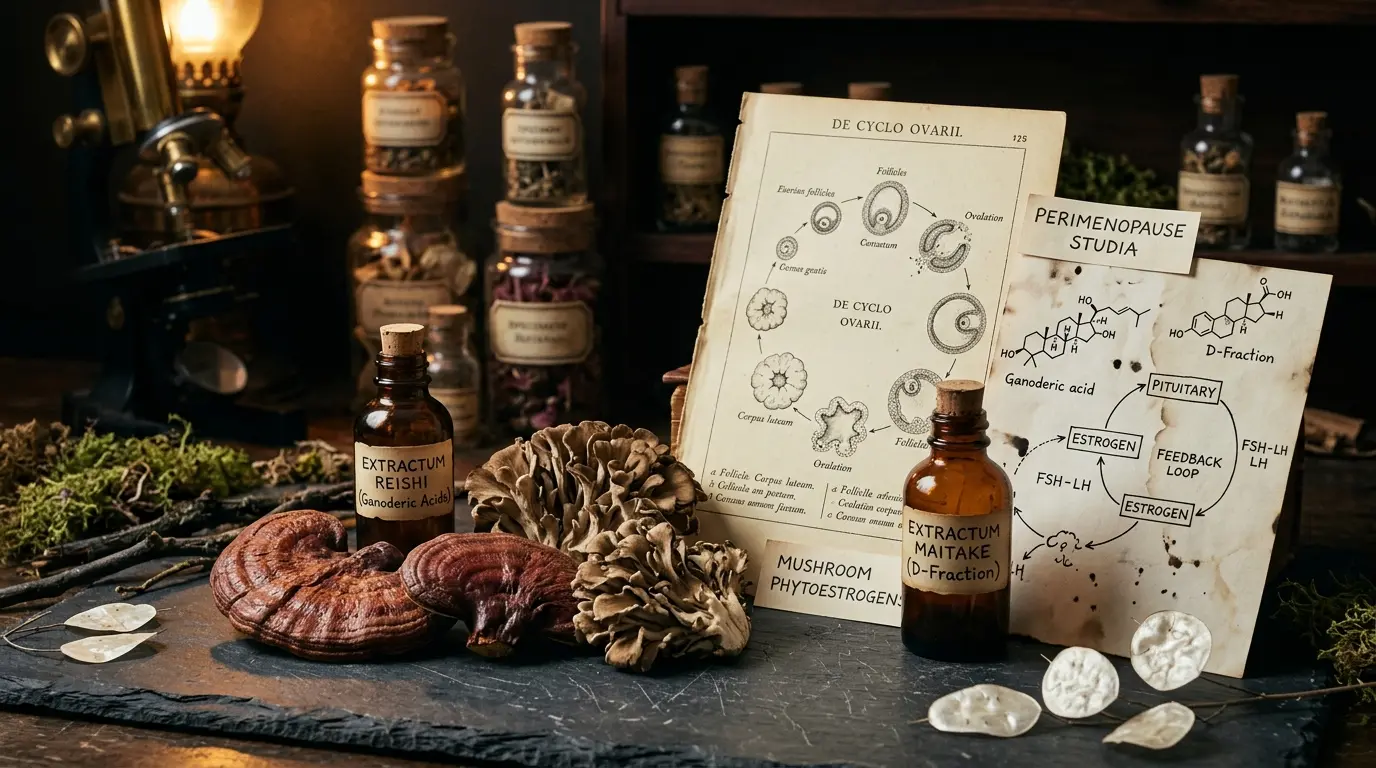
During perimenopause the cortisol rhythm frequently shifts; nocturnal awakenings increase. In animal and in vitro studies conducted with reishi (Ganoderma lucidum), the effects of triterpene fractions on HPA axis modulation constitute an active research topic. These studies offer a mechanistic framework rather than a clinical case report.
Cognitive Alertness
"Brain fog" appears with notable frequency in perimenopausal self-reports. Lion's mane (Hericium erinaceus) contains hericenone and erinacine derivatives; the effects of these molecules on NGF (nerve growth factor) synthesis have been documented in in vitro cell culture studies. Evidence supporting clinical translation remains limited.
Metabolic Transition
The decline in estrogen may influence visceral adiposity trends and insulin response. The effects of β-glucan-containing mushrooms on glucose and lipid metabolism are being investigated within the cardiometabolic literature. Results are inconsistent, and differences in product, dosage, and matrix render interpretation challenging.
What Cannot Be Claimed
The existing literature does not support the assertion that perimenopausal symptoms are "resolved" by functional mushrooms. The decision-making mechanism for hormone replacement therapy (HRT), lifestyle modifications, and pharmacological options resides between physician and patient. Mushroom compounds are not an alternative to this decision; at most they represent a nutritional component under discussion.
For individuals taking thyroid medications, anticoagulants, antidepressants, or HRT, consulting a physician before initiating functional mushroom consumption is the standard recommendation found in academic journals.
Related Reading
- Menopause and Functional Mushrooms: Literature and Safety — the period that follows perimenopause.
- Estrogen Receptors and Mushroom Compounds — a molecular-level examination.
- Postpartum Mushroom Use: Safety — another transitional window.
This content is for informational purposes only and does not constitute medical advice. Consult your physician before making any health-related decisions. Functional mushrooms are not pharmaceutical drugs and cannot be used to treat diseases.
Version: 1.0 | Last updated: 24 April 2026 | Sources reviewed: 12+ | Methodology: Editorial Policy | References: Bibliography