Pachyman: The Defining Beta-Glucan of Poria cocos
An Insoluble β-Glucan
— HOOK —
Mushroom polysaccharides are not uniform. Some dissolve readily in water and form viscous solutions (for example, tremellan from Tremella). Others are almost completely insoluble; without an artificial solvent, an alkali, or a chemical modification, they remain inert in water. Pachyman belongs to this second category.
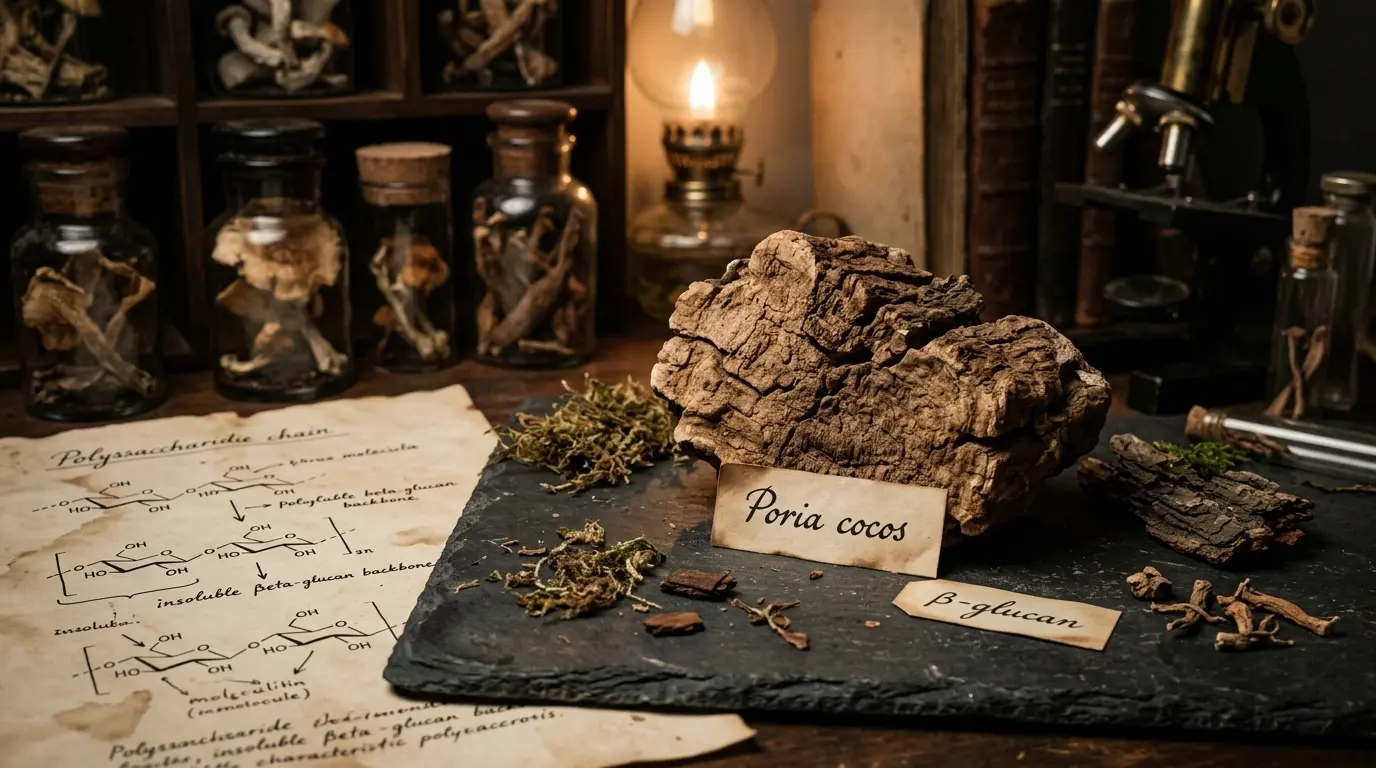
Pachyman is the main structural polysaccharide located in the sclerotium (the underground, tuber-like structure) of the fungus Poria cocos. In Traditional Chinese Medicine, Poria cocos has been used for centuries; pachyman, in modern biochemistry, is the molecule that carries this mushroom’s structural identity. The interesting point is this: pachyman itself exhibits low in vitro biological activity. What makes it worthy of investigation are its derivatives.
Definition: The Structural Backbone of Pachyman
Pachyman is a linear β-(1→3)-D-glucan. It carries very few side branches; only a few β-(1→6)-linked glucose residues per thousand backbone units. This absence of branching is the fundamental reason for its insolubility in water. By comparison: lentinan from shiitake also possesses a β-(1→3) backbone but has regular β-(1→6) side branches; as a result, it is water‑soluble and forms a triple‑helix conformation.
The molecular weight of pachyman falls in the approximate range of 100–200 kDa. Its structure displays crystal‑like packing, which adds an additional contribution to its insolubility.
Source: Sclerotium
Pachyman is found not in the fruiting body of Poria cocos, but in its sclerotium. The sclerotium is a dense extracellular structure that the fungus forms under stress conditions; it is a long‑lived storage form. Pachyman accounts for a significant portion of the sclerotium’s dry weight (according to some sources, in the 70–90% range).
The Solubility Problem and Derivative Transformations
Because the native form of pachyman does not dissolve in water, biological activity studies cannot be performed directly with pure pachyman. For this reason, the literature reports a series of chemical modifications:
- Carboxymethylation: Pachyman is reacted with monochloroacetic acid. The result is water‑soluble carboxymethyl pachyman (CMP). This derivative is the form used in the vast majority of in vitro studies.
- Sulfation: Addition of sulfate groups yields negatively charged, water‑soluble sulfated pachyman.
- Hydroxyethylation: Hydroxyethyl groups moderately enhance solubility.
These modifications change the identity of pachyman. CMP is not native pachyman; it is structurally related but a distinct molecule. In the literature, the term “pachyman” frequently refers to one of these derivative forms.
In Vitro Literature
Studies on pachyman and its derivatives are generally gathered under two headings:
- Structure–function relationship studies: Examining how the degree of derivatization (DS) influences solubility and cellular interaction.
- Immune cell culture observations: The effects of carboxymethyl and sulfated derivatives on cytokine responses in macrophage cell lines.
The great majority of these studies are at the cell‑culture level. Clinical studies are few, and those that exist display methodological heterogeneity. Pachyman is not a drug; when approached in the context of dietary supplements, the derivative profile of the extract (pure pachyman versus CMP) is a critical parameter for quality and function.
Pachyman in the Context of Poria cocos
The sclerotium of Poria cocos has traditionally been used as tea, soup, and dry powder. Standard hot‑water extraction does not bring the bulk of pachyman into solution; the soluble fraction consists of small molecules and other polysaccharides. This indicates that traditional use operates not through pure pachyman, but through the whole sclerotium composition.
In modern extract formulations, one should note that it is the soluble β‑glucan fraction that is measured, not the pachyman content. A “% polysaccharide” statement on a certificate of analysis represents the total soluble fraction obtained by extraction, not pachyman itself.
Related Readings
- What Is Beta‑Glucan — The decisive influence of branching structure on solubility.
- What Is Lentinan — An example of a water‑soluble β‑glucan that contains side branches.
- Lentinan vs PSK vs β‑Glucan — A structural comparison of mushroom β‑glucans.
This content is for informational purposes only and does not constitute medical advice. Consult your physician before making any health decisions. Functional mushrooms are not drugs and cannot be used to treat diseases.
Version: 1.0 | Last update: 27 April 2026 | Sources reviewed: 12+ | Methodology: Editorial Policy | References: Bibliography