Tremellan Defined: The Structural Profile of Tremella Polysaccharide
A Water-Holding Polysaccharide
— HOOK —
Place dried Tremella fuciformis in water and it undergoes a striking transformation. What begins as a small, white, shriveled cluster swells, over 20–30 minutes, into a gelatinous, translucent cloud several times its original volume. This behavior does not trace to a single molecule but to a family of compounds: acidic heteropolysaccharides. Among them, tremellan stands as a principal actor.
Tremellan appears frequently throughout the mushroom polysaccharide literature. Yet its precise structure resists encapsulation in a single formula; minor variations arise depending on cultivation conditions and extraction protocols. This entry examines what tremellan is, why it binds water with such efficiency, and how it is situated within the scientific record.
Definition: Structural Classification of Tremellan
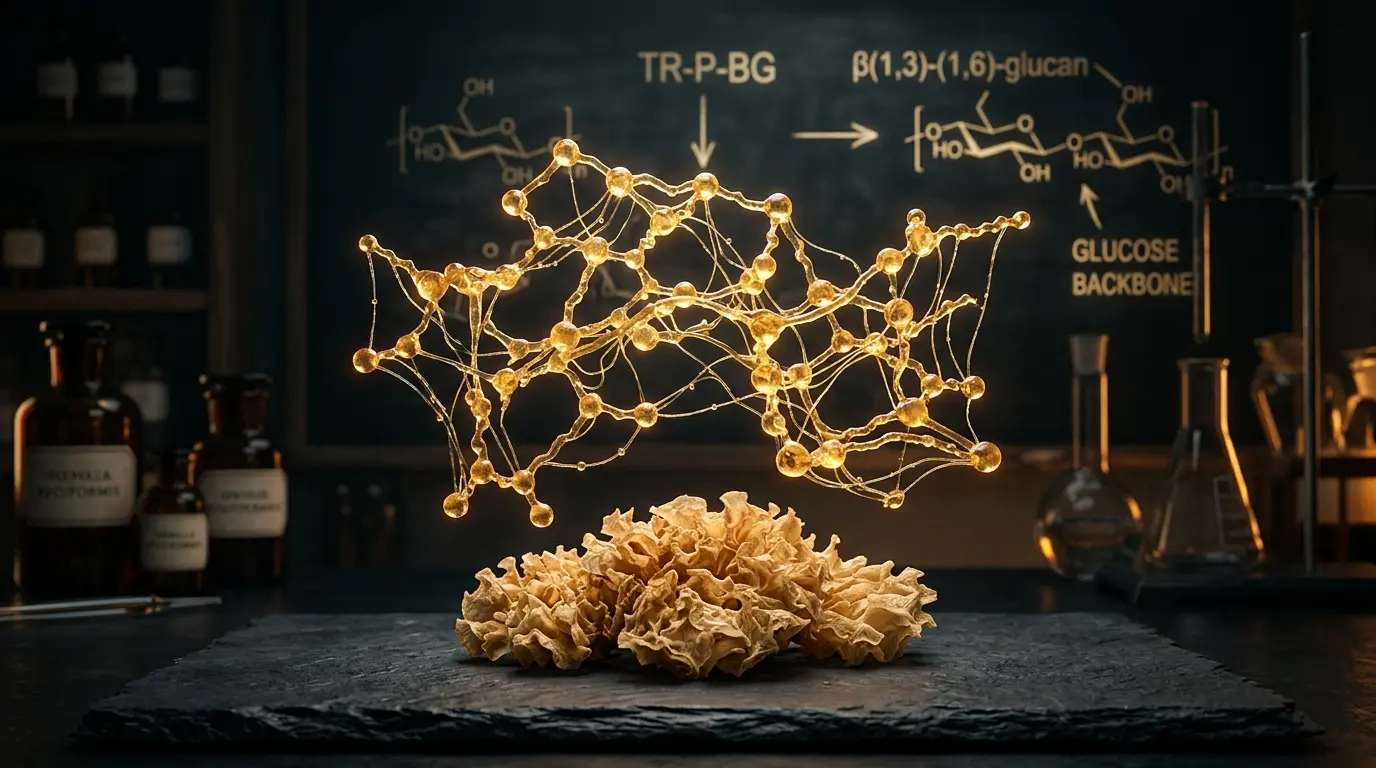
Tremellan is an acidic heteropolysaccharide — acidic because it contains uronic acid residues, hetero because its backbone comprises more than one type of sugar unit. The backbone consists predominantly of α-(1→3)-linked mannose residues. Branching from this core are side chains composed of xylose, glucuronic acid, and other monosaccharides.
The acidic character derives from the glucuronic acid groups. These confer a net negative charge in aqueous solution, which in turn underpins the polysaccharide's exceptional water-binding capacity. In the literature, tremellan is sometimes referred to as Tremella glucuronoxylomannan (GXM) — an alternative name for the same molecular family.
Molecular Weight Range
Tremellan does not possess a single definitive molecular weight. Depending on the purification protocol, fractions spanning approximately 200 kDa to 2,000 kDa are obtained. Higher-molecular-weight fractions display markedly elevated viscosity.
Water-Binding Capacity
The defining characteristic of Tremella and its signature polysaccharide is water-holding capacity. Purified tremellan binds many times its own weight in water within a gel matrix. This property arises from the interplay of three structural features: the hydrophilic side groups of uronic acids along the polymer backbone, the open-network architecture created by extensive branching, and the molecule's strong tendency to form viscous solutions.
This trait has drawn the attention of researchers in cosmetic formulation and food materials science. Tremellan is occasionally compared to hyaluronic acid, as both are high-molecular-weight, acidic, water-retaining polysaccharides. The two molecules, however, are structurally distinct; the comparison rests on functional parallelism, not structural homology.
Extraction and Purification
Tremellan is typically obtained through hot water extraction. The dried fruiting body of the mushroom is heated with water, the soluble fraction is separated, precipitated with ethanol, and dialyzed to remove low-molecular-weight species. For advanced purification, DEAE-cellulose ion-exchange chromatography is employed.
Extraction temperature and duration directly influence the molecular weight of the resulting polysaccharide. Lower temperatures yield more intact chains but at reduced efficiency; higher temperatures produce greater quantities but with increased fragmentation. This explains why extract formulations can exhibit markedly different viscosity and functional profiles.
In Vitro Literature
In vitro studies on tremellan cluster around three thematic areas:
- Structural chemistry: Mapping glycosidic linkage profiles through NMR and methylation analysis.
- Rheological properties: Solution viscosity, gel formation behavior, and thermal response characteristics.
- Cell culture investigations: Cytokine profile observations following exposure of immune cell lines — a potential immunomodulatory profile under exploration in the literature.
Clinical studies remain notably scarce. Tremellan is not a pharmaceutical agent; extract forms are handled as dietary supplements, and the overwhelming majority of published findings remain at the in vitro or animal-model level.
Tremellan Content as a Quality Parameter
The question "how much tremellan does a Tremella extract contain" cannot be answered with a single number. Manufacturers commonly report total polysaccharide percentage (e.g., 30%, 40%). This figure encompasses total soluble polysaccharide; the proportion of tremellan within that fraction must be verified through certificates of analysis (COA).
A high polysaccharide percentage alone does not serve as a reliable quality indicator. Extraction temperature, sterilization conditions, and substrate profile all influence the molecular weight distribution of the final product.
Further Reading
- What Is Beta-Glucan — Fundamental classification and structural distinctions among mushroom polysaccharides.
- What Is Lentinan — The structurally distinct triple-helix β-glucan from Shiitake.
- What Is D-Fraction — The proteoglycan fraction from Maitake.
This content is provided for informational purposes only and does not constitute medical advice. Consult a physician before making any health-related decisions. Functional mushrooms are not pharmaceuticals and cannot be used to treat diseases.
Version: 1.0 | Last updated: 27 April 2026 | Sources reviewed: 10+ | Method: Editorial Policy | References: Bibliography