Mushrooms and Skeletal Integrity: The Vitamin D and β-Glucan Connection to Bone Density
Bone Density, Vitamin D and Mushrooms
— HOOK —
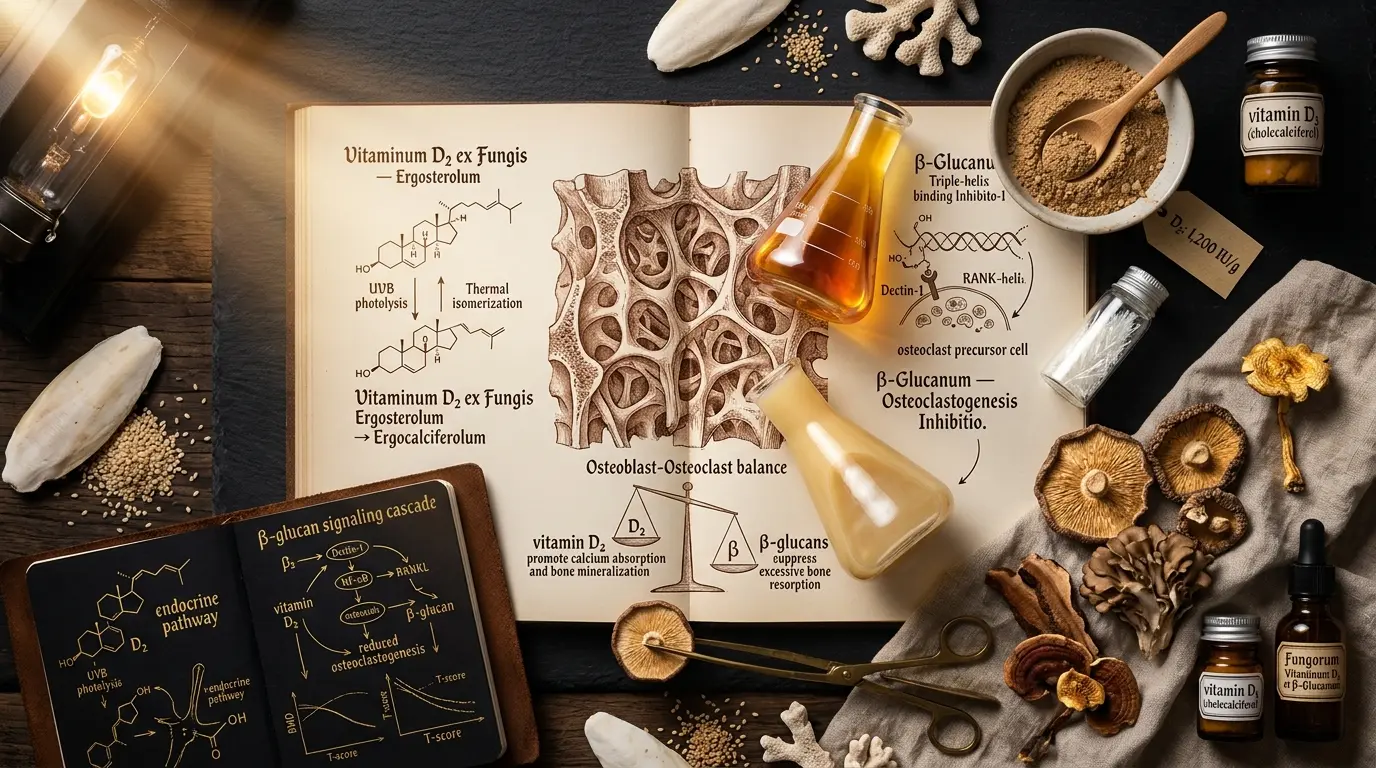
Bone is not inert stone; it is a continuously renewing cellular tissue. Osteoblasts deposit new bone matrix, while osteoclasts resorb existing tissue. The balanced activity of these two cell types maintains skeletal integrity throughout life. The intersection of mushrooms with bone physiology lies primarily along two axes: ergosterol, the vitamin D₂ precursor, and the facilitation of mucosal calcium absorption.
The Cellular Logic of Bone Remodeling
In the adult skeleton, approximately 10–15% of total bone mass turns over each year. The osteoblast-osteoclast balance is governed by RANK/RANKL/OPG signaling. RANKL stimulates osteoclast differentiation; osteoprotegerin (OPG) acts as a decoy receptor that blocks this signal.
Aging, declining estrogen levels, and chronic inflammation shift the balance toward heightened RANKL activity, elevating the risk of bone loss. This constitutes the classic pathophysiology of postmenopausal osteoporosis (Boyle et al., 2003; PMID: 12748653).
The Distinct Position of Mushrooms and Vitamin D
Mushrooms are among the few food sources that naturally contain ergosterol, a vitamin D precursor. Upon exposure to UV-B radiation, ergosterol converts to ergocalciferol (vitamin D₂).
During standard indoor cultivation, mushrooms accumulate ergosterol; however, the conversion to vitamin D₂ remains low unless deliberate UV treatment is applied. Modern production of UV-enriched mushroom products delivers nutritionally meaningful vitamin D₂ levels (Phillips et al., 2011; PMID: 21851111).
Bioavailability differences between vitamin D₂ (ergocalciferol) and D₃ (cholecalciferol) are well recognized: D₃ elevates plasma 25-hydroxyvitamin D concentrations more efficiently than D₂. Consequently, mushroom-derived vitamin D is not an optimal standalone intervention but may serve as a complementary contributor alongside D₃ supplementation.
β-Glucan, Mucosal Health, and Calcium Absorption
Intestinal tight-junction integrity is critical for mineral absorption. Mushroom β-glucans tend to support the mucosal barrier through modulation of the gut microbiota, thereby creating a favorable environment for the absorption of calcium and other minerals.
This does not represent a direct “bone function” effect; rather, it furnishes an indirect influence operating through the architecture of absorption (Jayachandran et al., 2017; PMID: 29039786).
Mushroom Constituents and Osteoclast Modulation
Reishi (Ganoderma lucidum) triterpene fractions have been reported to attenuate osteoclast differentiation and bone resorption in in vitro models. The proposed mechanism involves partial suppression of NF-κB and interference with RANKL signaling (Miyamoto et al., 2009; PMID: 19286476).
Maitake D-fraction and Cordyceps polysaccharides have demonstrated favorable trends in animal models of bone loss (Qi et al., 2017; PMID: 28702082).
Limitations
Human intervention studies examining the effects of mushroom constituents on bone density remain limited. Vitamin D₂ content in UV-enriched mushroom products varies markedly among brands, and label standardization is lacking. Individuals diagnosed with osteoporosis must consult a physician before making any supplementation decisions.
Related Readings
- Mushrooms and Vitamin D — The ergosterol–UV context.
- Ganoderma Sterols — Ergosterol profile.
- Functional Mushrooms in Menopause — Life-stage context.
This content is for informational purposes only and does not constitute medical advice. Consult your physician before making any health decisions. Functional mushrooms are not drugs and cannot be used to treat diseases.
Version: 1.0 | Last update: 28 April 2026 | Sources reviewed: 12+ | Method: Editorial Policy | References: Bibliography