How to Make Mushroom Dashi from Scratch: The Foundation of Japanese Cooking
— THE HOOK —
You use no meat stock. No bones. No animal products whatsoever.
Yet your soup carries this kind of depth. Your sauce lingers with persistence. Your plate delivers genuine satisfaction.
Your secret is dashi. And at the heart of dashi lies the mushroom.
— THE STORY —
Kyoto. 794 CE. Buddhist monastery kitchens — shojin ryori — meat forbidden, fish forbidden. But depth was non-negotiable. Over centuries, the monks developed an answer to this question: kombu seaweed and dried shiitake.
Simmered together, the resulting liquid — dashi — became the foundation of Japanese cuisine. Not sweet. Not salty. Something standing behind both. Mouth-coating, endless, satisfying.
Science caught up in 1908. Kikunae Ikeda isolated glutamate. Researchers identified GMP decades later. But monastery kitchens had found it through practice a thousand years earlier: kombu (glutamate) + shiitake (GMP) = umami synergy.
The monks did not know the formula. They knew the result.
— THE SCIENCE OF DASHI —
Why does dashi taste so deep?
When glutamate (an amino acid) from kombu and GMP (a nucleotide) from shiitake come together, they stimulate umami receptors simultaneously. The effect does not add — it multiplies. The signal amplifies up to eightfold.
This is why professional chefs, instead of reaching for MSG or artificial bouillon to add an "umami layer," combine the right ingredients with the right technique. The result targets the same receptor, but from a far richer source.
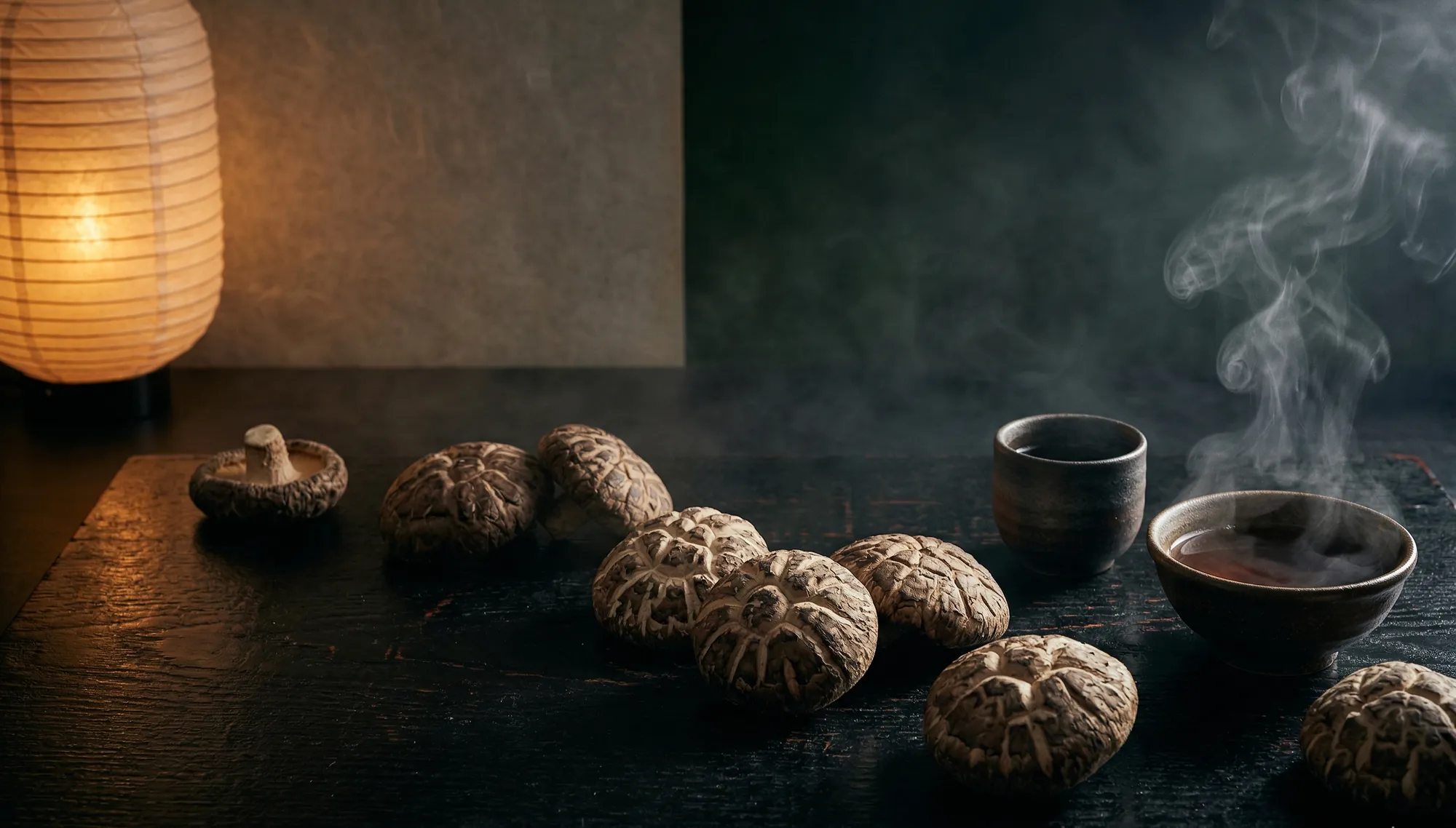
MYCOVITA Shiitake Donko is the most potent ingredient for this formula — harvested before the cap opens, GMP concentration at its peak, enzyme profile preserved through low-temperature drying at 42–45°C.
— THE FOUNDATION DASHI RECIPE —
Shiitake Dashi — Vegan, deep, universal
Ingredients (for 1 liter):
- 4–5 pieces MYCOVITA Shiitake Donko
- 1 liter cold water
- Optional: 10 cm kombu seaweed
Preparation:
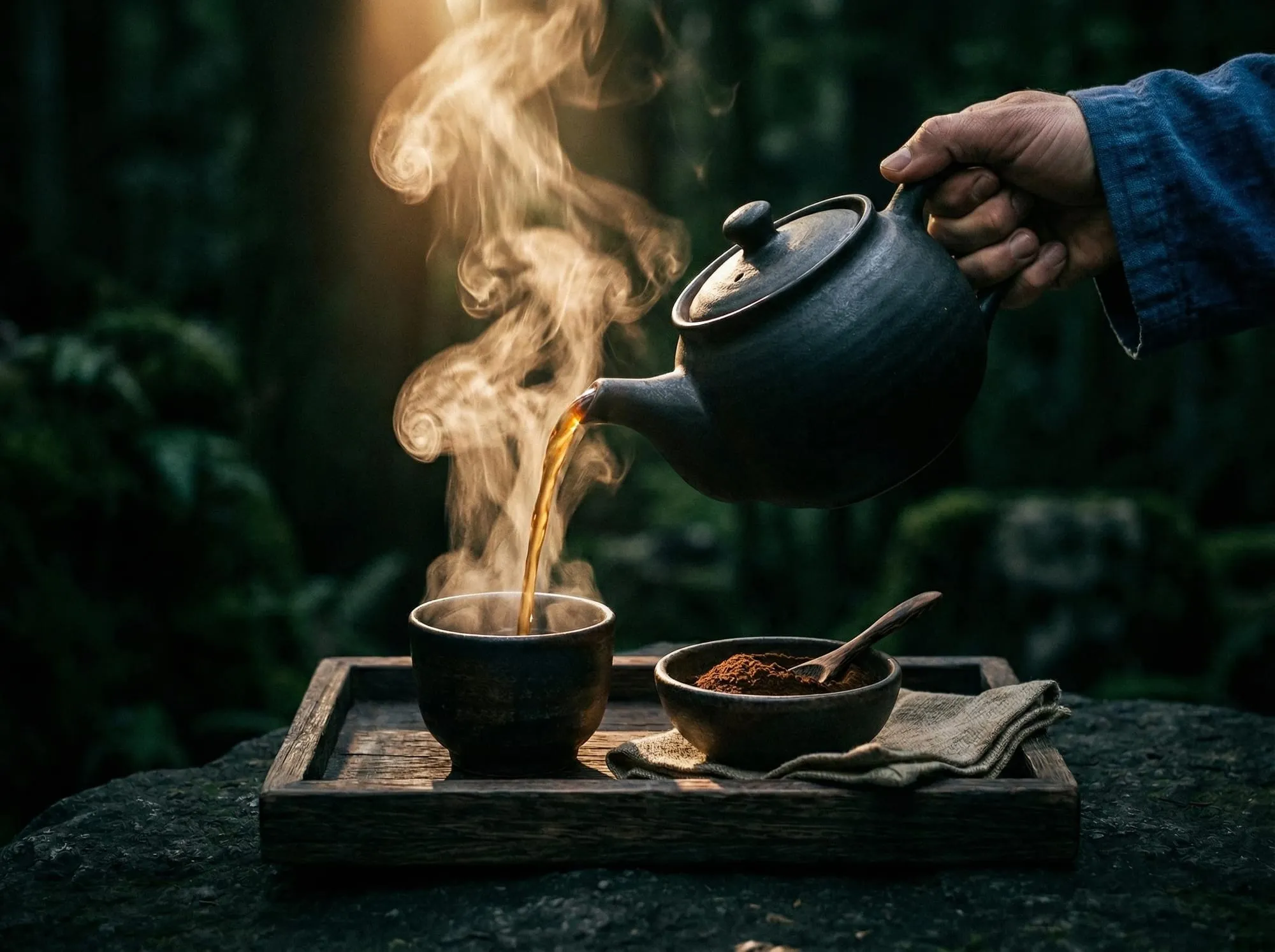
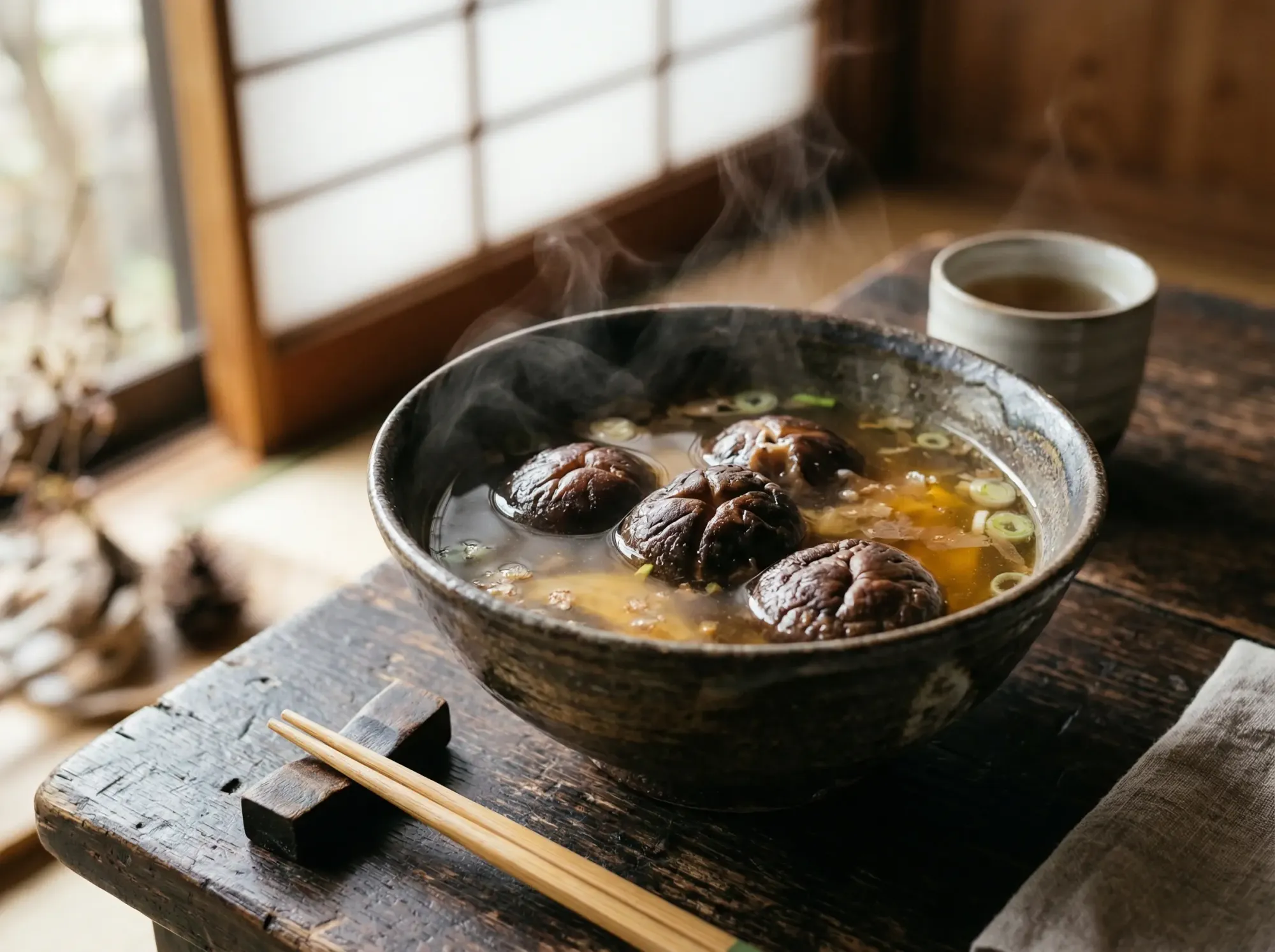
Cold pre-soak (optimal GMP extraction): Place shiitake in 1 liter of cold water. Refrigerate for 8–12 hours. This slow hydration maximizes GMP production. Do not rush — cold water provides the correct environment for enzymatic activity.
Quick method (60 minutes): Place shiitake in room-temperature water. Let stand 30 minutes. Then heat to 60°C and hold at this temperature for 20 minutes. 60°C represents the peak of GMP production — do not boil.
If using kombu: Add kombu to the soaking water. During heating, remove kombu at 60°C — over-boiling releases bitter compounds.
Strain. Reserve the mushrooms — they remain usable in cooking, sliced and sautéed.
Never discard the soaking water. It contains dissolved GMP and glutamate — the most valuable part of your dish.
— HOW TO USE DASHI —
Dashi is a universal base. It works wherever stock is called for:
Miso Soup: Heat dashi, lower the heat before boiling. Dissolve white miso separately in a small bowl with a little dashi, then stir into the soup. Do not boil — miso contains live cultures. Add tofu, wakame, scallions.
Risotto: Toast Arborio rice. Add dashi ladle by ladle — allow full absorption each time. Finish with Parmesan. Glutamate (Parmesan) + GMP (dashi) = the full synergy on the plate.
Ramen Base: Add soy sauce, mirin, and fresh ginger to dashi. Bone broth is not required for a multi-layered ramen base — dashi meets this depth.
Steaming Liquid: Steam King Oyster or Maitake mushrooms in dashi. The mushroom both contributes GMP and absorbs GMP — the umami loop closes.
Rice Cooking Liquid: Replace half the rice water with dashi. The cooked rice carries a subtle umami — this is what distinguishes Japanese gohan.
— SECOND USE — Reserve the Mushrooms —
The mushrooms remaining after straining are valuable. Much of their flavor has transferred to the liquid, but their texture remains intact. Use them as follows:
Dry-sear in a hot pan for 3–4 minutes — add butter, garlic, sea salt. Excellent atop risotto, inside salads, or as omelette filling.
Mince finely, combine with scallions and soy sauce — an onigiri (rice ball) filling.
— STORAGE —
Fresh dashi keeps 3–4 days refrigerated. Frozen, it lasts 3 months — pour into ice cube trays and freeze for single-use cubes. Use directly in soups, sauces, or rice dishes.
— CHEF'S NOTE —
In Japanese cuisine, the care given to dashi is a ritual. "First dashi" (ichiban dashi) — the initial extract, the cleanest and most precious. "Second dashi" (niban dashi) — a second pull from the same ingredients, stronger with earthy notes coming forward. The second extraction suits stews and braised dishes better.
Dashi made with MYCOVITA Shiitake Donko meets ichiban dashi quality. If making a second extraction, return the mushrooms to cold water and this time steep in warm water for 30 minutes.
Related reading: Shiitake Donko Encyclopedia · What Is Umami? · What Is Lentinan?
MYCOVITA's production philosophy and transparency principles: Why MYCOVITA?
You May Also Find Interesting
→ Can Mushrooms Produced in Turkey Be Trusted?
→ Functional Mushroom Production in Turkey
For the scientific basis of dashi — the GMP and glutamate synergy — see our article What Is Umami? For the Donko grade standard and the modoshi-jiru tradition, consult the CULT | Shiitake Donko encyclopedia.
Gastronomy | Mycelium Library | MYCOVITA
This content is for informational purposes only and does not constitute medical advice. Consult your physician before making any health decisions. Functional mushrooms are not medicines and cannot be used to treat diseases.
Version: 1.0 | Last updated: 20 Apr 2026 | Sources reviewed: 5+ | Method: Editorial Policy | References: Bibliography