Decoding Umami: The Molecular Foundations of the Fifth Taste
— HOOK —
You have just finished a bowl of soup. The ingredient list is simple — mushrooms, water, a little salt. Yet the bowl is empty, and something still lingers on your palate. It does not fade. It is satisfying. Deep.
This sensation is not sweet. It is not salty. It is not sour, nor is it bitter.
This is umami. And behind it lies 120 years of science.
— THE STORY —
- Tokyo Imperial University. Chemist Kikunae Ikeda decided to analyze the dashi broth his mother had been making for years. He wanted to understand why kombu seaweed water left such a profound impression on the palate.
After a year of chemical analysis, he isolated a molecule and named it using the Japanese word for "delicious essence": Umami.
That molecule was glutamate — an amino acid.
The Western world dismissed this discovery for decades. Sweet, salty, sour, bitter — four tastes were sufficient. Umami's formal scientific acceptance as the fifth taste arrived only in 2002. Specific receptors named T1R1/T1R3 were identified on the tongue — they detect glutamate and nucleotides exclusively.
Japanese cuisine had been getting it right for 1,000 years. Science confirmed it retroactively.
— THE LANGUAGE OF MOLECULES —
Umami is the work of two molecular groups:
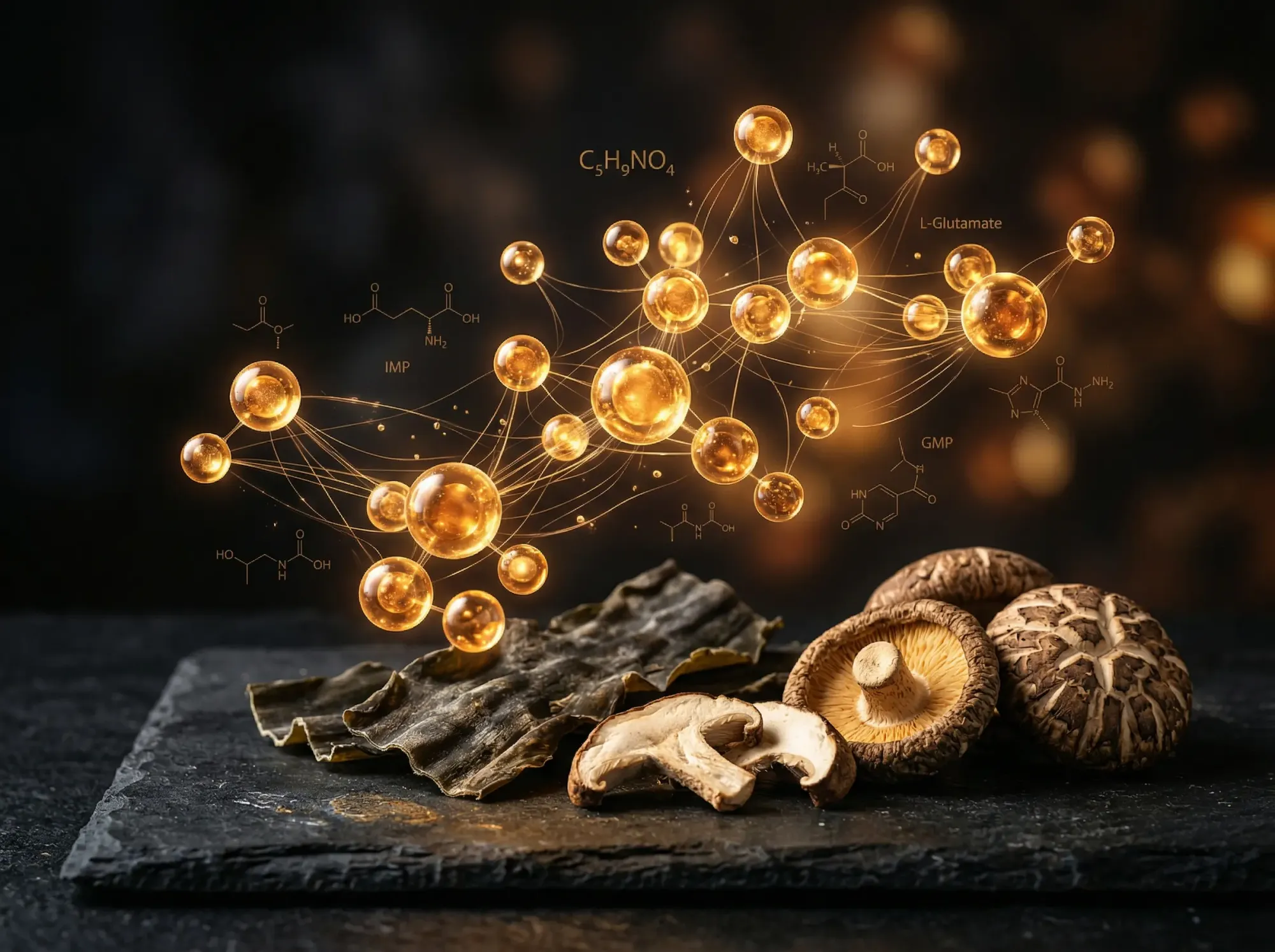
L-Glutamate: An amino acid. Found in kombu, tomatoes, Parmesan, and fermented products. The cornerstone of umami.
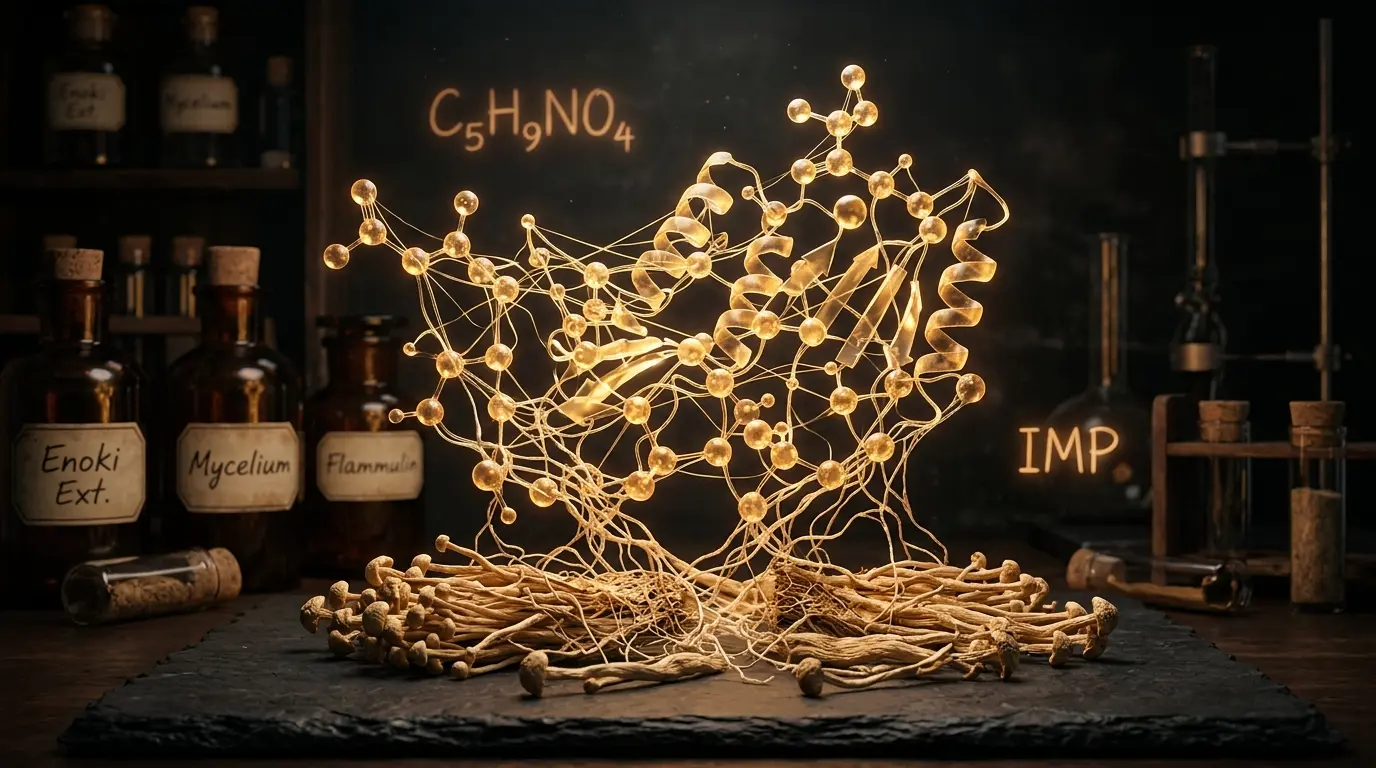
Nucleotides — GMP and IMP: Formed through RNA breakdown. GMP (Guanosine Monophosphate) concentrates in mushrooms, IMP in fish and meat. Alone, without glutamate, these nucleotides are subtle — but when they meet glutamate, something remarkable occurs.
Umami Synergy: 1 unit glutamate + 1 unit GMP does not equal 2 units of umami. The receptors are stimulated simultaneously, and the perceived intensity multiplies — up to 8-fold. This is precisely the secret behind the inexplicable depth of Japanese dashi (kombu + shiitake). Two sources, each amplifying the other.
— WHY DRIED? —
The greatest paradox of the mushroom world: fresh mushrooms do not contain as much umami as dried ones.
Shiitake in its fresh form is rich in RNA. When dried under proper conditions, the cell walls undergo stress, and the endogenous enzymes activate. When you place dried mushrooms in warm water, these enzymes break down RNA, producing massive quantities of GMP.
The thousand-year-old Asian tradition of drying was an early application of biotechnology. The technical name came later.
This is why low-temperature drying at 42–45°C is critical in the MYCOVITA Gastronomy Series — high heat kills the enzymes, and the GMP potential is lost.
— UMAMI IN MYCOVITA GASTRONOMY —
Shiitake Donko — The Pinnacle of GMP Harvested before the cap opens, while the furin dust is visible. GMP concentration reaches its peak at this stage. Soak in warm water at 50–60°C for 20–30 minutes — the optimal temperature for enzymatic activity. Never discard the soaking water (modoshi-jiru) — it contains dissolved GMP. Combine it with a glutamate-rich ingredient: kombu, tomato, Parmesan. This is where synergy begins.
King Oyster — The Maillard Reaction A different dimension of umami. Amino acids + high heat + a dry surface = the Maillard Reaction. Caramelization, crust, deep aroma. The scallop-like texture is the product of this reaction. When King Oyster is cooked properly, umami arrives from within (GMP) and from the surface (Maillard) simultaneously.
Maitake — Forest Depth This species, which carries D-fraction beta-glucan, reveals layered umami profiles when cooked. Each layer undergoes caramelization at a different rate — a distinct sensation with every bite.
— KITCHEN APPLICATION —
Instead of using MSG or artificial bouillon:
- Shiitake Donko soaking water → soup, risotto, sauce base
- Seared King Oyster → protein alternative, center of the plate
- High-heat Maitake → side dish, garnish
Add a glutamate source — achieve synergy:
- Kombu + Shiitake dashi → classic Japanese umami base
- Tomato + King Oyster → Mediterranean umami
- Parmesan + Maitake + butter → Italian depth
— CHEF'S NOTE —
Umami is not an ingredient; it is a layer. Saying "I am adding umami to the plate" is asking the wrong question. The right question is: "Are glutamate and GMP sources present on my plate, and are they amplifying each other?"
Shiitake soaking water + a tomato-based sauce = two sources stimulating receptors simultaneously. The formula that explains why the dish feels so profoundly deep.
Related reading: Shiitake Donko Encyclopedia · Mushroom Dashi · What Is Lentinan?
MYCOVITA's production philosophy and transparency principles: Why MYCOVITA?
You May Also Find Interesting
→ Can You Trust Mushrooms Produced in Turkey?
→ Functional Mushroom Production in Turkey
For the story of Shiitake Donko, umami's most powerful fungal source, explore the KÜLT | Shiitake Donko encyclopedia; for a vegan dashi recipe, see our Mushroom Dashi article.
Gastronomy | Mycelium Library | MYCOVITA
This content is for informational purposes only and does not constitute medical advice. Consult your physician before making any health-related decisions. Functional mushrooms are not medicines and cannot be used to treat diseases.
Version: 1.0 | Last updated: 20 Apr 2026 | Sources reviewed: 5+ | Method: Editorial Policy | References: Bibliography