Functional Foods Explained: Definition, Scope, and the Regulatory Landscape
You Might Be Interested In
→ Is Mushroom Produced in Turkey Reliable?
→ Functional Mushroom Production in Turkey
→ Functional Mushroom Market in Turkey
Further reading: What Are Functional Mushrooms? · What Is Beta-Glucan?
MYCOVITA’s production philosophy and transparency principles: Why MYCOVITA?
Mycelium Library — No.21
Let us begin with a question.
You drink Lion’s Mane powder. Someone close to you asks: “Is that a drug?” To answer, you must first resolve a deeper question: What is a functional food, what is a drug, and where does the boundary between them lie?
Most people cannot give a clear answer. They pick the product off the shelf, see “natural” or “herbal” on the label, and consume it without further thought. Yet understanding this grey area is critical — both for consumer rights and for managing expectations realistically.
Food, Drug, and the Grey Area Between Them
The World Health Organization defines food as processed, semi-processed, or raw substances intended for human consumption — for nutritional purposes. A drug, by contrast, is a substance used to diagnose, treat, or prevent a specific disease. Those three words — diagnose, treat, prevent — draw the line that separates drugs from food.
Between these two definitions lies a wide grey zone. It is exactly here that the concept of the “functional food” was born.
A functional food is a food that is claimed to exert a positive effect on health beyond its basic nutritional value. The Japanese Ministry of Health formally defined this concept for the first time in 1991. It created a category called FOSHU — Foods for Specified Health Uses. Provided that scientific evidence was submitted, the government granted certain products an approved health claim. This was a revolution: a food could now state that it “supports heart health” — but it had to prove it.
The European Union adopts a broader definition. EFSA — the European Food Safety Authority — describes functional foods as “foods that beneficially affect one or more target functions in the body, beyond adequate nutritional effects.” Even this definition, however, remains the subject of debate. There is no global consensus on how to measure “beneficial effect.”
Legal Framework in Turkey: Where Is the Boundary?
The Turkish Food Codex does not define a separate category for “functional food.” The implication is clear: these products are classified in Turkey as food supplements or food products. And that classification brings a very strict rule.
You may not claim that a product treats, prevents, or cures any disease. Statements such as “strengthens the immune system,” “prevents cancer,” or “lowers cholesterol” are prohibited under Turkish food legislation.
This restriction applies to MYCOVITA as well. And we deliberately and respectfully embrace it. The prohibition on health claims does not restrict us — on the contrary, it compels our honesty. We do not write these claims because they are true — we refrain from writing them because it is the right thing to do.
Why, Then, Do People Use Them?
The vast majority of those who take an interest in functional mushroom powders fit the following profile: they have done their own research, delved into the academic literature, examined the traditional history of use, and are making an informed choice. These individuals are not looking for a drug. They are looking for a science-backed food that can contribute to their nutritional quality.
For these individuals, MYCOVITA’s position is unequivocal: we make no health claims. But we do relay the research literature. We share the history of traditional use. We present the compositional profile transparently. We document everything with our Certificate of Analysis. The decision is yours.
Where Does Mushroom Powder Fit Within This Category?
The definition of a functional food rests on three core criteria.
First, the product must contain bioactive constituents beyond its basic nutritional value. Mushroom powders satisfy this criterion — Beta-glucans, triterpenoids, cordycepin, lentinan, ergothioneine. These are compounds that have been studied in the research literature for decades. They are ingredients approved for clinical use in Japan under the name PSK, granted drug status in Korea, and classified as nutraceuticals in Europe.
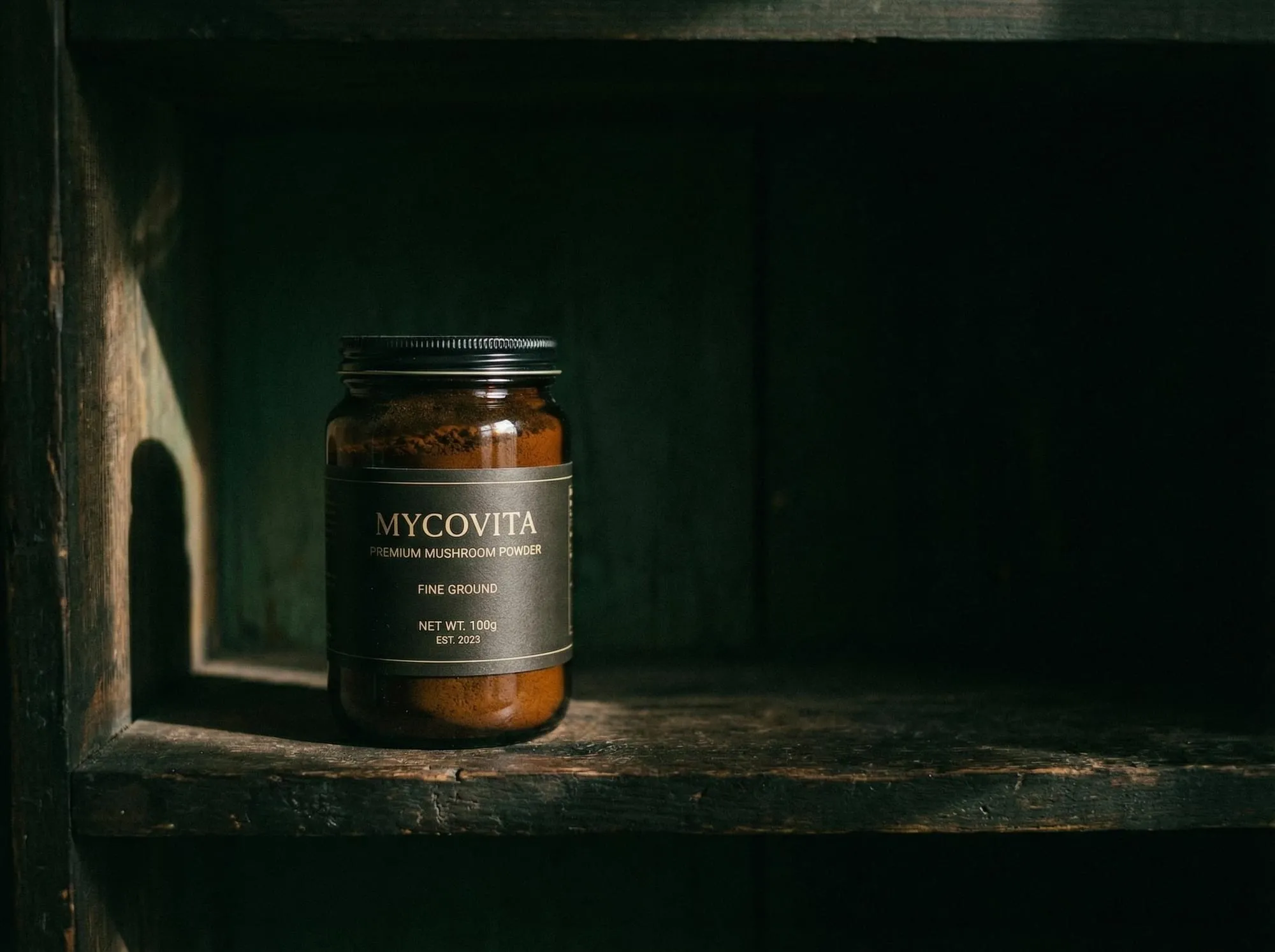
Second, the product must be consumable as part of a normal diet. Mushroom powder can be added to tea, coffee, or food. It is consumed in food format, not as a capsule. Half a teaspoon in your morning coffee — this is not a drug protocol; it is a nutritional habit.
Third, the product must possess a potential for biological activity supported by scientific studies. Decades of academic literature from Japan, Korea, China, Europe, and the United States provide a strong, albeit debated, foundation for this criterion.
Within the legal framework of Turkey, mushroom powder is a food product. Within the scientific framework, it falls into the functional food category. These two frameworks do not contradict one another — one defines legislation, the other defines science. Knowing both is essential for consumer and producer alike.
A Caution About the Market: Prohibited Claims
“Prevents cancer,” “stops Alzheimer’s,” “treats diabetes” — consumers who encounter such statements should know this: they are illegal in Turkey. They do not meet the standard of scientific evidence. In most cases, they are misleading.
Approach any mushroom powder brand that makes such claims with caution. Either the brand does not know the legislation — which is ignorance. Or it knows and chooses to ignore it — which is dishonesty. In either case, a trust problem exists.
A functional food is not a drug. It is not a miracle. But it is a genuine category — one that is backed by science, honestly produced, and capable of meaningfully contributing to nutritional quality when used with appropriate expectations.
We choose to remain honest within this category.
This content is for informational purposes and does not constitute medical advice. Consult your physician before making any health-related decisions. Functional mushrooms are not drugs and cannot be used to treat diseases.
Version: 1.0 | Last updated: 20 Apr 2026 | Sources reviewed: 5+ | Methodology: Editorial Policy | References: Bibliography