Estrogen Receptors and Mushroom-Derived Bioactives: A Comprehensive Literature Review
Two Different Patients, One Shared Question
— HOOK —
The first patient is twenty-eight years old: diagnosed with PCOS, presenting with irregular menstruation, acne, and insulin resistance. The second is fifty-two: postmenopausal, struggling with hot flashes and anxiety over bone density. Their endocrine profiles appear to be opposites, yet both conditions orbit the same receptor family — the estrogen receptors. An internet blog post gathers them under the headline “mushrooms balance hormones.”
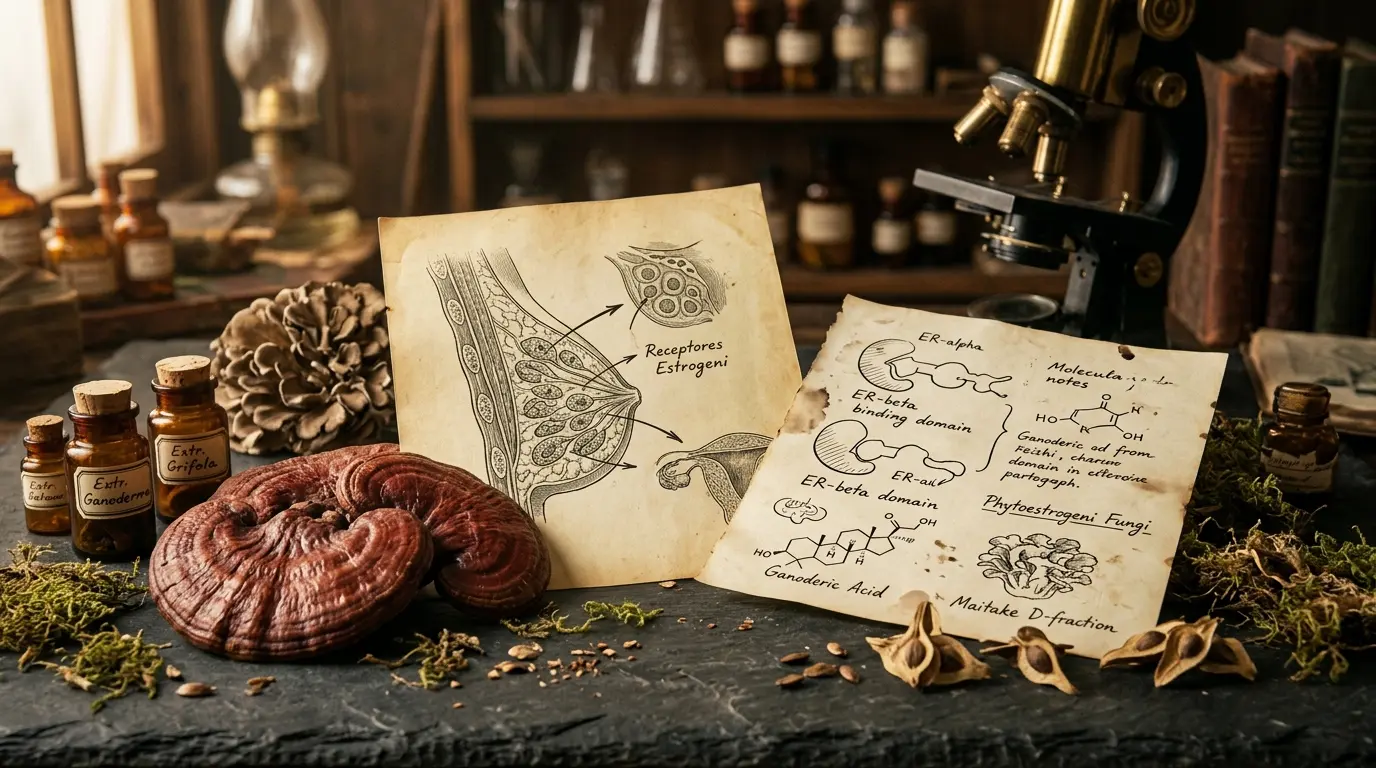
This article tests the scientific foundation of that headline. It explains the estrogen receptors, the mushroom-derived compounds studied in vitro, and why sweeping terms such as “balance” must be deployed with great caution.
Estrogen Receptors (ERα and ERβ)
Estrogen receptors exist in two main isoforms: ERα and ERβ. Their tissue distributions differ: ERα predominates in the uterus, breast tissue, and liver; ERβ is prominent in ovarian granulosa cells, bone, colon, prostate, cardiovascular system, and central nervous system. The two receptors can frequently generate opposing functional effects; therefore, “estrogenic” is not a single uniform category.
Whether a compound is ERα‑selective or ERβ‑selective carries major pharmacological weight. Selective estrogen receptor modulators (SERMs) such as tamoxifen are built upon this isoform‑selectivity.
The Phytoestrogen Concept and Mushrooms
Phytoestrogens are plant‑derived molecules that possess estrogen receptor‑binding capacity; isoflavones (soy), lignans (flax), and coumestans are recognized members of this group. In classical literature, mushrooms are not classified as a standard phytoestrogen source. Virtually no known mushroom produces indirect estrogenic effects in a manner comparable to soy.
This does not imply that mushrooms have no connection with hormonal axes. Their mechanisms of interaction are simply different.
Aromatase Inhibition Framework
Aromatase (CYP19A1) is the enzyme that converts androgens into estrogens. A substantial portion of postmenopausal estrogen originates from peripheral aromatization; aromatase inhibitors are therefore a critical therapeutic class in breast cancer management.
Extracts of the white button mushroom (Agaricus bisporus) have been described in in vitro and animal studies as displaying weak aromatase inhibitory activity. While this mechanism has drawn academic attention, clinical efficacy remains unproven; the available studies are small and heterogeneous. Oncology patients receiving aromatase inhibitors require caution regarding food‑drug interactions, and any decision must be made jointly with the treating oncologist.
PCOS: A Mechanistic Perspective
PCOS is multifactorial: there are interconnected axes of insulin resistance, hyperandrogenism, anovulation, and low‑grade inflammation. First‑line management consists of lifestyle measures (weight management, physical activity, nutrition), after which pharmacologic options such as metformin, combined oral contraceptives, or inositol may be considered according to the clinical presentation.
Within the mushroom literature, two axes are most frequently invoked in the context of PCOS:
- Glucose–insulin axis: The effects of β‑glucan and other soluble fibers on postprandial glucose response have been discussed.
- Low‑grade inflammation: Certain mushroom polysaccharides have been shown in vitro to modulate the cytokine profile.
Both axes remain at the mechanistic level; they do not constitute components of PCOS clinical management.
Menopause: A Broader Framework
Postmenopause brings vasomotor symptoms, altered bone turnover, lipid profile shifts, and genitourinary syndrome, all of which have established medical options. Mushroom‑derived components have not been proven to serve as either substitutes for or adjuncts to these options. Conceptually, limited associations are discussed around ergosterol/vitamin D₂, β‑glucan, and ergothioneine; all these points require studies with extended time horizons.
Shared Caution
Individuals using hormone replacement therapy (HRT), combined oral contraceptives, aromatase inhibitors, tamoxifen, metformin, anticoagulants, or antithyroid medications must undergo physician evaluation before incorporating functional mushrooms into their regimen. During pregnancy and lactation, decisions regarding the use of mushroom extracts and powders must be made together with a physician.
Related Reading
- Perimenopause Framework — literature covering the transition period.
- Menopause and Functional Mushrooms — postmenopause literature.
- Postpartum Safety — another hormonal transition.
This content is for informational purposes only and does not constitute medical advice. Consult your physician before making any health decisions. Functional mushrooms are not drugs and cannot be used to treat diseases.
Version: 1.0 | Last updated: 24 April 2026 | Sources reviewed: 12+ | Methodology: Editorial Policy | References: Bibliography