Encyclopedia of the Black Antler Morphology in Reishi (Ganoderma lucidum)
— HOOK —
You begin the day exhausted. You slept, but did not rest. The mind remains on continuous alert, the nervous system perpetually braced, each stress compounding the one before it.
This is not a weakness of character. Adaptive capacity has reached its limit.
And in the world of functional mushrooms, the species that delivers the deepest answer has been offering the same response for 2,400 years.
— STORY —
Around 400 BCE, China’s earliest pharmacological document — the Shen Nong Ben Cao Jing — classified 365 of the era’s most precious substances. Only a handful were placed in the supreme category: safe for sustained use and capable of enhancing quality of life.
Lingzhi occupied the head of that category.
Lingzhi — 灵芝. Ling: spirit, the realm of the sacred. Zhi: fungus. “The herb of the spirit.” For centuries, Chinese palace art depicted it as the emblem of longevity, wisdom, and divine power. It was cultivated in palaces, carved into temple walls, and presented to emperors. Common access was forbidden — a consequence of both its status and its extreme rarity in nature.
In the wild, Ganoderma lucidum colonizes the roots of ancient oaks and beeches. It may appear once every ten years. Rarity explains the legend.
In Japan it is called Mannentake — 万年茸 — “ten-thousand-year mushroom.” From the Heian period onward it was absorbed into court medicine. In the 20th century, systematic research by Japanese scientists laid the foundation of modern medicinal mycology on this very species.
Traditional Chinese medicine grouped Ganoderma taxa into six colors: Red, Black, Blue, White, Yellow, and Purple. Each corresponded to different organs. Black Reishi — 黑芝 — Hei Zhi was aligned with the kidneys and yin energy; it was regarded as the form that nourishes mental tranquility and supports the nervous system.
MYCOVITA cultivates this species not in the standard cap form but in the rarest, most bioactive-dense expression: the Antler Form.
— DESCRIPTION AND MORPHOLOGY —
Ganoderma lucidum (Curtis) P. Karst. — a member of the family Ganodermataceae and one of the most intensively researched medicinal mushrooms on Earth. The genus name Ganoderma derives from the Greek ganos (brightness) and derma (skin) — a direct reference to its lacquer-like lustre.
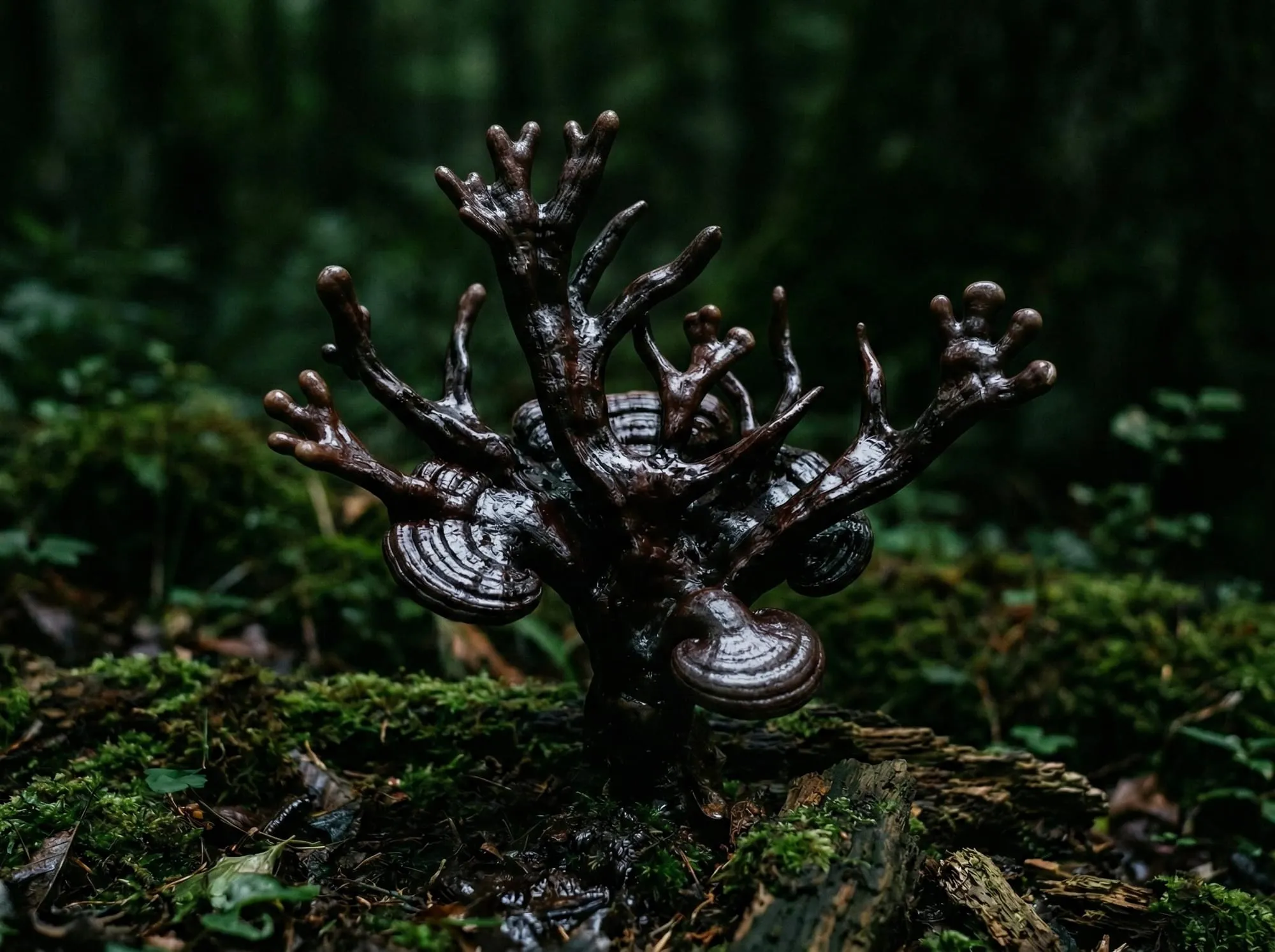
Antler Form: In controlled environments where CO₂ concentration is held within the 2–5% range, G. lucidum does not develop a cap; instead it branches. The morphology, reminiscent of deer antlers, invests all growth energy into the stem tissue. Colour ranges from deep black-brown to pale black.
A comprehensive 2018 study (Sudheer et al., Fungal Biology) demonstrated that the concentration of bioactive constituents in the antler form — phenolics, flavonoids, polysaccharides, and ganoderic acid among them — can be up to twice that of the normal form.
Reference: Sudheer, S. et al. (2018). Development of antler-type fruiting bodies of Ganoderma lucidum. Fungal Biology, 122(4), 293-301.
— BIOACTIVE COMPOUNDS —
Ganoderma lucidum is one of the rare species documented in the literature to contain more than 400 bioactive constituents.
Ganoderic Acids (Triterpenoids) Highly oxidized lanostane-type triterpenoids unique to G. lucidum. More than 150 distinct ganoderic acids have been isolated. Responsible for the species’ characteristic bitterness, this class is the most extensively studied in the literature. Research examines their role in the adaptogenic stress response, hepatic enzyme activity, and cortisol metabolism. In the antler form, triterpenoid concentration reaches its maximum toward the tips.
Important note: Ganoderic acids are fat-soluble. Steeping with coconut milk enhances bioavailability.
Reference: Lin, Z. et al. (2022). HPLC determination of active components in antler-shaped Ganoderma lucidum. International Journal of Medicinal Mushrooms.
Beta-Glucan 10–15% Beta-(1→3)-D-glucan and beta-(1→6)-D-glucan fractions — the principal carriers of immunomodulatory activity. In the antler form, polysaccharide concentration peaks in the basal region.
Reference: Wang, X. et al. (2025). Wide-target metabolomics in antler-shaped Ganoderma lucidum. Scientia Horticulturae.
Ergosterol and Steroids The vitamin D precursor ergosterol is present at 0.3–0.4%. Various steroidal compounds investigated in anti-inflammatory research have also been isolated.
Adenosine and Nucleotides Adenosine and guanosine derivatives shown to inhibit platelet aggregation; these are referenced in studies concerning blood viscosity.
— CURRENT RESEARCH —
Immunology Extensive in vitro and animal studies demonstrate that G. lucidum polysaccharides enhance macrophage activation, NK cell proliferation, and cytokine production (IL-2, TNF-α).
Reference: Sun, L.X. et al. (2011). Promoting effects of Ganoderma lucidum polysaccharides. Frontiers in Pharmacology.
Sleep and Stress In murine models, the effects of G. lucidum polysaccharides on GABA receptor activity and their potential modulatory influence on the sleep cycle are under investigation.
Reference: Cui, X.Y. et al. (2012). Extract of Ganoderma lucidum prolongs sleep time in rats. Journal of Ethnopharmacology, 139(3), 796-800.
Cardiovascular Research Findings have been published indicating that ganoderic acids inhibit HMG-CoA reductase activity — a mechanism analogous to that of statins.
Reference: Boh, B. et al. (2007). Ganoderma lucidum and its pharmaceutically active compounds. Biotechnology Annual Review, 13, 265-301.
Oncology Research In vitro studies demonstrate that G. lucidum extracts induce apoptosis and inhibit tumour angiogenesis in various cancer cell lines. Human clinical trials remain insufficient.
Reference: Wasser, S.P. (2005). Reishi or Ling Zhi (Ganoderma lucidum). Encyclopedia of Dietary Supplements.
— MYCOVITA —
In MYCOVITA Room 1, CO₂ concentration is maintained continuously in the 2–5% range for the antler form. Harvesting is performed the moment cap-initiation signals appear — never a moment late.
Colour: Dark chestnut, verging on black. Surface matte, with deep pigmentation. This colour is the visible signature of dense triterpene accumulation. Light or brightly coloured Reishi does not carry this profile.
Drying: Constant 45°C. Ganoderic acids preserve structural integrity up to this threshold.
Mycelium source: Netherlands-certified production facilities. 100% fruiting body. Every batch is documented with a Certificate of Analysis.
— HOW TO USE —
Reishi demands a long, hot extraction. Ganoderic acids do not solubilize adequately during brief steeping — do not steep for less than 8 minutes.
Evening Ritual — Classic 1–1.5 g / 200 ml · 85–90°C · 10–15 minutes Combine with coconut milk — triterpenes are fat-soluble, so bioavailability increases. Sweeten with honey or dates if desired.
Deep Extraction — Maximum Extraction 2 g / 300 ml · 90°C · 20–25 minutes Yields a dark amber colour and intense flavour; the infusion thickens as it cools. This method delivers the strongest ganoderic acid extraction.
Adaptogenic Night Drink 1 g Reishi + 1 g Lion’s Mane + 200 ml coconut milk · 85°C · 10 minutes An end-of-day nervous-system protocol — Reishi is adaptogenic, Lion’s Mane is neurotrophic.
Mushroom Night Chocolate 1 g Reishi + 1 teaspoon raw cacao + 200 ml coconut milk · 85°C · 8 minutes · Sweeten with honey Triterpene + theobromine combination — the most conscious beverage for the evening.
Soup Base 3–5 g powder / 500 ml water · steep at 85°C for 20–25 minutes · Strain Use in place of meat or vegetable stock. Reishi’s earthy, woody profile lends depth to stews and soups.
Long-Term Protocol Research is built on cumulative use. 1–2 g daily, integrated into the evening routine, with consistency. A one-time expectation is not accurate.
Important Note: A pronounced bitterness in the first few exposures is an expected and normal characteristic. Bitterness signals ganoderic acid density — not a flaw to be hidden, but a marker of quality.
Taste profile: Deep, woody, with a distinct bitterness. Earthy and resinous notes. Coconut milk balances and softens this profile.
Related reading: What Is Ganoderic Acid? · What Is an Adaptogen? · How Does Reishi Affect Sleep Quality? · Stress, Cortisol, and Adaptogenic Mushrooms
On MYCOVITA’s production philosophy, technical infrastructure, and transparency principles: Why MYCOVITA?
Ganoderma lucidum is classified as a food under the Turkish Food Codex. The scientific studies cited on this page are drawn from the academic literature and serve an informational purpose.
MYCOVITA Ganoderma lucidum products are food products. They make no claim to treat, prevent, or cure any disease. Individuals using blood thinners, diabetes medications, or immunosuppressive drugs are advised to consult their physician. Caution is warranted before surgical procedures.
— SCIENTIFIC REFERENCES —
Sudheer, S. et al. (2018). Development of antler-type fruiting bodies of Ganoderma lucidum. Fungal Biology, 122(4), 293-301. Wang, X. et al. (2025). Wide-target metabolomics in antler-shaped Ganoderma lucidum. Scientia Horticulturae. Boh, B. et al. (2007). Ganoderma lucidum and its pharmaceutically active compounds. Biotechnology Annual Review, 13, 265-301. Cör Andrejč, D. et al. (2022). Antioxidant, antibacterial, antitumor, antifungal, antiviral activity of Ganoderma lucidum. Frontiers in Pharmacology. Cui, X.Y. et al. (2012). Extract of Ganoderma lucidum prolongs sleep time in rats. Journal of Ethnopharmacology, 139(3), 796-800. Wasser, S.P. (2005). Reishi or Ling Zhi (Ganoderma lucidum). Encyclopedia of Dietary Supplements. Sun, L.X. et al. (2011). Promoting effects of Ganoderma lucidum polysaccharides. Frontiers in Pharmacology. Lin, Z. et al. (2022). HPLC determination of active components in antler-shaped Ganoderma lucidum. International Journal of Medicinal Mushrooms.
Corporate & B2B: For restaurants, hotels, wellness centres, and bulk supply, contact [email protected].
You May Also Like
→ Travel Protocol — How Do I Use It While Traveling?
This content is for informational purposes only and does not constitute medical advice. Consult a physician before making any health decisions. Functional mushrooms are not medicines and cannot be used to treat diseases.
Version: 1.0 | Last Updated: 20 Apr 2026 | Sources Reviewed: 11+ | Methodology: Editorial Policy | References: Bibliography