Culinary Applications of the Shiitake Donko Mushroom
— THE DISTINCTION —
Two boxes of dried shiitake. One 80 TL, the other 380 TL.
What sets them apart?
Most often, a single word: Donko.
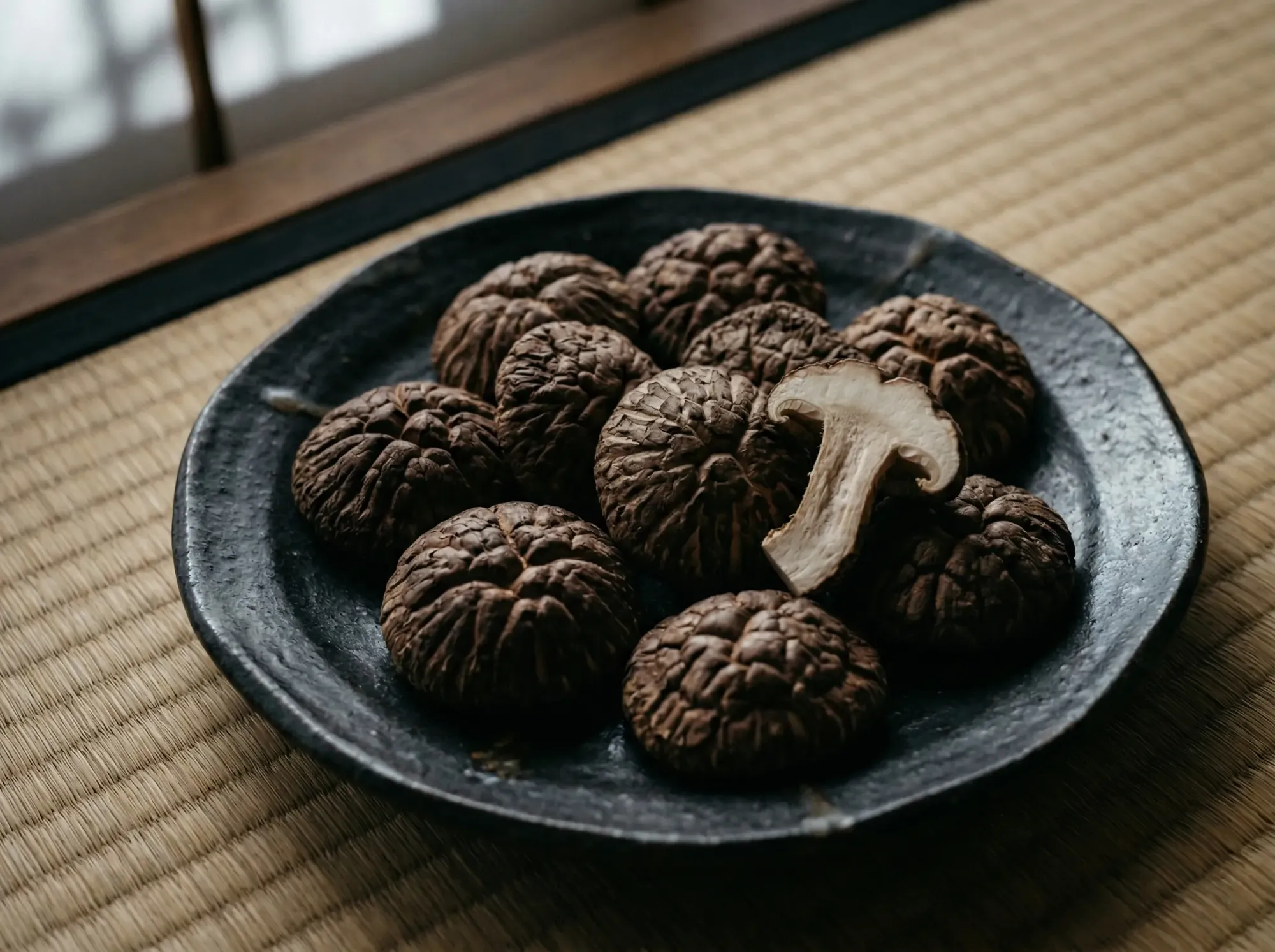
Donko grade — 冬菇 — refers to shiitake harvested with the cap still closed, the furin (flower-patterned bloom) fully visible, and the concentration of Lentinan and GMP at its zenith. The mushroom develops this character under the retarded growth imposed by winter cold, which is precisely why it bears the name “winter mushroom.”
Yet purchasing Donko grade alone is insufficient. Incorrect reconstitution squanders this value.
Technique governs the outcome. The framework follows.
— HISTORICAL CONTEXT —
Japan. Muromachi period (1336–1573). The cultivation of shiitake was already a practical art — inoculating oak logs with mycelium. The concept of “Donko,” however, crystallized later.
Japanese traders observed that shiitake gathered in winter, with caps not yet unfurled — slow-grown in the cold, concentrated in substance — possessed a different flavour and texture. A deeper umami, a fleshier body, a longer shelf life.
These shiitake were graded separately and priced accordingly. They acquired the name Donko.
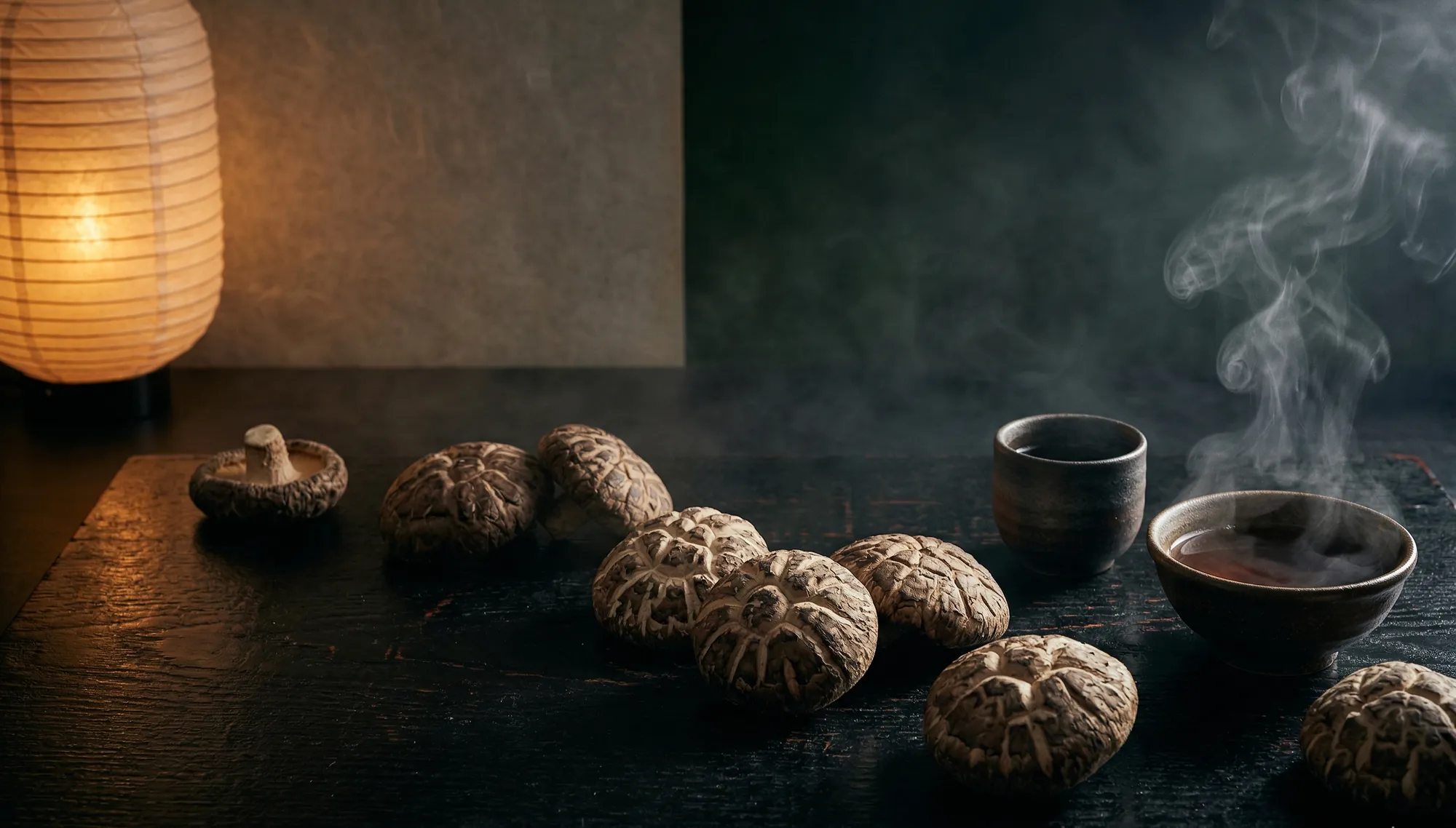
Donko shiitake became a standard article among the gifts presented to the Japanese imperial court. In the delicate dishes served to guests during tea ceremonies, the closed cap signified both respect and uncompromising quality.
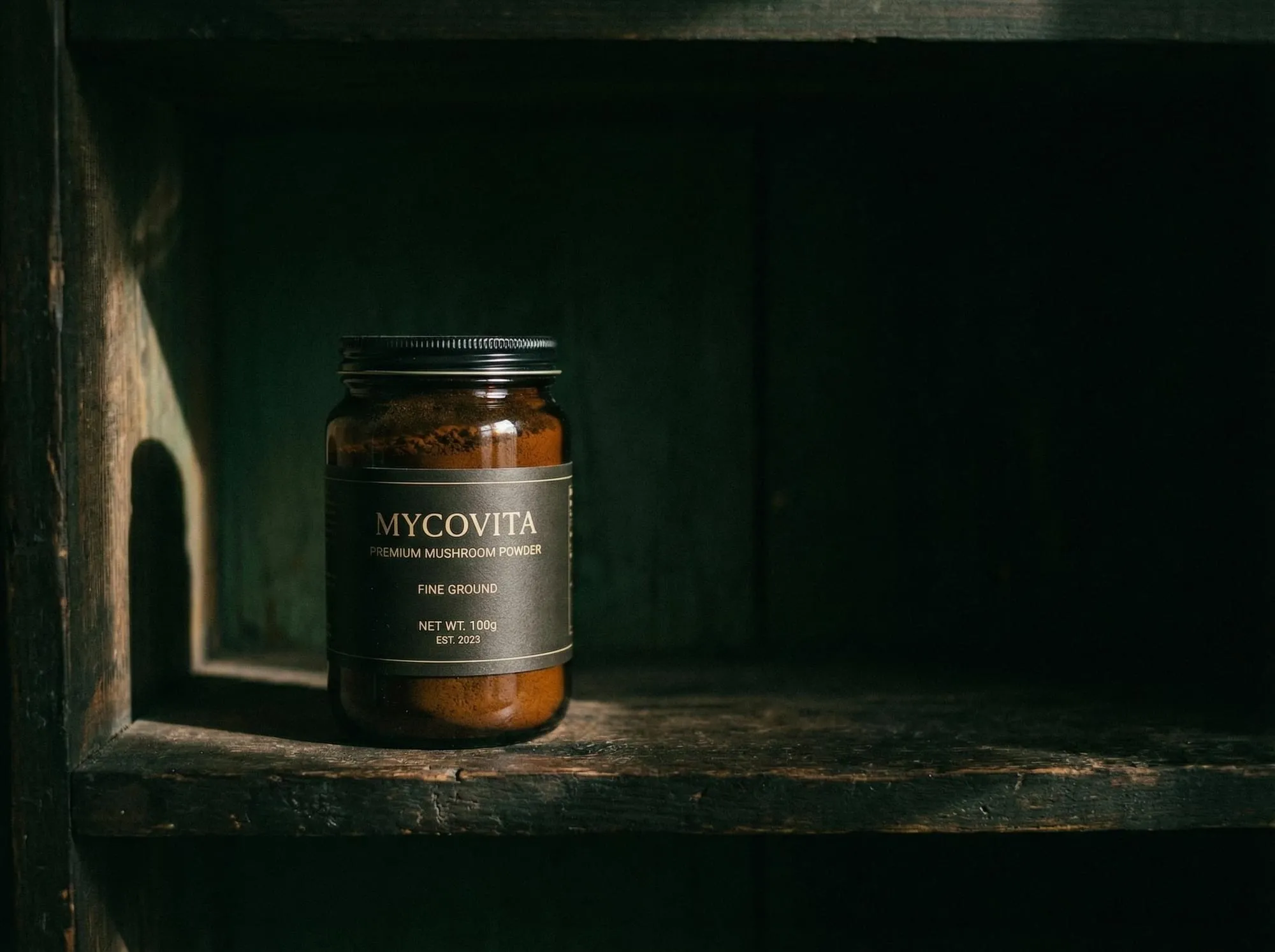
MYCOVITA’s Shiitake Donko adheres to this standard: harvested with the cap fully closed while the furin bloom remains intact, at the moment of maximum GMP and Lentinan concentration.
— THE DONKO GRADE: WHAT SHIFTS —
As the shiitake cap opens:
GMP declines. Guanosine monophosphate — the nucleotide component of umami — reaches its highest concentration before the cap opens. Once expansion begins, enzymes start to degrade GMP.
Lentinan declines. Lentinan, a beta-(1→3)-D-glucan polysaccharide, loses concentration as the cap opens and the mushroom matures.
Texture transforms. An opened cap is thin and brittle. The Donko’s closed cap is thick, succulent, and structurally ideal for Maillard reactions at high heat.
These values are fixed at harvest and preserved by low‑temperature drying at 42–45°C. High‑heat drying disrupts this biochemical profile.
— RECONSTITUTION — THE MOST CRITICAL STEP —
Cold‑Water Method — Maximizing GMP (Recommended)
Place the shiitake in cold water. Ratio: 4–5 mushrooms per 500 ml of water.
Refrigerate for 8–12 hours. This slow hydration forces maximal release of GMP into the water — the 5ʹ‑nucleotidase enzyme remains active in the cold and liberates GMP.
Do not discard the soaking water — the Japanese term is modoshi-jiru. This liquid holds dissolved GMP, Lentinan fractions, and glutamate. It forms a dashi base, the very foundation of umami, and represents the most valuable portion.
Rapid Method — The 60°C Technique
Pre‑soak at room temperature for 20 minutes. Then heat the water to 55–60°C and maintain this temperature for 20–30 minutes. At 60°C the 5ʹ‑nucleotidase enzyme reaches its optimum activity — GMP production peaks at this point.
Do not boil. Temperatures above 80°C denature the enzyme: GMP production halts and a portion of the already‑formed GMP degrades.
— MODOSHI‑JIRU: HARNESS THE SOAKING WATER —
Composition of this liquid: GMP (guanosine monophosphate) — the umami nucleotide; Glutamate fractions; Eritadenine — a compound investigated for its role in cholesterol metabolism; Lentinan fractions; Aromatic compounds — lenthionine and other volatiles responsible for shiitake’s characteristic aroma.
Applications: direct dashi base, soup stock, risotto stock, sauce foundation, rice cooking liquid.
Storage: refrigerated for 3 days, frozen for 2 months (ice‑cube trays work well).
— COOKING — TECHNIQUES FOR THE DONKO CAP —
Whole Cap — Stuffing Method
After reconstitution, the interior of the Donko cap becomes a natural receptacle. Fill with a tofu–miso blend, vegetable brunoise, or rice. Steam for 8 minutes.
In Japanese cuisine, the fukume‑ni technique applies: simmer the shiitake cap in a mixture of dashi, mirin, soy sauce, and sugar over low heat for 20–25 minutes. The cap both receives and imparts flavour — yielding a balanced, deep profile.
High‑Heat Sauté — Maillard
The closed cap withstands high heat. Use a cast‑iron pan over high heat with butter. Place the cap face down — 3 minutes. Baste — 1 minute. Salt only at the final step.
Shiitake intensifies its lenthionine aroma under high heat — the fragrance that emerges during sautéing derives from this compound. Turn on the extraction fan.
Cooking in Dashi
Warm the modoshi-jiru to 60°C. Add the reconstituted shiitake. Hold at this temperature for 15 minutes. Strain. Both the cap and the liquid are now ready for use.
This technique follows the logic of niban dashi (second extraction) in Japanese culinary practice — a two‑stage extraction yields two distinct profiles.
— STORAGE —
Dry state — airtight, dark, cool: 18 months. After reconstitution, refrigerated: 3 days. Modoshi-jiru refrigerated: 3 days. Frozen: 2 months.
— CHEF’S NOTE —
The aromatic profile of Shiitake Donko is notably potent. When working with delicate fish, seafood, or neutral grain‑based dishes, dose conservatively — a single cap suffices for 400 ml of soup.
With robust meats — red meat, lamb — the pairing is exceptional: Lentinan and GMP do not compete with the meat’s natural glutamate; they amplify it. Drop one Donko cap into a meat broth and observe the transformation.
MYCOVITA Gastronomy No.02 — Shiitake Donko. Whole dried, dried at 42–45°C, harvest timing held to standard.
Related reading: Shiitake Donko Encyclopedia · What Is Lentinan? · What Is Umami? · Mushroom Dashi
MYCOVITA’s production philosophy and transparency principles: Why MYCOVITA?
You May Also Like
→ Can Mushrooms Produced in Turkey Be Trusted?
→ Functional Mushroom Production in Turkey
For the biochemical profile of Shiitake Donko and the Lentinan mechanism, explore the KÜLT | Shiitake Donko Encyclopedia. For the science of GMP and umami, see the articles “What Is Umami?” and “What Is Lentinan?”.
This content is for informational purposes only and does not constitute medical advice. Consult a physician before making any health decisions. Functional mushrooms are not medicines and are not intended to treat diseases.
Version: 1.0 | Last updated: 20 Apr 2026 | Sources reviewed: 5+ | Methodology: Editorial Policy | References: Bibliography