Understanding MYCOVITA's Cost Structure and Quality Premium
— THE LANDSCAPE —
Open a major e-commerce platform. Search for "Lion's Mane mushroom powder."
You will see prices at x.500 currency units. You will see x.700. Some products are imported from international distributors, some are domestically produced.
MYCOVITA's price sits above these.
This raises a legitimate question: why?
Is it marketing? Packaging? Brand equity?
No. Every element has a calculation behind it. This article lays out that calculation — number by number, step by step.
— COST FACTORS —
1. Fruiting Body versus Mycelium — The Fundamental Difference
The most critical cost decision in mushroom powder production: what raw material do you use?
Mycelium-on-substrate powder production is fast and inexpensive. Mycelium is grown on grain, then the entire mass — grain and all — is ground together. Yield is high, cycle time is short, cost is low. The product you receive is 40–80% grain, not actual mushroom — but the gram weight is satisfied.
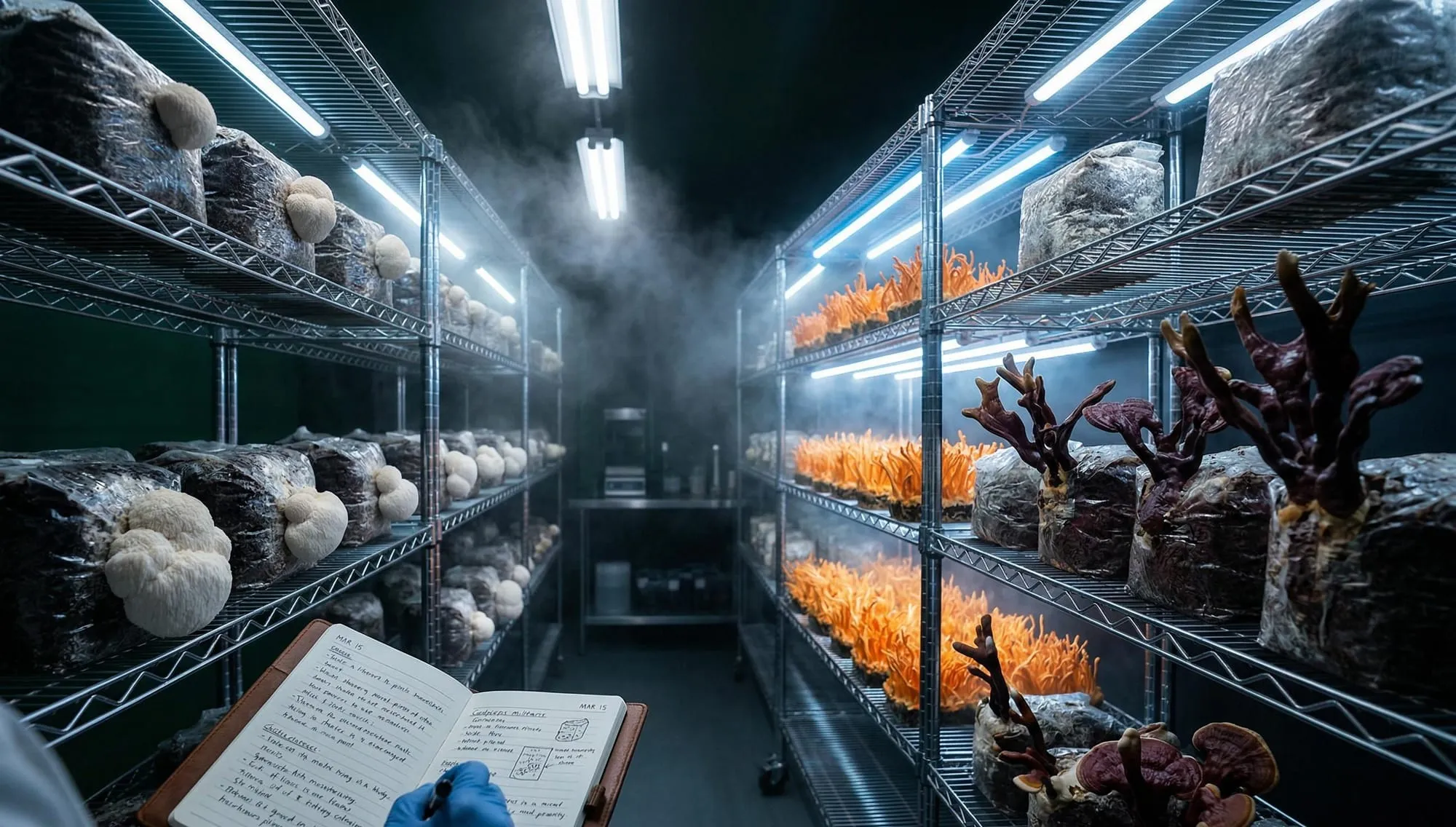
Fruiting body production is different. Colonization time ranges from 45 to 120 days depending on the species. The fruiting environment is controlled and sensitive. The harvest window spans merely 24–48 hours. Yield per gram is far below that of substrate mycelium. Longer duration, more resources, less output.
Result: fruiting body-based production is approximately 3–5 times more expensive than substrate-inclusive mycelium. The genuine active compound ratio per gram is substantially higher.
3. Technical Infrastructure — The Unseen Investment
Behind the price lies infrastructure that is invisible yet reflected in every gram. The VRF climate control system operates 24/7 — managing the temperature of each room with 0.5°C precision. An industrial generator system guarantees uninterrupted power — a few hours of electrical outage can reset a production cycle lasting weeks. An AI-assisted sensor network collects real-time data, detects anomalies, and alerts when intervention is required.
In a factory producing by the ton, this infrastructure lowers unit cost. At an artisanal scale, it is reflected more heavily in each gram. Yet without this infrastructure, producing consistent quality is impossible. Seasons change, external temperature fluctuates, power fails — without automation, each event means quality degradation.
Large-scale operations amortize this infrastructure across tonnage. We amortize it across quality. We produce less, but this system stands behind every gram.
2. COA — Batch-Specific Independent Analysis
Independent laboratory analysis is repeated for every production batch. Accredited laboratory fees are a fixed cost — independent of batch size.
This cost appears small but is reflected in the price. A producer without a COA eliminates this cost to zero. You also zero out — the analysis guarantee.
3. Netherlands-Certified Strain
Certified strain procurement and renewal every 3–4 cycles is a fixed operational cost. Sourcing a strain from a local or uncertified source reduces this cost — but the guarantee of genetic stability disappears. Compound concentration becomes variable from batch to batch.
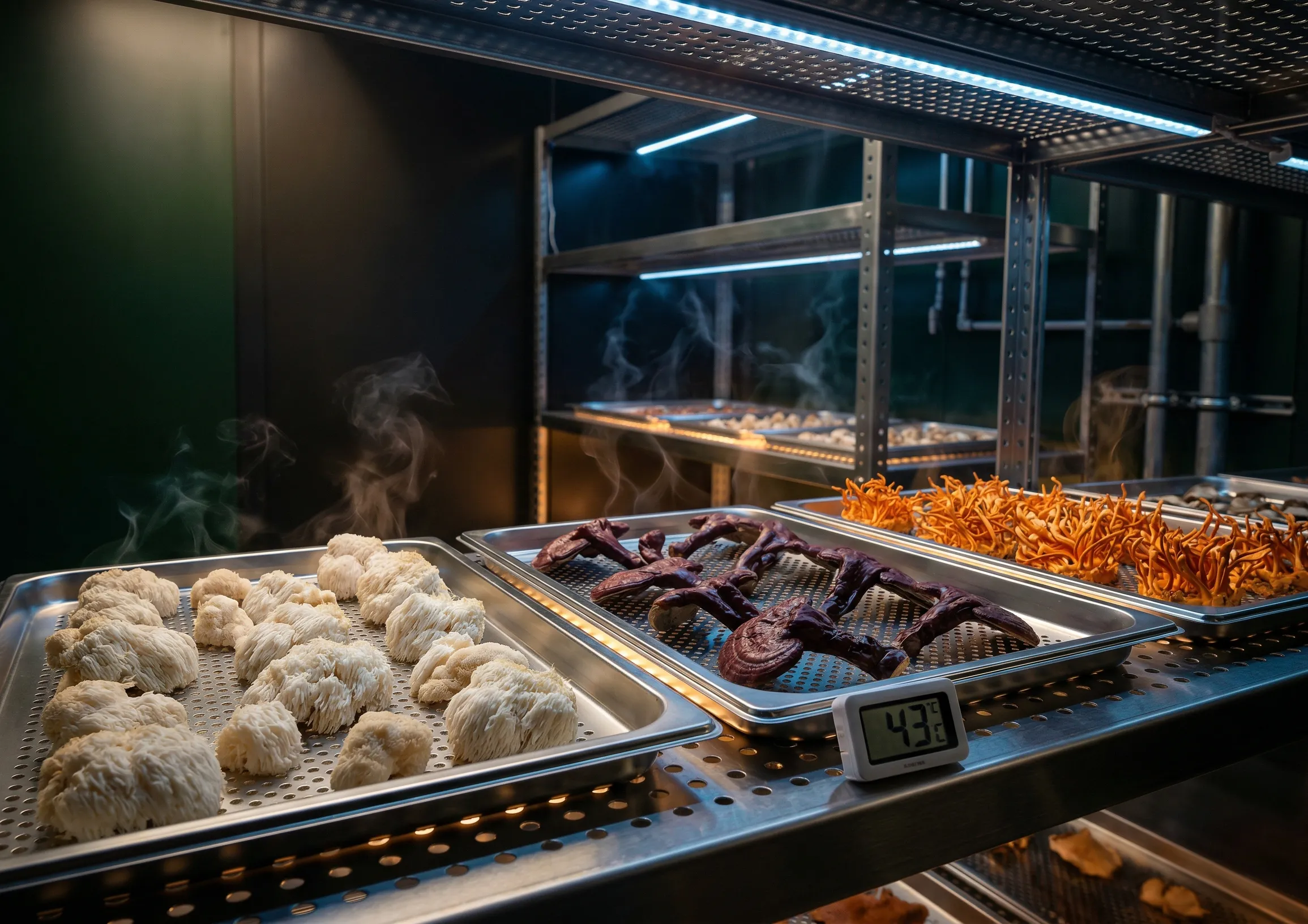
4. 42–45°C Low-Temperature Drying
Industrial high-temperature drying (70–100°C) is fast and energy-efficient. 42–45°C low-temperature drying is slow — drying the same volume takes 2–3 times longer.
Energy consumption and duration equal cost. This difference translates directly into the price.
5. Small-Batch Production
Large-scale production drives unit cost down. In artisanal production — as practiced by MYCOVITA — economies of scale do not apply. Each batch is small, each step is manually tracked, each control is manual.
This is a deliberate choice. Quality control does not degrade in direct proportion to scale growth — we will grow, but without compromising this foundation.
— THE COST OF A CHEAP PRODUCT —
In a world where you can purchase Lion's Mane powder at 600 currency units, why choose MYCOVITA?
A simple calculation: if 60% of that 600-unit product is grain, the price you pay for actual Lion's Mane by gram weight is effectively far higher. Moreover, the active compound concentration is uncertain — no COA, no verification.
This is not about buying a more expensive product — it is about the price you pay per gram of genuine active compounds.
You can verify this calculation with a COA document. We can show it.
— TRANSPARENCY COMMITMENT —
MYCOVITA never aims to be "the cheapest." The goal: that the value behind the price is transparent and documented.
We can always demonstrate the following:
- Which laboratory performed the analysis, and what the results are
- Which batch your product came from, and that the batch-specific COA is available
- The beta-glucan profile confirming it is fruiting body, not substrate
- Drying temperature logs
Transparency is not marketing; it is an operational standard.
— FINAL WORD —
You are not obligated to buy an expensive product. But we believe you are obligated to know what you are buying.
Buy a product that has a COA. Buy a product documented as fruiting body. Buy a product that accounts for drying temperature.
After asking those questions, evaluate the best price-to-value ratio for yourself.
MYCOVITA can answer all of those questions. And we are prepared to do so.
Related readings: Mycelium vs Fruiting Body · What is a COA? · What is Chitin?
On MYCOVITA's production philosophy, technical infrastructure, and transparency principles: Why MYCOVITA?
You Might Be Interested In
→ Can Mushroom Products Produced in Turkey Be Trusted?
→ Functional Mushroom Production in Turkey
→ The Functional Mushroom Market in Turkey
→ Where to Buy Functional Mushrooms in Turkey
This content is for informational purposes only and does not constitute medical advice. Consult your physician before making any health-related decisions. Functional mushrooms are not pharmaceuticals and cannot be used to treat diseases.
Version: 1.0 | Last updated: 20 Apr 2026 | Sources reviewed: 5+ | Method: Editorial Policy | References: Bibliography