The Lentinus tigrinus Compendium
One Fungus, Two Life Forms
— THE TIGER —
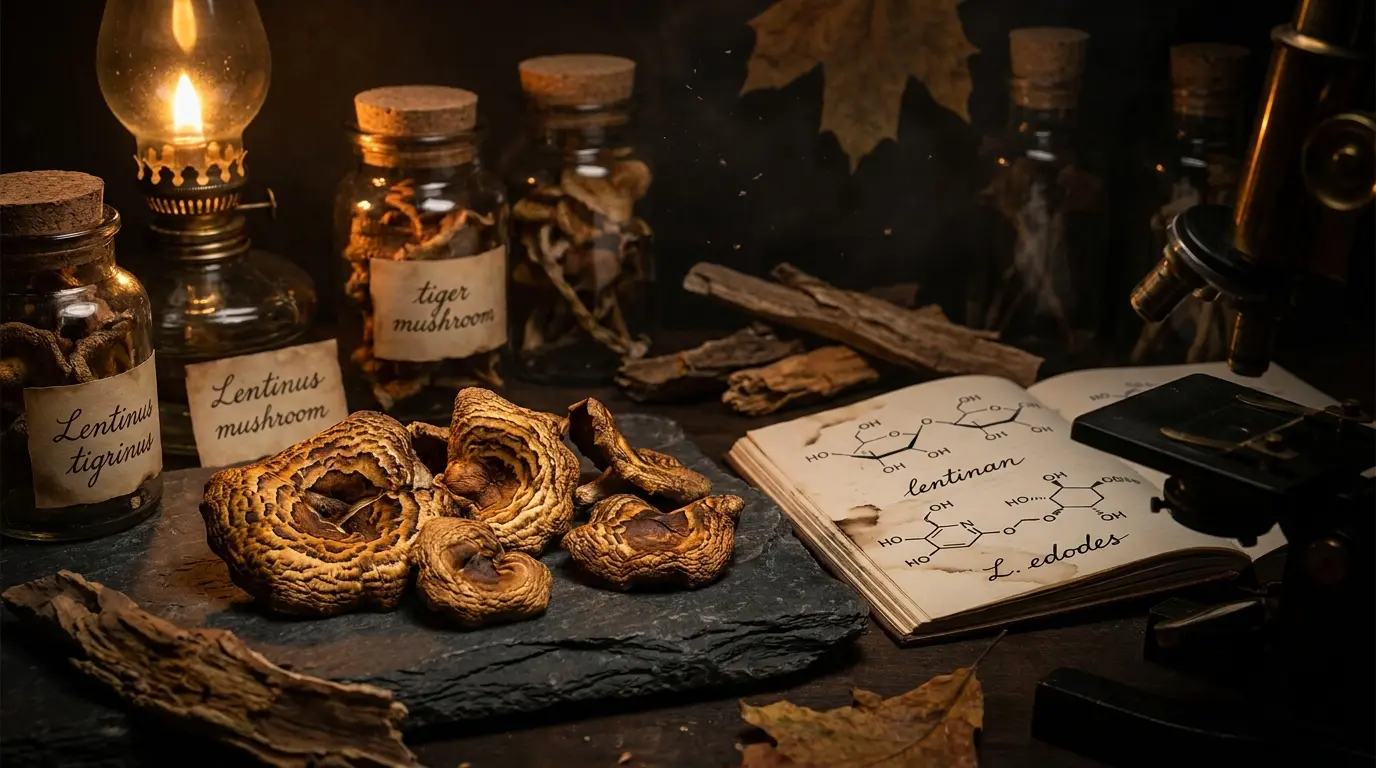
Lentinus tigrinus possesses a peculiar distinction in the mycological literature: the same species can produce two completely different fruiting body forms, one in nature and another under laboratory conditions. The classical form develops an open cap with a whitish ground adorned by brown-black speckles (the epithet "tigrinus" — tiger pattern — refers to these markings). The alternative form is termed "secotioid"; the cap never opens, spores remain enclosed within, and the mushroom assumes a globular, truffle-like appearance.
This morphological plasticity subjected the species to decades of taxonomic controversy. Today, both forms are accepted as belonging to a single species; the difference maps to variants at a single gene locus. This article examines L. tigrinus's kinship with Shiitake (Lentinula edodes), its distinctive chemistry, and why it serves as a compelling model in mycology.
Taxonomy: Lentinula and Lentinus
Historically, both Shiitake and the tiger Lentinus were classified under a single genus (Lentinus). Molecular taxonomy, however, has since separated them into distinct genera:
- Lentinula edodes: Shiitake. Genus Lentinula.
- Lentinus tigrinus: Tiger Lentinus. Genus Lentinus.
Though the two genera are related, they represent divergent evolutionary lineages. The genus Lentinus belongs to the order Polyporales and includes species with tougher, woodier fruiting bodies. The genus Lentinula falls within the order Agaricales and produces softer, agaricoid fruiting bodies. This distinction keeps the two species separate in both culinary and chemical identity.
The similarity in names and their shared taxonomic past occasionally cause confusion; the expression "Lentinus edodes" appears frequently in older literature, but modern terminology is Lentinula edodes.
Natural Habitat and Identification
L. tigrinus exhibits a broad distribution across temperate regions. It appears frequently on decaying hardwood logs, particularly those of poplar and willow. The species is encountered in Mediterranean and Black Sea climates, including Turkey.
Identifying characteristics:
- Cap diameter 4–10 cm, whitish ground covered with brown-black scales (tiger pattern).
- Gills decurrent (running down the stipe), whitish.
- Stipe central, white, with brown scales toward the base.
- Flesh typically tough and cartilaginous; difficult to chew when raw.
Regarding edibility, young specimens find use in certain regional cuisines, though their toughness limits gourmet consumption.
Two Fruiting Body Forms
The most intriguing element in the taxonomic history of this fungus is the existence of two morphological forms:
- Agaricoid form: The classical open-capped, gilled structure. Spores are released into the air from the exposed underside of the cap.
- Secotioid form: The cap remains closed and never expands. Spores accumulate internally; the mushroom resembles a small sphere or tuber. This form was once separately designated as Lentinus tigrinus f. tigrinus, but modern revision accepts it as a form within the same species.
The difference between the two forms depends on variants at a single gene locus. Mycological literature treats this as an example of an "evolutionary transition": secotioid forms represent an intermediate stage between gymnocarpic (open) and angiocarpic (closed) life strategies. The closed form offers advantages under certain ecological conditions — arid environments or intense insect pressure — by protecting spores.
Chemical Profile
The characteristic compound profile of Lentinus tigrinus runs parallel to that of Shiitake but is not identical. Principal compound families include:
- β-glucan polysaccharides: Branched β-(1→3) structures. Structurally similar to lentinan but differing in branching frequency and molecular weight distribution.
- Antimicrobial peptides: A group of small peptides named tigerins has been isolated; they exhibit in vitro activity against filamentous fungi.
- Aromatic compounds: The volatile profile differs from Shiitake; aromatic aldehydes, including methyl cinnamate, are typical.
- Polyphenols: Low to moderate phenolic compound content.
The species' chemical identity does not include eritadenine (one of Shiitake's signature molecules); this constitutes a clear chemical demarcation from Shiitake.
Literature
The body of literature on L. tigrinus is limited. Research themes include:
- Taxonomy and evolution: The genetic switch between the two forms and the ecological significance of the secotioid form.
- Lignocellulase enzyme profile: The species produces robust ligninolytic enzymes; it attracts interest in bioremediation and agricultural waste conversion studies.
- Polysaccharide chemistry: Comparative β-glucan profiling.
- Antimicrobial activity: In vitro characterization of tigerin peptides and other small antimicrobial molecules.
No human clinical studies exist; the species rarely appears as a standalone ingredient in the dietary supplement market. It may more commonly be encountered as a component in blended extracts.
Quality and Culinary Notes
Lentinus tigrinus should not be confused with Shiitake in terms of culinary value. Its toughness necessitates extended cooking or marination. The aroma profile is earthier, and the umami intensity is lower compared to Shiitake.
The term "Lentinus" on product labels is insufficient; the full species name (L. tigrinus or L. edodes) must be specified. The two species are not chemically interchangeable.
Related Reading
- Lentinula Edodes (Donko) — Species encyclopedia for Shiitake and the donko-grade fruiting body.
- What Is Lentinan — The characteristic β-glucan of Shiitake.
- What Is Ergothioneine — Chemical profile of the fungal amino acid derivative.
This content is for informational purposes only and does not constitute medical advice. Consult a physician before making any health-related decisions. Functional mushrooms are not pharmaceuticals and cannot be used to treat diseases.
Version: 1.0 | Last updated: 27 April 2026 | Sources reviewed: 12+ | Methodology: Editorial Policy | References: Bibliography