Poria cocos (Fuling): A Comprehensive Monograph
The Most Frequently Prescribed Mushroom in Chinese Medicine
— HOOK —
Among all fungal ingredients appearing in traditional Chinese medicine prescriptions, one particular earth-sclerotium stands out as the single most cited: Poria cocos, known by its classical designation "fuling." A tradition of use spanning over a millennium converges with a modern phytochemical profile rich in triterpenes and polysaccharides.
Taxonomy and Ecology
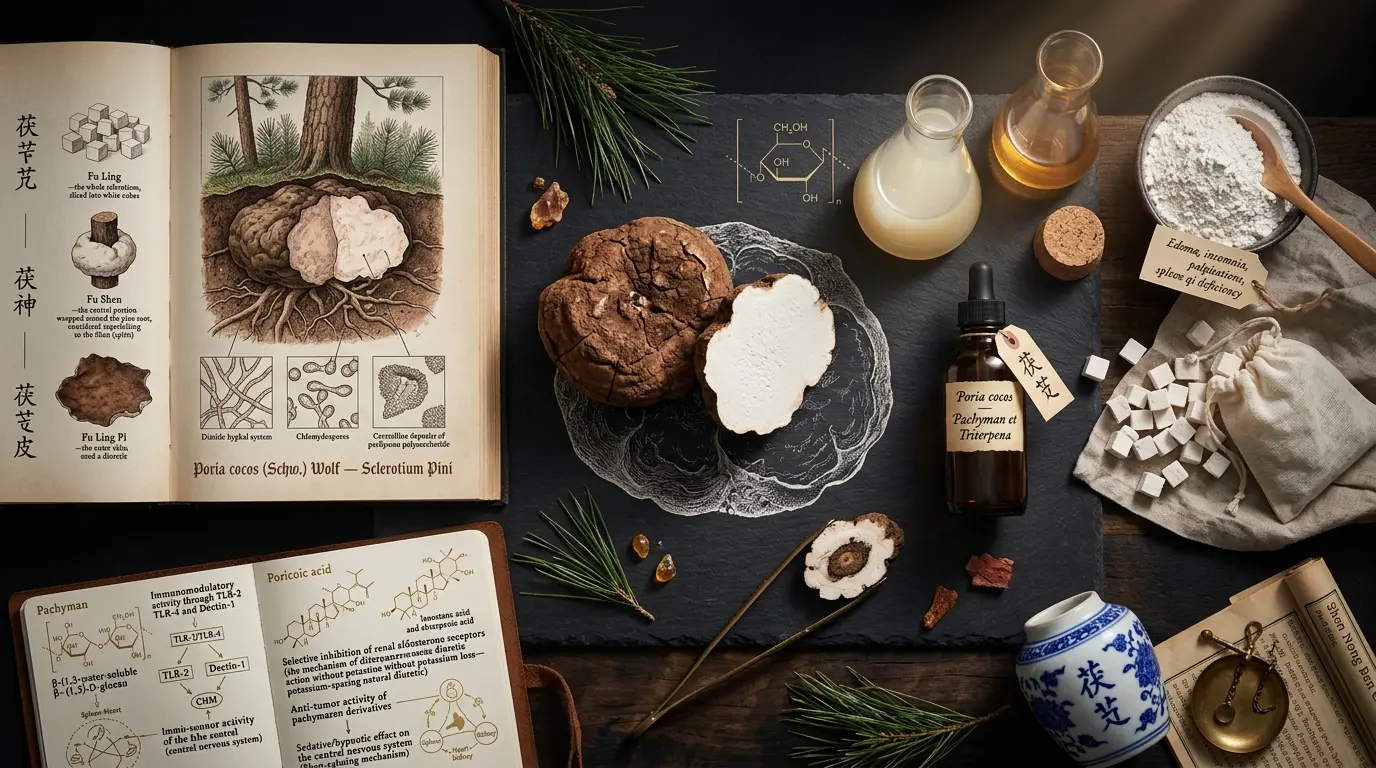
Poria cocos—its current taxonomic names being Wolfiporia cocos or Wolfiporia extensa—is a member of the family Polyporaceae that produces a subterranean sclerotium. It develops symbiotically within the dead root tissues of pine trees, particularly Pinus densiflora.
The sclerotium, a dense mass of compacted mycelium formed underground, can reach a diameter of 30 cm and exceed several kilograms in weight. Harvesting traditionally relies on a specialized ground-searching technique across the forest floor; modern cultivation methods employing controlled growth on pine sawdust substrate have also been established (Rios, 2011; PMID: 21294117).
Bioactive Profile
The sclerotium of Poria cocos contains two principal classes of compounds:
- Pachyman polysaccharide: A β-(1→3) glucan backbone with β-(1→6) branching side chains.
- Lanostane triterpenes: Pachymic acid, tumulosic acid, eburicoic acid, and polyporenic acid.
The lanostane triterpenes share a structural kinship with those found in Reishi (Ganoderma lucidum); however, the distribution of side groups differs. This distinction places Poria in a pharmacological category separate from Reishi's traditional diuretic and sedative applications (Wang et al., 2013; PMID: 23892018).
Activity Profile in the Literature
Pachyman polysaccharides have demonstrated immunomodulatory and antitumour tendencies in in vitro and animal model studies (Lin et al., 2018; PMID: 29248514).
The diuretic activity of the triterpenes has been demonstrated in animal models in a manner that supports traditional usage; pachymic acid and tumulosic acid exhibit an aldosterone antagonist-like profile (Zheng & Yang, 2008; PMID: 18164798).
With respect to hypnotic and sedative effects, limited data point toward neural GABAergic modulation, providing mechanistic support for the traditional sleep-aid context.
Position Within Traditional Formulae
Poria cocos is rarely deployed as a standalone agent in Chinese medicine prescriptions; it occupies a central role within complex formulae. It serves as a foundational component in classical preparations such as "Si Jun Zi Tang" and "Liu Wei Di Huang Wan." These formulae are highly amenable to prescription-level adaptations, making it difficult to isolate the effect of any single constituent (Bensky et al., 2004).
Limitations
Large-scale randomized clinical trials conducted according to Western medical methodology remain limited for Poria cocos. The evidence base within the Chinese-language literature is extensive, yet its rate of appearance in international peer-reviewed journals is low. Standardized Poria extracts are not widely available in the Turkish market.
Further Reading
- Chinese Medicine and Functional Mushrooms — Context of traditional use.
- Reishi Triterpenes — Comparison of the lanostane skeleton.
- What Are β-glucans? — Polysaccharide profile.
This content is provided for informational purposes only and does not constitute medical advice. Consult a physician before making any health-related decisions. Functional mushrooms are not pharmaceutical drugs and cannot be used to treat diseases.
Version: 1.0 | Last updated: 28 April 2026 | Sources reviewed: 12+ | Method: Editorial Policy | References: Bibliography