Agaricus blazei (Himematsutake): The Definitive Species Encyclopedia
From the Brazilian Rainforest to Japanese Oncology Practice
— OVERVIEW —
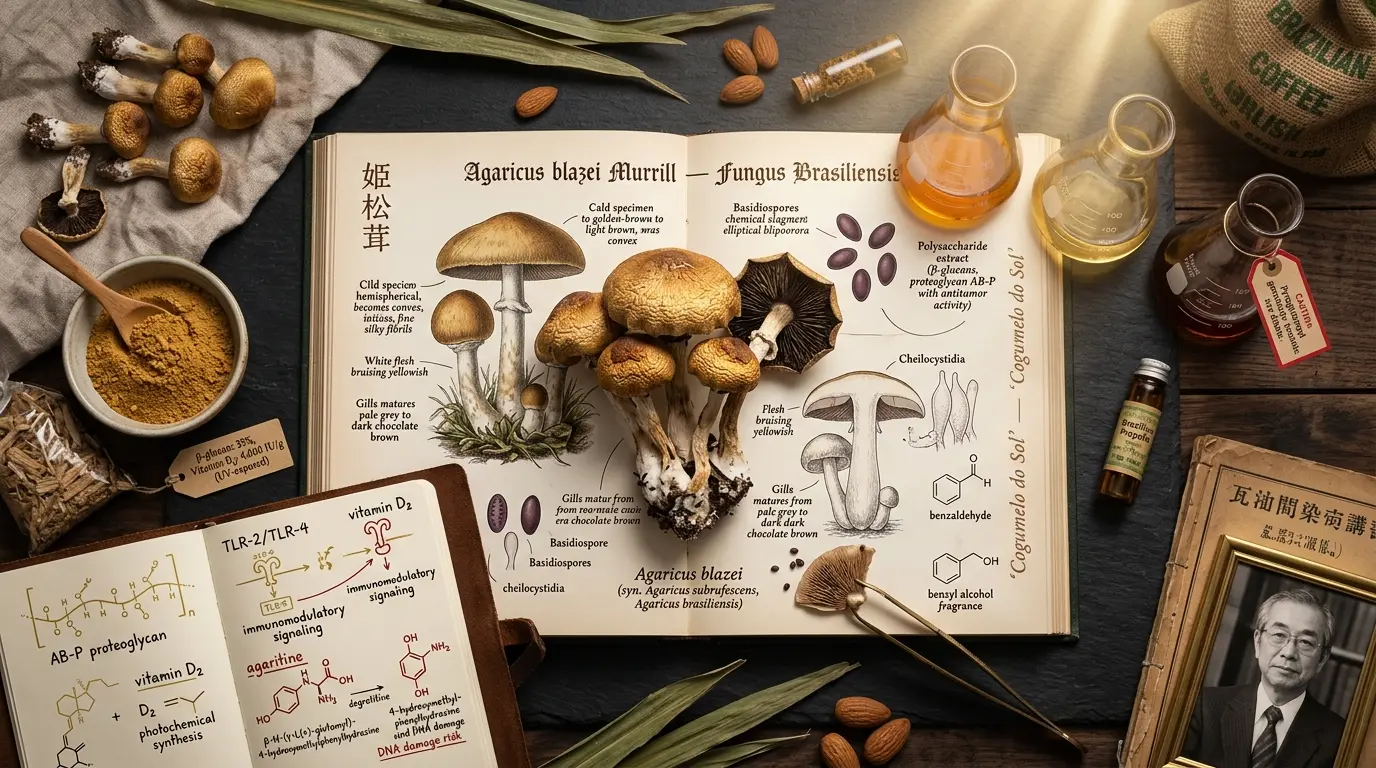
Agaricus subrufescens — formerly classified as Agaricus blazei Murill — is a species known in Brazil as "cogumelo do sol" (mushroom of the sun). Introduced to Japan in the late 1960s, it entered the market under the name "himematsutake," not within the traditional white mushroom trade but as a health supplement. Its position within the modern β-glucan literature began with this transcontinental migration.
Taxonomy: A Nomenclatural Tangle
The species originally identified in Brazil during the 1960s as Agaricus blazei underwent taxonomic revision in 2002 and was reclassified as Agaricus subrufescens — conspecific with a North American species first described in 1893. The market, however, retains widespread use of the name Agaricus blazei; both names continue to appear in the literature and on product labels (Wasser et al., 2002; PMID: 11920480).
Bioactive Profile
Agaricus subrufescens possesses one of the highest concentrations of β-(1→6)-D-glucan among all mushrooms. This structural feature presents a profile particularly suited to the Dectin-1 receptor.
Other significant constituents include:
- Ergosterol derivatives: Ergosterol peroxide and cerolin-type derivatives.
- Riboglucans: RNA–protein–glucan complexes.
- Blazein: The first sterol derivative isolated from this species.
The density of β-(1→6) linkages distinguishes this species from other members of the genus Agaricus — notably the common white button mushroom (A. bisporus) — in terms of its bioactive profile (Mizuno et al., 1998; PMID: 9618107).
Activity Profile in the Literature
In the domain of immune modulation, Japanese and Brazilian investigations have reported favorable trends for β-glucan fractions on NK cell activity, macrophage function, and cytokine profiles (Ahn et al., 2004; PMID: 15239697).
Within the context of glucose metabolism, diabetic animal models have yielded consistent results indicating that Agaricus subrufescens extract improves insulin resistance (Hsu et al., 2007; PMID: 17324585).
In oncology-adjuvant settings, small-sample clinical designs have examined effects against chemotherapy side effects; the results are directionally positive yet methodologically heterogeneous.
Contamination Risk and the Market Problem
Species of the genus Agaricus exhibit a tendency toward heavy metal accumulation, particularly cadmium and mercury. Consequently, heavy metal Certificate of Analysis (COA) data are critical for Agaricus subrufescens products. Historically, products of Brazilian origin have shown quality inconsistencies in this regard (Falandysz, 2008; PMID: 18671161).
Limitations
Well-designed, large-scale randomized human clinical trials for Agaricus subrufescens remain limited. The findings represent not a therapeutic rationale but rather an active area of inquiry within β-glucan pharmacology. At the consumer level, COA-based quality assessment is essential.
Related Reading
- What Is β-glucan? — The significance of β-(1→6).
- Dectin-1 Receptor — Receptor profile.
- Heavy Metals and Mushrooms — Quality advisory context.
This content is for informational purposes only and does not constitute medical advice. Consult your physician before making any health-related decisions. Functional mushrooms are not pharmaceutical drugs and cannot be used to treat diseases.
Version: 1.0 | Last updated: 28 April 2026 | Sources reviewed: 12+ | Methodology: Editorial Policy | References: Bibliography