PI3K/Akt Signaling: The Landscape of Fungal Triterpenoid Research
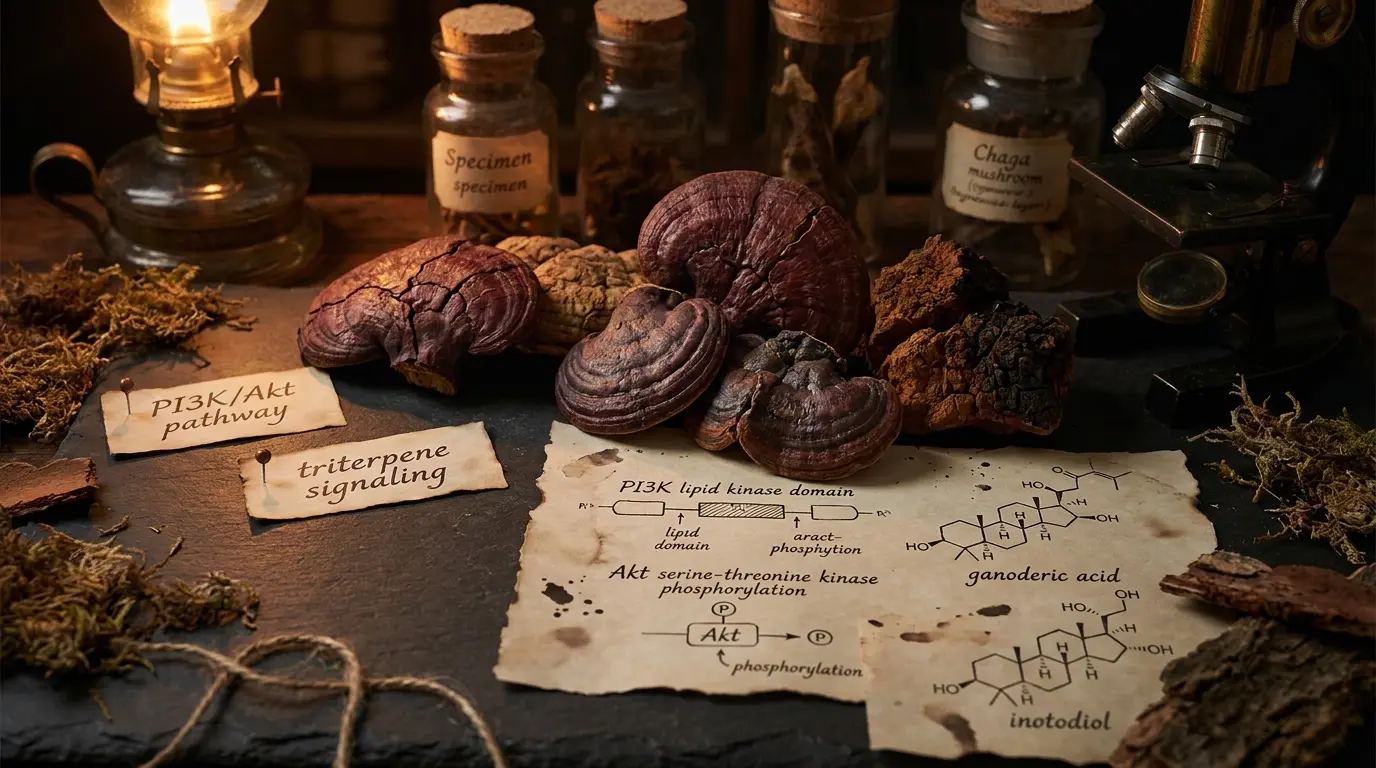
The PI3K/Akt pathway is one of the key signaling axes in cell biology. Originating from growth factor stimulation and extending to decisions on survival, metabolism, and cell cycle progression, this cascade ranks among the most intensively studied topics in cancer biology. The interaction of mushroom-derived constituents with this pathway presents an increasingly coherent picture.
PI3K/Akt Pathway: General Framework
Phosphatidylinositol 3-kinase (PI3K) converts PIP₂ to PIP₃ following receptor tyrosine kinase activation. PIP₃ recruits Akt kinase to the membrane, enabling its activation. Active Akt phosphorylates dozens of substrates, thereby regulating cell survival (via Bcl-2/Bcl-xL), protein synthesis (via mTOR activation), and glucose metabolism (via GLUT4 translocation).
The principal negative regulator of the PI3K/Akt pathway is the tumor suppressor PTEN. Loss of PTEN underpins the hyperactivation of this cascade in many cancers.
Ganoderma Triterpenes and PI3K/Akt
Several triterpenes isolated from Ganoderma lucidum (ganoderic acids A, C, H, T) have been examined for their ability to inhibit the PI3K/Akt pathway. These compounds have been reported to reduce Akt phosphorylation in cancer cell lines, thereby lowering the threshold for apoptosis (Zhao et al., 2011; PMID: 21295412).
Autophagy induction through mTORC1 inhibition has also been noted in some studies; this mechanism aligns theoretically with Reishi’s anti‑aging research context.
Polysaccharide Effects
Beta-glucan polysaccharides trigger PI3K activation in immune cells via the Dectin-1 → Syk → PI3K cascade. This immune‑context PI3K activation stands in direct contrast to the inhibition observed in cancer cell models—the same pathway can produce opposite outputs in different cell types.
This contextual dependence demands caution regarding broad generalizations about “PI3K/Akt effects.”
Limitations
The current understanding of mushroom constituents on PI3K/Akt rests predominantly on in vitro cancer cell models. The scant data on oral bioavailability, in vivo dosing, and tissue distribution complicate clinical interpretation. For clinicians, the message remains: scientifically intriguing at the research level, but not yet supported by evidence suitable for recommendations.
Related Reading
This page has been prepared within the MYCOVITA Mycology Library. It serves scientific reference purposes; it does not constitute medical advice. Source: mycovita.bio · Content Policy v1.0