Natural Killer Cells and Mushroom-Derived Compounds: A Survey of the Innate Immunity Literature
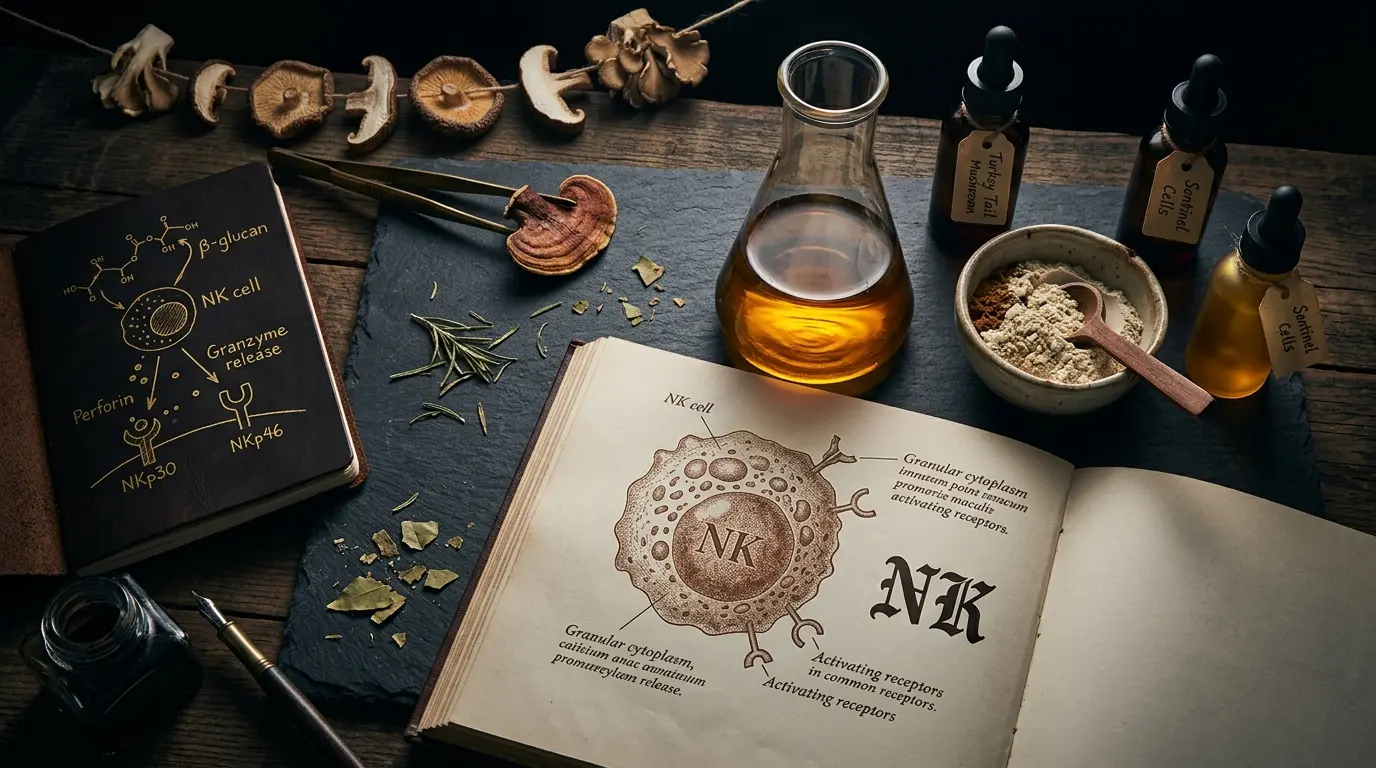
A Cell True to Its Name: The Natural Killer
— HOOK —
Adaptive immunity is memory-laden, deliberate, and requires training. The rapid arm of innate immunity operates without prior education — yet remains discerning. Its most remarkable agent is the natural killer (NK) cell, one of the rare immune cells capable of recognizing and acting upon a target it has never encountered before.
This entry examines the biology of NK cells, the logic by which they distinguish targets, and the body of literature on how functional mushroom polysaccharides modulate NK activity.
NK Cells: The Unorthodox Relative of the Lymphocyte
NK cells arise from lymphoid progenitors — the same lineage that produces T cells and B cells. Yet they carry no antigen-specific receptor, neither TCR nor BCR. Instead, their surface bristles with a combinatorial array of activating and inhibitory receptors.
These receptors integrate the signaling landscape presented by a target cell. When the net verdict tilts toward action, the NK cell releases perforin and granzyme, triggering apoptosis in the target (Vivier et al., 2008; PMID: 18650752).
The "Missing Self" Hypothesis
NK target recognition operates on a logic fundamentally distinct from that of T cells. Healthy cells display MHC class I molecules on their surface; these engage the inhibitory receptors on NK cells, maintaining quiescence. Under viral infection or malignant transformation, cells frequently downregulate MHC-I expression. The NK cell perceives this "missing self" and mounts a response.
This mechanism explains why viruses and certain tumors that evade T cells by suppressing MHC-I remain subject to surveillance (Ljunggren & Kärre, 1990; PMID: 2189709).
Activation Signals and Cytokine Profile
IL-2, IL-12, IL-15, and IL-18 are central cytokines in NK cell activation. Once activated, the NK cell is more than a cytotoxic effector; it secretes IFN-γ, steering neighboring immune cells — particularly macrophages — toward a Th1-polarized response.
The age-related decline in NK activity, and its diminished efficacy under chronic inflammatory conditions, constitutes a major axis of immunosenescence research (Solana et al., 2012; PMID: 22841633).
Mushroom Constituents and NK Activity: A Review of the Literature
Maitake D-fraction has demonstrated a tendency to enhance NK activity in animal models and limited human studies. The mechanism is interpreted partly through increased IL-12 production and partly through macrophage-mediated NK activation (Kodama et al., 2002; PMID: 11890458).
Reishi polysaccharide fractions have shown a consistent trend toward elevating in vitro NK cytotoxicity (Gao et al., 2003; PMID: 12851815).
Standardized Shiitake derivatives such as AHCC and PSK have produced measurable increases in NK activity in clinical studies. Although a substantial portion of these investigations employ small sample sizes and heterogeneous designs, the direction of effect remains consistent (Matsui et al., 2002; PMID: 12184739).
Limitations
NK activity measurement is not a standardized laboratory parameter; methodological variability is high. Cross-study comparisons must therefore be interpreted with caution. These findings represent the active field of immunomodulation research, not a therapeutic protocol.
Further Reading
- How the Immune System Works — The contours of innate and adaptive immunity.
- D-Fraction — The active fraction of Maitake.
- Lentinan, PSK, and β-glucan — Standardized fractions.
This content is provided for informational purposes only and does not constitute medical advice. Consult a physician before making any health-related decisions. Functional mushrooms are not pharmaceuticals and are not indicated for the treatment of disease.
Version: 1.0 | Last updated: 28 April 2026 | Sources reviewed: 12+ | Methodology: Editorial Policy | References: Bibliography