Mushrooms and Thyroid Function: A Literature Review
Thyroid Hormone, Immunity, and Mushroom Polysaccharides
— OVERVIEW —
The thyroid gland is a central endocrine organ governing basal metabolic rate and energy homeostasis. Thyroid dysfunctions — hypothyroidism and hyperthyroidism — are predominantly autoimmune in origin. Consequently, the subject of "thyroid" intersects with the functional mushroom literature not through direct pathways, but primarily via immune modulation.
A Brief Summary of Thyroid Physiology
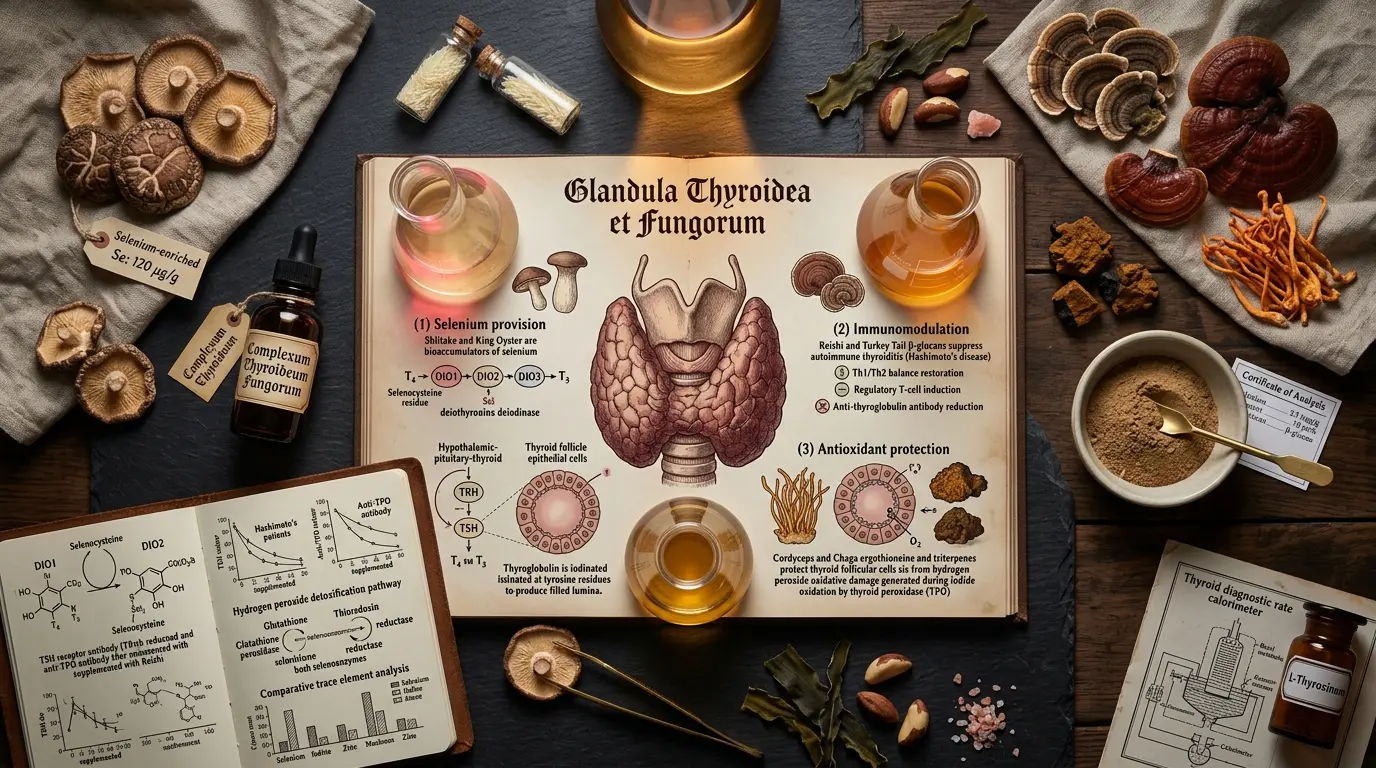
The thyroid gland produces the hormones T3 (triiodothyronine) and T4 (thyroxine). T4 is secreted in greater abundance; however, T3 is the biologically active form and is converted from T4 in peripheral tissues. This conversion is regulated by deiodinase enzymes.
Hashimoto's thyroiditis (autoimmune hypothyroidism) and Graves' disease (autoimmune hyperthyroidism) are the two most common autoimmune conditions of the thyroid, sharing the hallmark feature of immune system misdirection against thyroid antigens (Caturegli et al., 2014; PMID: 24494053).
Autoimmune Thyroid and Immune Regulation
Disruption of the Th17/Treg balance lies at the core of autoimmune thyroid pathogenesis. Dominance of the Th17 response facilitates attack on the thyroid epithelium; insufficient Treg activity compromises the ability to restrain this assault.
The immunomodulatory profile of mushroom β-glucans exhibits a balancing, tonic effect on the immune milieu — dampening overstimulated responses while bolstering weak ones. This profile presents a property that warrants careful consideration in the context of autoimmune conditions (Quintin et al., 2012; PMID: 22789518).
Mushroom Constituents and the Thyroid Literature
Studies directly measuring the effects of mushrooms on thyroid hormone levels remain scarce. The available literature proceeds through indirect axes.
In vitro data indicating that Reishi and Cordyceps polysaccharides support Treg cell function provide a source of mechanistic hypotheses within the autoimmune thyroid context (Kohguchi et al., 2004; PMID: 15179035).
Selenium plays a critical role in thyroid hormone production and in the activity of the antioxidant enzyme glutathione peroxidase. Certain mushroom species — notably some members of the genus Boletus — demonstrate a selenium accumulation profile. This opens the mineral content dimension in evaluating mushrooms as a nutritional resource for thyroid health (Falandysz, 2013; PMID: 23973081).
Precautions
Thyroid medications — particularly levothyroxine — are sensitive to gastric contents and concurrently ingested substances with respect to absorption. Although no pronounced effect of mushroom extracts on absorption has been demonstrated, individuals taking levothyroxine should consult their physician regarding the timing of mushroom supplementation.
For individuals with autoimmune thyroid conditions, a physician-led evaluation is recommended before initiating mushroom polysaccharide supplementation; the risk-benefit analysis differs for each person.
Limitations
Well-designed human intervention studies examining the effects of mushroom constituents on thyroid hormone profiles or thyroid antibodies do not exist. Current inferences are projected onto the thyroid context as a sub-question of immunomodulation; they do not constitute direct clinical recommendations.
Related Reading
- Mushrooms and Autoimmune Processes — Immune balance.
- How the Immune System Works — Th17/Treg balance.
- Mushrooms and Mineral Content — The selenium context.
This content is for informational purposes only and does not constitute medical advice. Consult your physician before making any health decisions. Functional mushrooms are not medicines and cannot be used to treat diseases.
Version: 1.0 | Last updated: 28 April 2026 | Sources reviewed: 12+ | Methodology: Editorial Policy | References: Bibliography