Mushrooms and the Science of Aging: A Comprehensive Review of Ergothioneine Research
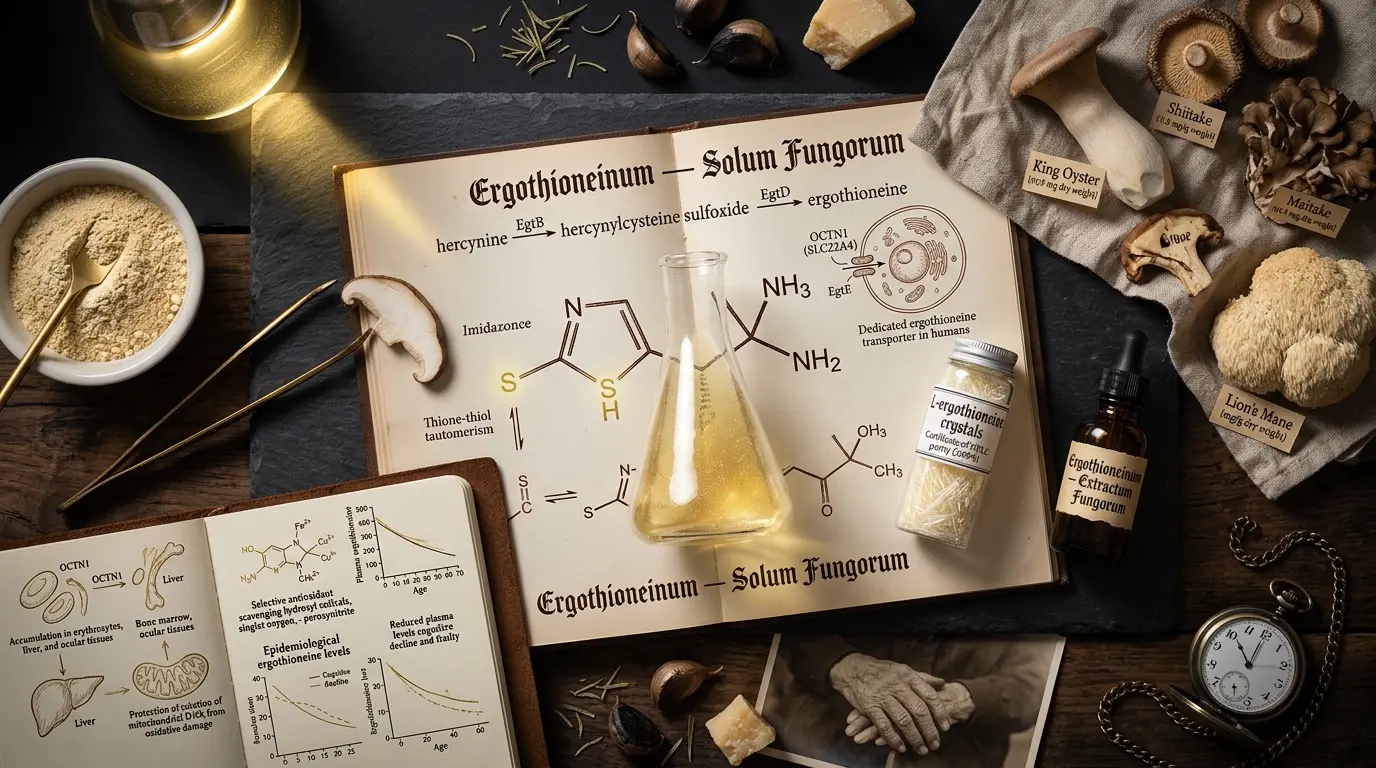
A literature review of the amino acid ergothioneine, cellular aging mechanisms, and the metabolic context of mushroom-derived content. This article contains no health claims.
— THE HOOK —
In 1909, French researcher Charles Tanret isolated a white crystalline substance from rye ergot and named it after its source: ergothioneine. For a century, its function remained largely unknown. Then, in 2005, researchers discovered that the human body possesses a dedicated transporter protein — SLC22A4 (OCTN1) — evolved specifically to shuttle this amino acid into cells.
The evolutionary development of a dedicated transporter for a single molecule is no trivial detail. The body prioritizes the uptake of compounds it deems essential.
And the near-exclusive dietary source of ergothioneine is mushrooms.
What Is Ergothioneine?
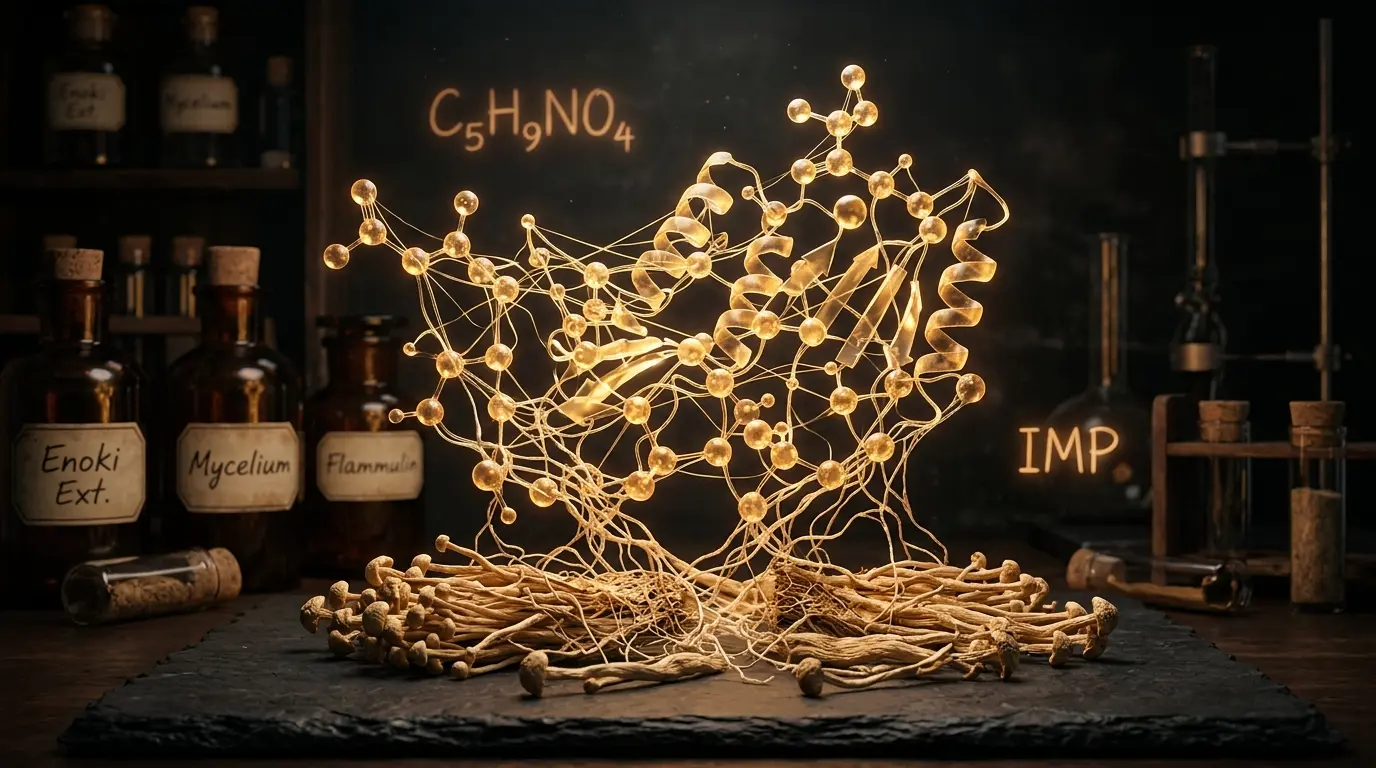
Ergothioneine — (2S)-3-(2-thioxo-2,3-dihydro-1H-imidazol-4-yl)-2-(trimethylazaniumyl)propanoate — is a sulfur-containing betaine amino acid. It is synthesized exclusively by select species of fungi and mycobacteria. Humans and animals lack the biosynthetic capacity to produce it; it must be acquired through the diet.
Ergothioneine Content in Mushrooms
Based on dry weight analysis (Kalaras et al., 2017, Food Chemistry):
- Pleurotus eryngii (King Oyster): ~4.7 mg/g
- Pleurotus ostreatus (Oyster): ~2.6 mg/g
- Agaricus bisporus (Portobello): ~0.4–1.3 mg/g
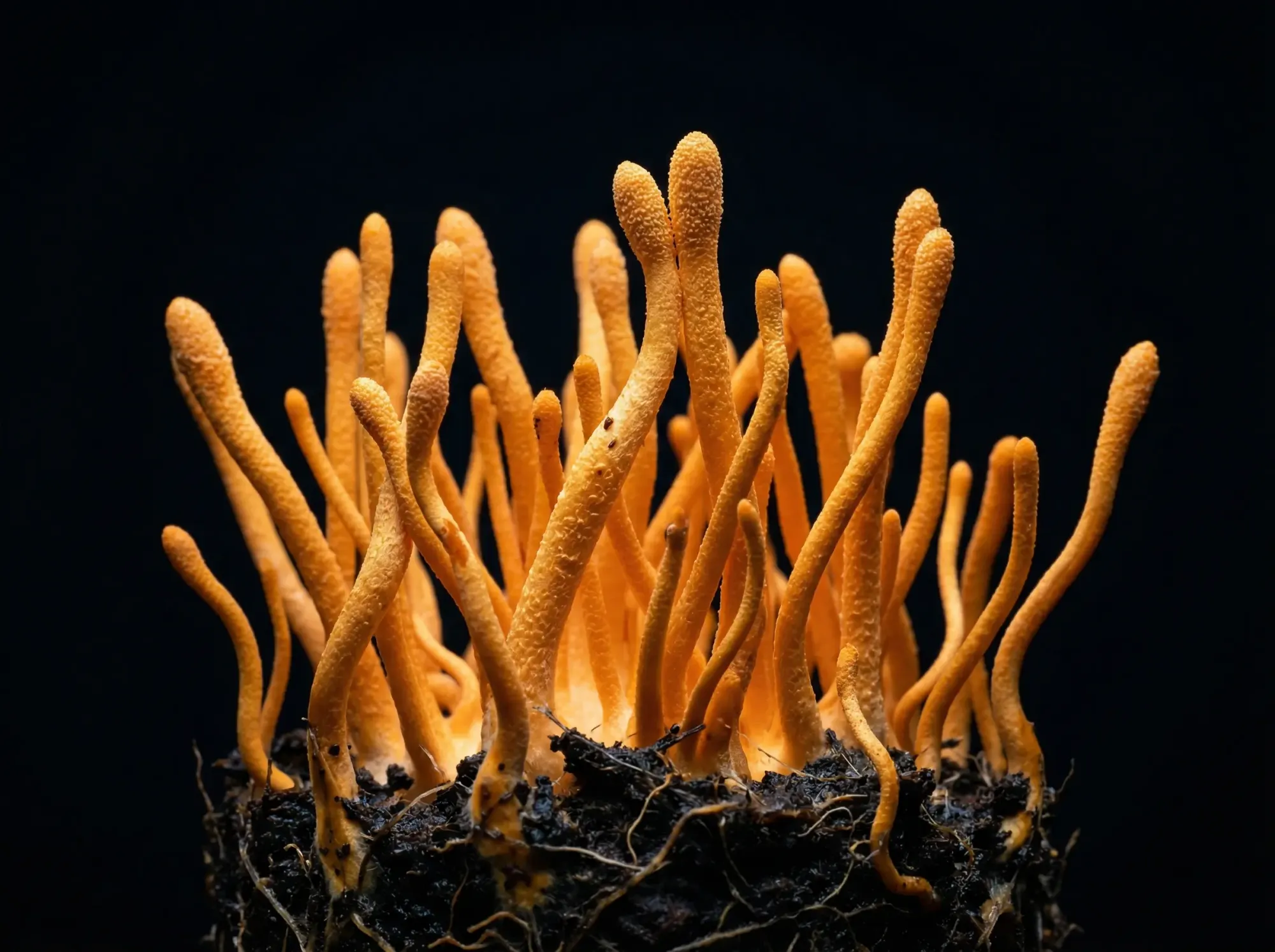
- Cordyceps militaris: significant quantities detected
King Oyster stands as the richest reported source of ergothioneine within the functional mushroom category.
Mechanism — Not an Antioxidant, a Cellular Protectant
Although ergothioneine is classified as an antioxidant, its chemical behavior diverges from classical antioxidants such as vitamin C and vitamin E:
- Redox potential: Ergothioneine is responsive to shifts in the intracellular redox environment — it exhibits active antioxidant behavior selectively under conditions of oxidative stress.
- Mitochondrial accumulation: The SLC22A4 transporter shows concentrated expression at mitochondrial membranes. Ergothioneine accumulates in the cell's energy production hub.
- Stability: It resists oxidation. Once taken up, its plasma half-life extends to the order of days to weeks.
- Hydroxyl radical scavenging: In vitro studies demonstrate efficacy against hydroxyl radicals, the products of Fenton reactions.
Collectively, these mechanisms fall under the umbrella of "cellular damage reduction" (Cheah & Halliwell, 2012, Biochimica et Biophysica Acta).
Place in the Aging Literature
Ergothioneine occupies a position in the biology of aging literature where associations are drawn at the observational level. The evidence tiers are as follows:
Plasma Levels and Age
Cheah et al. (2016, Biochemical Journal): Plasma ergothioneine levels in individuals over 60 years of age were reported to be lower than those in younger adults. This finding alone does not establish causality — it may reflect age-related reductions in dietary intake, changes in absorption, or metabolic differences.
Neurodegenerative Disease Risk Correlation
Individuals with mild cognitive impairment demonstrated lower plasma ergothioneine levels compared to healthy controls (Cheah et al., 2016). This is an observational association — it does not warrant the conclusion that ergothioneine causally prevents neurodegeneration.
Cardiovascular Observational Study
Smith et al. (2020, Heart) reported that low plasma ergothioneine levels correlated with cardiovascular events in a long-term European cohort (PREDIMED). Again, this is observational — not an interventional trial.
The Longevity Vitamin Hypothesis
Barry Halliwell and colleagues (FEBS Letters, 2018) evaluated ergothioneine within the framework of the "longevity vitamin" hypothesis. The hypothesis posits that while ergothioneine may not be strictly essential for survival, it may be necessary for optimal cellular protection. This hypothesis has not been tested — no randomized interventional trial has confirmed it at this stage.
Critical Methodological Limitations
- Reverse causality: It remains unclear whether low ergothioneine contributes to disease, or whether the disease state depletes ergothioneine.
- Observation versus intervention: Randomized controlled trials of ergothioneine supplementation using human aging endpoints have not yet been conducted.
- Dose uncertainty: An optimal daily intake has not been established.
- Bioavailability: Bioavailability differences may exist between synthetic supplement forms and food-derived ergothioneine. A theoretical advantage is attributed to the matrix of food-based intake.
From a Gastronomic Perspective
Ergothioneine exhibits considerable heat resistance. It is largely preserved at standard cooking temperatures. Common mushroom preparation methods — sautéing, grilling, roasting — do not cause significant degradation of this molecule.
King Oyster, particularly when cooked using the high-heat dry pan (scallop technique), develops Maillard reaction aromatic compounds alongside its ergothioneine content.
Summary — Level of Evidence
- [Basic science] Ergothioneine is a mushroom-derived, specialized amino acid. A dedicated transporter exists in the human body.
- [Preclinical] Antioxidant and mitochondrial protective effects have been demonstrated in vitro and in animal models.
- [Observational] Low plasma levels correlate with certain age-associated conditions.
- [Hypothesis] A "longevity vitamin" role has been proposed — unconfirmed by randomized trials.
- [Not yet demonstrated] No human study has proven that regular mushroom consumption extends lifespan.
Conclusion
Ergothioneine is an intriguing and instructive molecule. It serves as a compelling example of why mushrooms cannot be dismissed as an ordinary food. However, the existing literature does not permit the conclusion that "mushrooms slow aging." The data warrant caution.
A balanced interpretation: Mushroom consumption provides a dietary source rich in ergothioneine. Mechanistically, there is potential for reducing cellular oxidative damage. The impact of this potential on human aging processes remains an active area of investigation.
An unfinished story. But one worth following.
Related reading: Ergothioneine Molecule Card · King Oyster Species Encyclopedia · Skin Health and Ergothioneine · Hair Health and Ergothioneine
This content is provided for informational purposes only and does not constitute medical advice. Consult a physician before making any health decisions. Functional mushrooms are not pharmaceutical drugs and cannot be used to treat diseases.
Version: 1.0 | Last updated: 20 Apr 2026 | Sources reviewed: 11+ | Methodology: Editorial Policy | References: Bibliography