Investigating the Influence of Lion’s Mane Mushroom on the Brain–Gut Axis
— HOOK —
“Lion’s Mane is the brain mushroom.”
That definition is accurate. But incomplete.
Because the brain does not end inside the skull.
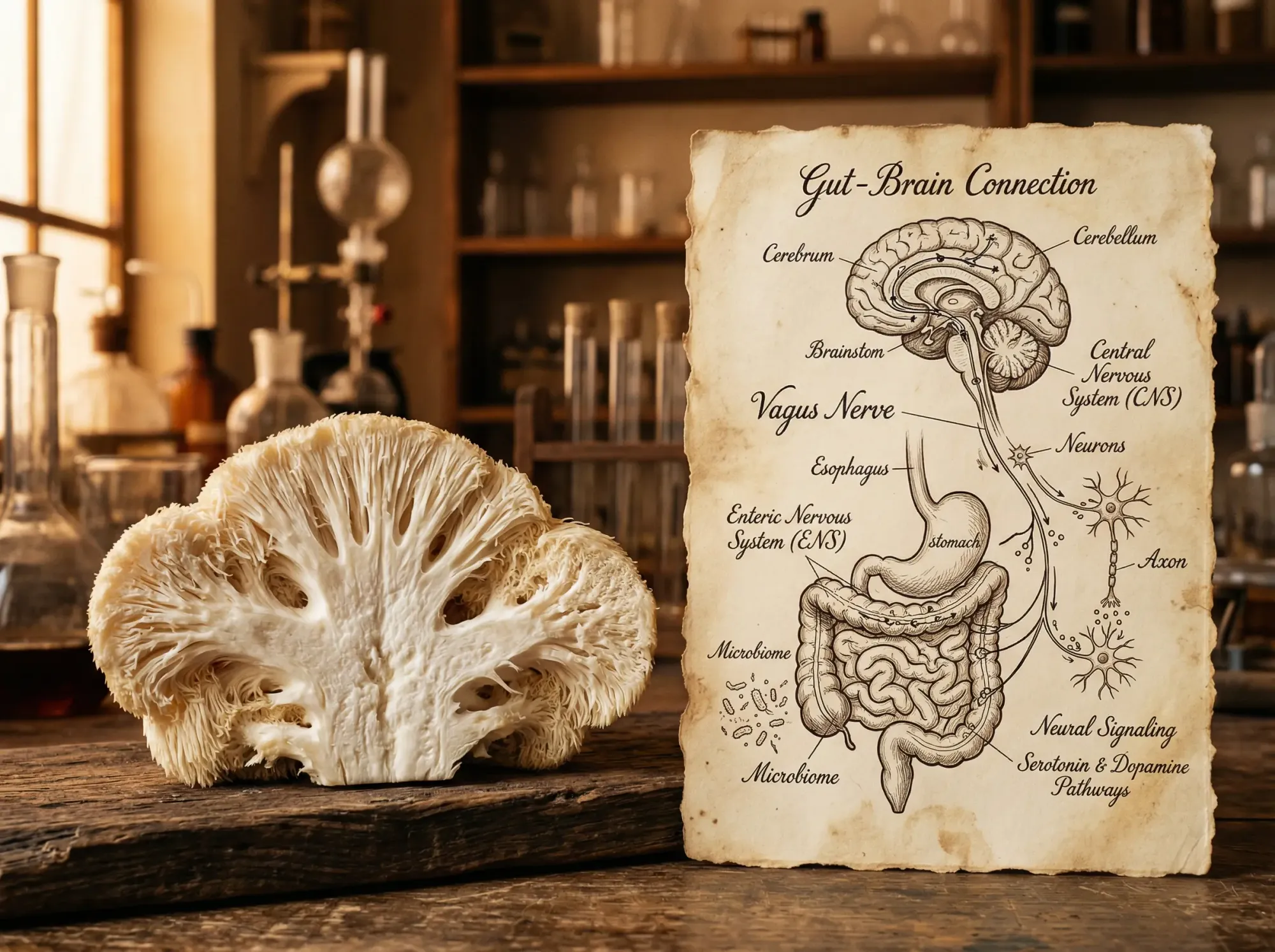
The human body houses a second nervous system: the enteric nervous system. More than 500 million neurons line the digestive tract from stomach to bowel. The gut‑brain axis — the bidirectional communication highway linking these two systems.
And NGF — Nerve Growth Factor — is produced largely in the gut.
This explains why Lion’s Mane is not solely a “brain mushroom.”
— THE ENTERIC NERVOUS SYSTEM —
It is customary to think of the nervous system as the brain plus spinal cord. Yet the body contains a third nerve mass: the enteric nervous system (ENS).
The ENS stretches along the walls of the gastrointestinal tract, from mouth to anus. It holds 500 million neurons — roughly five times the number in the spinal cord. For this reason it is occasionally called the “second brain.”
The ENS can operate independently, without waiting for instructions from the brain. It regulates digestive rhythm, peristalsis, and gut‑barrier permeability. Through the vagus nerve it remains in constant dialogue with the brain — and about 90% of that communication flows from the gut to the brain, not the other way around.
— NGF AND THE GUT —
NGF (Nerve Growth Factor) is known for regulating the growth and maintenance of brain neurons. But ENS neurons also require NGF.
Enterochromaffin cells in the gut mucosa, together with local immune cells, produce NGF. This NGF acts both on local ENS neurons and, via the vagus nerve, on the brain.
The hericenone and erinacine compounds in Lion’s Mane have been shown to stimulate NGF synthesis. This effect extends to both the cerebral cortex and the gut nerve tissue — the compounds are small molecules capable of crossing the blood‑brain barrier as well as the gut mucosa.
Reference: Nagano, M. et al. (2010). Reduction of depression and anxiety by 4 weeks Hericium erinaceus intake. Biomedical Research, 31(4), 231‑237.
— MICROBIOME EFFECT —
Lion’s Mane polysaccharides — especially beta‑glucans — display prebiotic properties.
A prebiotic is a non‑digestible fibre compound that serves as a food source for gut bacteria. Evidence indicates that Lion’s Mane polysaccharides support the growth of Lactobacillus and Bifidobacterium species.
The gut microbiome and the brain‑gut axis are directly interconnected. Microbial balance influences vagal signalling and the immune system through short‑chain fatty acids (SCFAs).
Reference: Diling, C. et al. (2019). Extracts from Hericium erinaceus relieve inflammatory bowel disease. Oncotarget, 8(49), 85838‑85857.
— IBD AND ENTERIC INFLAMMATION —
Animal models have yielded findings that Lion’s Mane extract exerts a protective effect on the gut mucosa in inflammatory bowel disease (IBD) models. The mechanism involves suppression of inflammatory cytokines through the NF‑κB pathway.
These findings have not yet been confirmed by human clinical trials — the distance between an animal model and a clinical outcome is substantial. However, the mechanism has been defined and research continues.
Reference: Wang, M. et al. (2014). Mechanism of immunostimulatory activity of Hericium erinaceus polysaccharides. Journal of Ethnopharmacology, 152(1), 189‑196.
— WHY THE SECOND PROFILE MATTERS —
A proportion of Lion’s Mane users notice a digestive shift before any cognitive change — abdominal comfort, regularity, reduced bloating.
This is not a side effect — it is prebiotic adaptation. The gut flora encounters a new substrate.
The digestive change during the first week is usually transient. It diminishes as the body adapts. But this process signals that Lion’s Mane’s profile across the gut‑brain axis is beginning.
— USAGE AND THE GUT —
Cold infusion (8–12 hours in the refrigerator) is considered by some researchers to be more suitable for the prebiotic profile — polysaccharides that dissolve at low temperature may offer a different profile than hot water extraction.
Rotational use: morning hot extraction (neurotrophic compound profile), evening cold infusion (prebiotic profile). A full‑spectrum approach.
Related reading: Lion’s Mane Encyclopedia · What Is NGF? · 30‑Day Lion’s Mane Experience
MYCOVITA’s production philosophy and transparency principles: Why MYCOVITA?
— HEALTH CLAIM NOTE —
— SCIENTIFIC REFERENCES —
Nagano, M. et al. (2010). Reduction of depression and anxiety by 4 weeks Hericium erinaceus intake. Biomedical Research, 31(4), 231‑237. Diling, C. et al. (2019). Extracts from Hericium erinaceus relieve inflammatory bowel disease by regulating immunity and gut microbiota. Oncotarget, 8(49), 85838‑85857. Wang, M. et al. (2014). Mechanism of immunostimulatory activity of Hericium erinaceus polysaccharides. Journal of Ethnopharmacology, 152(1), 189‑196. Szabo, A. et al. (2021). The gut‑brain axis. Nature Reviews Neuroscience, 22(9), 536‑553. Carabotti, M. et al. (2015). The gut‑brain axis: interactions between enteric microbiota, central and enteric nervous systems. Annals of Gastroenterology, 28(2), 203‑209.
You May Also Be Interested In
→ Travel Protocol — How Do I Use It While Traveling?
For details on how Lion’s Mane supports NGF synthesis, see our What Is NGF? article; for clinical literature and the bioactive profile, consult the MIND | Lion’s Mane encyclopedia.
Related Articles
- → MIND | Lion’s Mane — Species Encyclopedia
- → What Is NGF? Nerve Growth Factor
- → Stress, Cortisol and Adaptogenic Mushrooms
NGF Axis — Related Resources
A structured content cluster on the Lion’s Mane neurotrophic pathway:
- Lion’s Mane Species Encyclopedia — the full profile of the species.
- Hericenon — NGF‑synthesis stimulators in the fruiting body.
- Erinacin — the form in the mycelium that can cross the blood‑brain barrier.
- NGF — the biological role of nerve growth factor.
- Brain‑Gut Axis — enteric nervous system interaction.
- 30‑Day Profile — timeline of the neurotrophic process.
- Nootropic Stack — assessment of combinations with other ingredients.
This content is for informational purposes only and does not constitute medical advice. Consult your physician before making any health decisions. Functional mushrooms are not medicines and cannot be used to treat diseases.
Version: 1.0 | Last update: 20 Apr 2026 | References reviewed: 9+ | Methodology: Editorial Policy | References: Bibliography