Functional Mushrooms: A Scientific Definition and Scope
— HOOK —
"Functional mushroom." The term appears everywhere — on packaging, across Instagram, throughout health blogs.
But what does it actually mean?
Is it marketing? A scientific category? Why is a common pizza mushroom not functional while Lion's Mane is?
The answer runs through compounds. And this article explains exactly what those compounds are, how they operate, and which mushrooms genuinely belong in this category.
This is the right place to begin.
— DEFINITION —
A functional mushroom describes a mushroom species that contains bioactive compounds beyond its basic nutritional value — compounds for which peer-reviewed research exists.
The word "functional" signals purpose: these mushrooms do not merely supply calories. They deliver constituents that interact with specific biological pathways in the body.
This is not a formal medical classification — yet it is an operational category widely used in the scientific literature. Researchers employ the terms "medicinal mushroom" or "functional mushroom" to designate these species.
— EDIBLE MUSHROOMS vs FUNCTIONAL MUSHROOMS —
All functional mushrooms are edible. But not every edible mushroom is functional.
The Portobello mushroom: edible, nutritious, delivers protein and minerals. Yet its bioactive profile lacks specificity — no hericenones, no ganoderic acids, no cordycepin, no PSK.
Lion's Mane: edible, flavourful, and simultaneously a source of hericenones and erinacines — compounds that stimulate nerve growth factor (NGF) synthesis. Research exists, literature is established, the mechanism is identified.
The distinction hinges on compound specificity: in functional mushroom species, discrete molecules have been studied and their interactions with defined biological pathways described.
— PRIMARY BIOACTIVE COMPOUND CATEGORIES —
Beta-Glucans
Polysaccharides present in all functional mushrooms. They bind to Dectin-1 receptors on the intestinal wall, triggering immunomodulation. This is the most extensively researched category of mushroom compounds.
Each species carries them at different concentrations and structural configurations: Sparassis crispa leads at 40–45%, while Cordyceps sits at the lower band with 8–15%.
Triterpenes
Found predominantly in Reishi (ganoderic acids) and other polypores. Associated with stress hormone regulation, hepatoprotective effects, and an anti-inflammatory profile. Responsible for Reishi's characteristic bitterness.
Neurotrophic Compounds
Unique to Lion's Mane: hericenones (fruiting body) and erinacines (mycelium). These compounds influence NGF synthesis. They represent the only known class of food-derived NGF-stimulating compounds.
Nucleoside Analogues
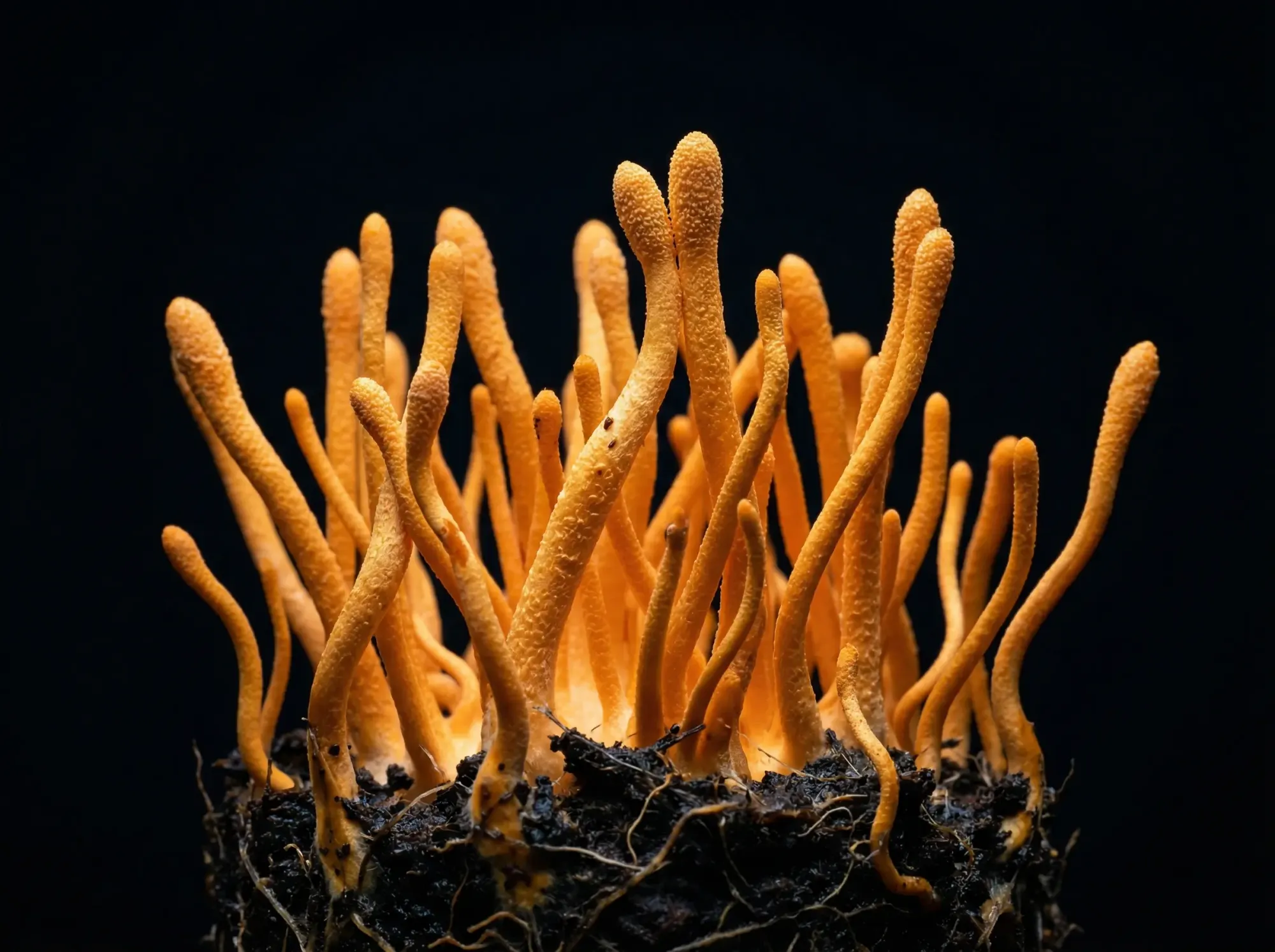
Unique to Cordyceps: cordycepin (3'-deoxyadenosine). A compound with a documented research profile centred on ATP synthesis and mitochondrial energy metabolism.
Specific Polysaccharides
Turkey Tail's PSK (Polysaccharide-K) and PSP — compounds registered as licensed adjuvants in Japan. Shiitake's Lentinan — investigated in clinical studies.
— WHICH SPECIES ARE CONSIDERED FUNCTIONAL? —
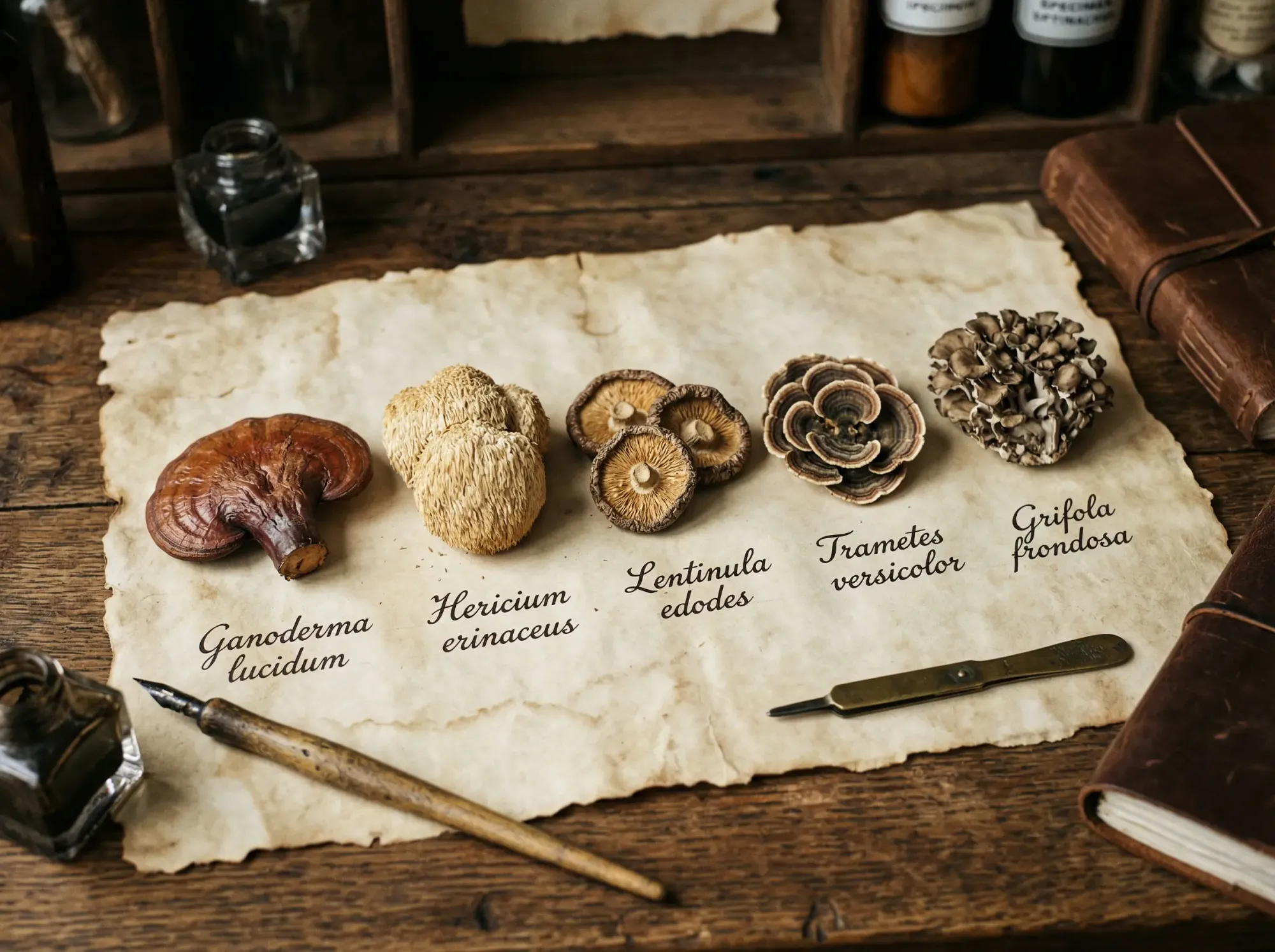
The species most frequently represented in the research literature:
Hericium erinaceus (Lion's Mane) — neurotrophic Ganoderma lucidum (Reishi) — adaptogenic, immune Cordyceps militaris (Cordyceps) — energy metabolism Trametes versicolor (Turkey Tail) — immunomodulation, PSK Sparassis crispa — high beta-glucan content Lentinula edodes (Shiitake) — lentinan, GMP Grifola frondosa (Maitake) — D-fraction, beta-glucan Phellinus linteus (Sang Huang) — long-term immune support
— FOOD PRODUCT — MEDICINAL PRODUCT DISTINCTION —
In Turkey and across the EU, functional mushrooms are classified as food products. They are not medicinal products.
This distinction carries weight:
As food products, they cannot be marketed with claims that they "treat," "prevent," or "cure." They can be sold, their research can be published, and their compounds can be characterised — but they cannot be prescribed as pharmaceuticals and must not carry medical claims.
MYCOVITA adheres strictly to this boundary. All of our content shares research knowledge — but never, under any circumstance, makes treatment claims.
— WHY MYCOVITA? —
Five factors determine compound quality in functional mushroom production: species selection, fruiting body standard, strain quality, drying temperature, and the COA certificate.
MYCOVITA operates at the highest standard across all five variables. 100% fruiting body. 42–45°C drying. Dutch-certified strain. Every batch COA-verified.
— MYCOVITA AND FUNCTIONAL MUSHROOMS —
MYCOVITA is a biotechnology company operating in the functional mushroom sector in Turkey. Five functional species — Lion's Mane, Reishi Black Horn, Sparassis, Cordyceps, and Turkey Tail — are produced under the Apothecary Series.
All species are produced from 100% fruiting body. Cultivation takes place in four independent production chambers controlled by a VRF climate-conditioning system, with parameters monitored in real time through an AI-supported sensor network. A low-temperature drying protocol at 42–45°C is applied. Every batch is analysed by an independent laboratory.
Everything you wish to know about functional mushrooms is on this site — presented with sources, at a scientific level, and with complete honesty.
You May Also Be Interested In
→ Can You Trust Mushrooms Produced in Turkey?
→ Functional Mushroom Production in Turkey
→ The Functional Mushroom Market in Turkey
Related reading: Which Mushroom Is Right for Me? · What Are Beta-Glucans? · What Is Chitin?
On MYCOVITA's production philosophy, technical infrastructure, and transparency principles: Why MYCOVITA?
— HEALTH CLAIM NOTICE —
— SCIENTIFIC REFERENCES —
Wasser, S.P. (2002). Medicinal mushrooms as a source of antitumor and immunomodulating polysaccharides. Applied Microbiology and Biotechnology, 60(3), 258-274. Stamets, P. (2005). Mycelium Running: How Mushrooms Can Help Save the World. Ten Speed Press. Ferreira, I.C.F.R. et al. (2010). Antioxidant activity of Portuguese wild edible mushrooms. Food Chemistry, 119(4), 1043-1050. Valverde, M.E. et al. (2015). Edible Mushrooms: Improving Human Health and Promoting Quality Life. International Journal of Microbiology, 2015, 376387.
Complete list of scientific sources cited on this page: Bibliography · Our content production method: Editorial Policy
Quality and Production — Related Resources
A structured content cluster covering every stage of the functional mushroom production chain:
- What Is Substrate? — Grain and wood-based substrate fundamentals.
- Certified Mycelium — Spawn source is critical.
- Strain and Intraspecies Variation — The impact of genetic lineage.
- Mycelium vs Fruiting Body — Differences in compound profiles.
- Low-Temperature Drying — The science behind the 42–45°C threshold.
- Extraction Methods — Hot water, ethanol, dual.
- Beta-Glucan Measurement — Megazyme and other methods.
- Reading a COA — How to read a certificate of analysis.
- Contamination and Mycotoxins — Safety protocols.
- The Black Sea Climate — Geographic advantages.
- Storage — Shelf life and quality preservation.
This content is for informational purposes only and does not constitute medical advice. Consult your physician before making any health-related decisions. Functional mushrooms are not drugs and cannot be used to treat diseases.
Version: 1.0 | Last updated: 20 Apr 2026 | Sources reviewed: 9+ | Method: Editorial Policy | References: Bibliography